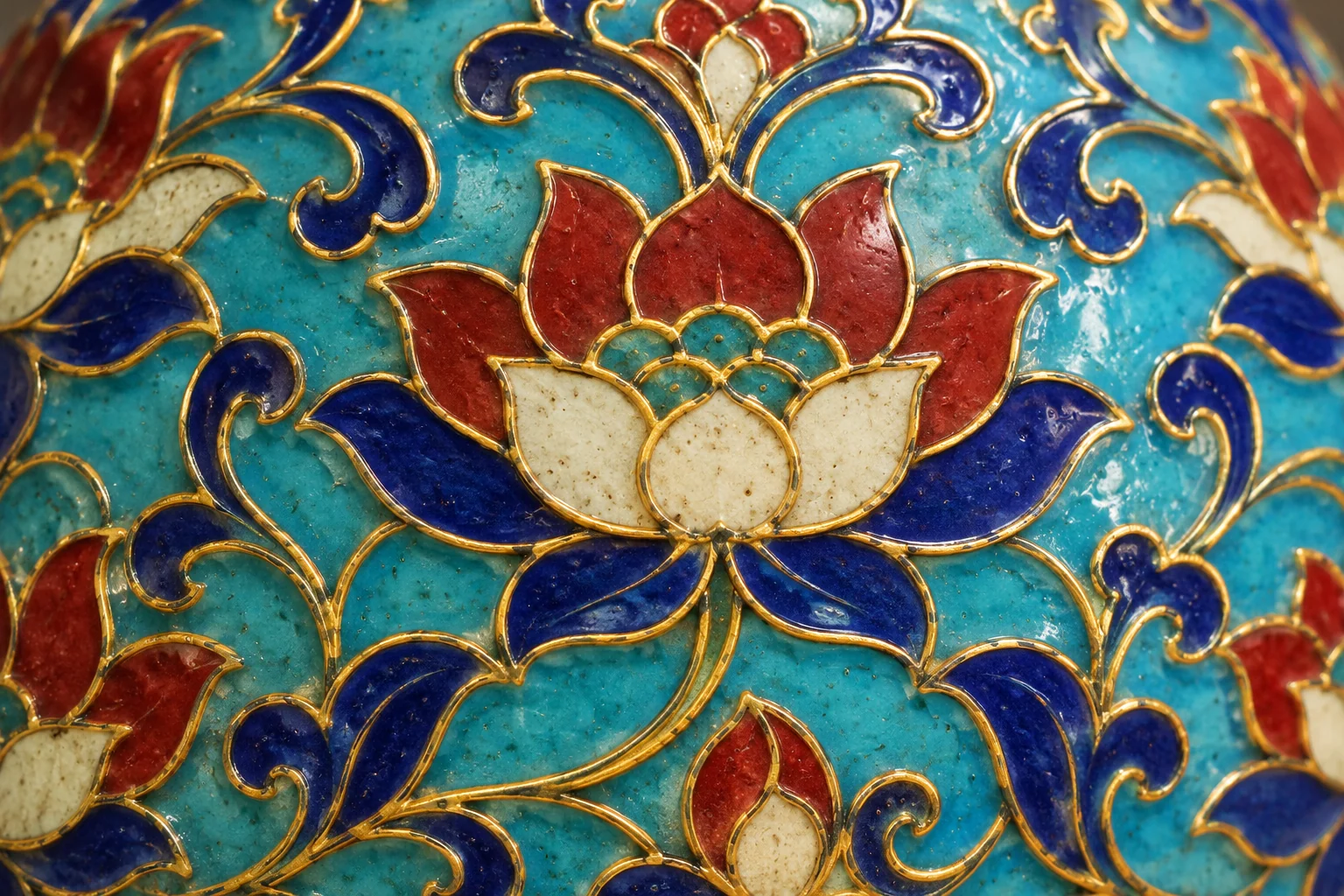
Follow the gold-coloured outline of a petal on a cloisonné vase. At first it reads as a line drawn on a blue surface. Its history runs in the opposite direction. A maker shaped the metal line first, fixed it to the vessel, then filled the spaces on either side with coloured enamel. The visible line is the upper edge of a narrow partition. It began as part of the structure that held the picture together and survived the firing and polishing as part of the picture itself.[1, 2, 4]
The drawing begins as a set of walls
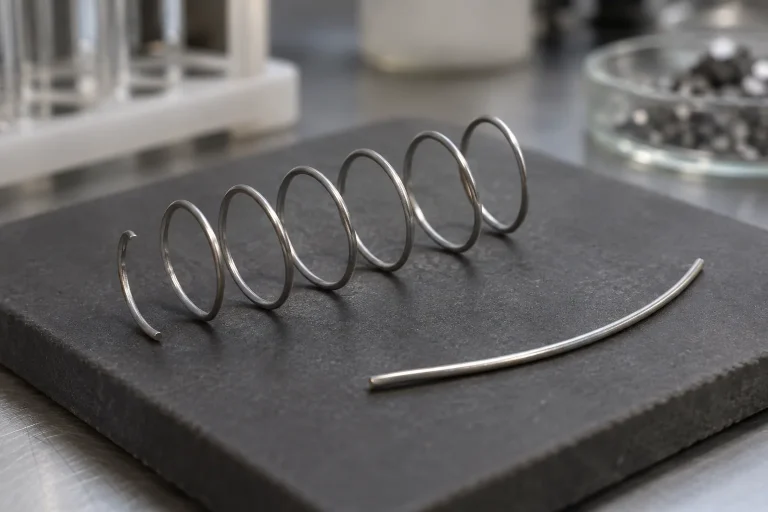
The French word cloison means a partition. On a Chinese cloisonné vessel the partitions can be slender strips of copper or bronze bent into curves, corners and loops. On an unfinished object the network stands above the metal underneath. Look down on it and you see a design. Look across it and you see the shallow compartments waiting to receive glass. A lotus blossom that appears to be a single motif might require a series of individual cells, with two neighbouring petals sharing a single length of metal between them.[1, 2]
It helps to imagine the maker’s problem at the shoulder of a vase. A paper drawing can lie flat on a table. The wires have to meet on a surface that curves around the vessel and also rises and falls toward its neck. A strip that looks like a neat petal on the bench has to follow that surface closely once it is attached. The curve that a viewer later traces with a finger or an eye is the narrow exposed edge of a much larger piece of metal seen almost entirely end-on.[1, 4]
One useful object for understanding this work is a Qing-dynasty vase from a sample set held by the Metropolitan Museum of Art. The museum identifies the materials as copper alloy and glass. Those two materials can be difficult to disentangle in a photograph of a finished vase. A smooth area of blue and the bright line beside it meet so closely that they seem like colours applied by the same brush. The materials list gives you a better question to ask of that photograph: where is the glass, and where does metal reach the surface?[1]
Filling each cell with glass
The enamel begins as ground glass prepared in a form that can be placed in the compartments. Metal oxides are among the ingredients used to obtain different colours. The maker selects where each colour goes while the individual cells are still visible. Fine partitions can define a sharp edge between adjacent fields. If a loop encloses a red petal, the ground around it can be blue, even along the ends of the petal where a brush would otherwise have to trace two exceptionally fine converging edges.[1, 2, 3]
At this stage enamel occupies space differently from the finished smooth surface. Ground particles packed together leave gaps. In firing, glass softens and fuses and the filled area can sink below the top of its enclosure. The Met describes repeated firings around 800 degrees Celsius for traditional Chinese work. More enamel can be added to a low area and fired again. A deep, even patch of colour on a finished object may consequently record several visits to the same compartment, each separated from the next by a trip through the heat.[1, 2, 3]
Imagine cutting across a completed red cell and looking at its edge under magnification. On either side would be the narrow metal walls. Beneath it would be the body supporting the enamel. Above it would be the surface that has been ground and polished. That imaginary section explains why adding all the glass once and hoping it ends level with every adjacent wire is such an exacting proposition. A sequence of filling, firing and finishing gives the maker several opportunities to establish the final surface.[1, 3, 4]
What polishing reveals
After firing, the surfaces of neighbouring cells need not stand at precisely the same height. Working them down and polishing them exposes the tops of the partitions. Look at an outline where the corner of a petal meets the background. The continuous bright path is readable precisely because the edge of a wire remains visible between two fields of glass. On Chinese examples the exposed metal is often gilded. A gold-coloured outline therefore need not mean that the entire length and depth of the underlying wire is solid gold.[1, 2, 3]
Compare this with champlevé, another way of putting enamel on metal. A champlevé maker forms hollows in the body itself and places enamel in them. Metal remaining between the hollows forms the borders. In cloisonné the maker adds upright partitions to the surface to create the cells. A polished example of either technique can present smooth patches of bright glass separated by metal. The distinction is in what was added or taken away before those patches ever saw a furnace.[4]
When a painted line looks just as convincing
Some historical makers deliberately exploited that resemblance between a physical border and an image of one. An Archaeometry study examined Chinese painted enamels decorated in the style of cloisonné. On the objects in that study, gold lines painted over enamel gave the appearance of wire. The vessels echoed the lotus motifs and turquoise fields familiar from cloisonné while achieving the effect with a different arrangement of layers. The question of what makes a line can matter enough for a researcher to look at the composition of a surface as well as the apparent design.[5]
This is a good reason to return to a museum photograph after reading its caption. Choose just one small area, perhaps a leaf tucked behind a flower. Follow the boundary and see which other coloured regions it encloses. Then ask what evidence the photograph actually gives for a partition there. A catalogue identification or a piece showing an incomplete stage can tell you more than the shine alone. Once you understand the order of making, even a tiny shared line between two petals reveals a decision the craftsperson had to take before either petal had any colour.[1, 4, 5]
Related reading
Sources
- Metropolitan Museum of Art — Vase from a sample set of Chinese cloisonné
- Metropolitan Museum of Art — Chinese cloisonné
- Museo d’Arte Cinese ed Etnografico — Cloisonné enamel vase
- Victoria and Albert Museum — A guide to metalworking techniques
- Archaeometry — Emulation in Chinese painted enamels
Keep exploring.
One remarkable idea at a time—nature, science, history and beyond.
Last updated November 24, 2026.

Barnakle Editorial Team
Barnakle Editorial Team is the collective byline used for Barnakle’s editorial articles. The contributor profile explains the team identity and links to the publication’s editorial policies.
More from the editorial team →