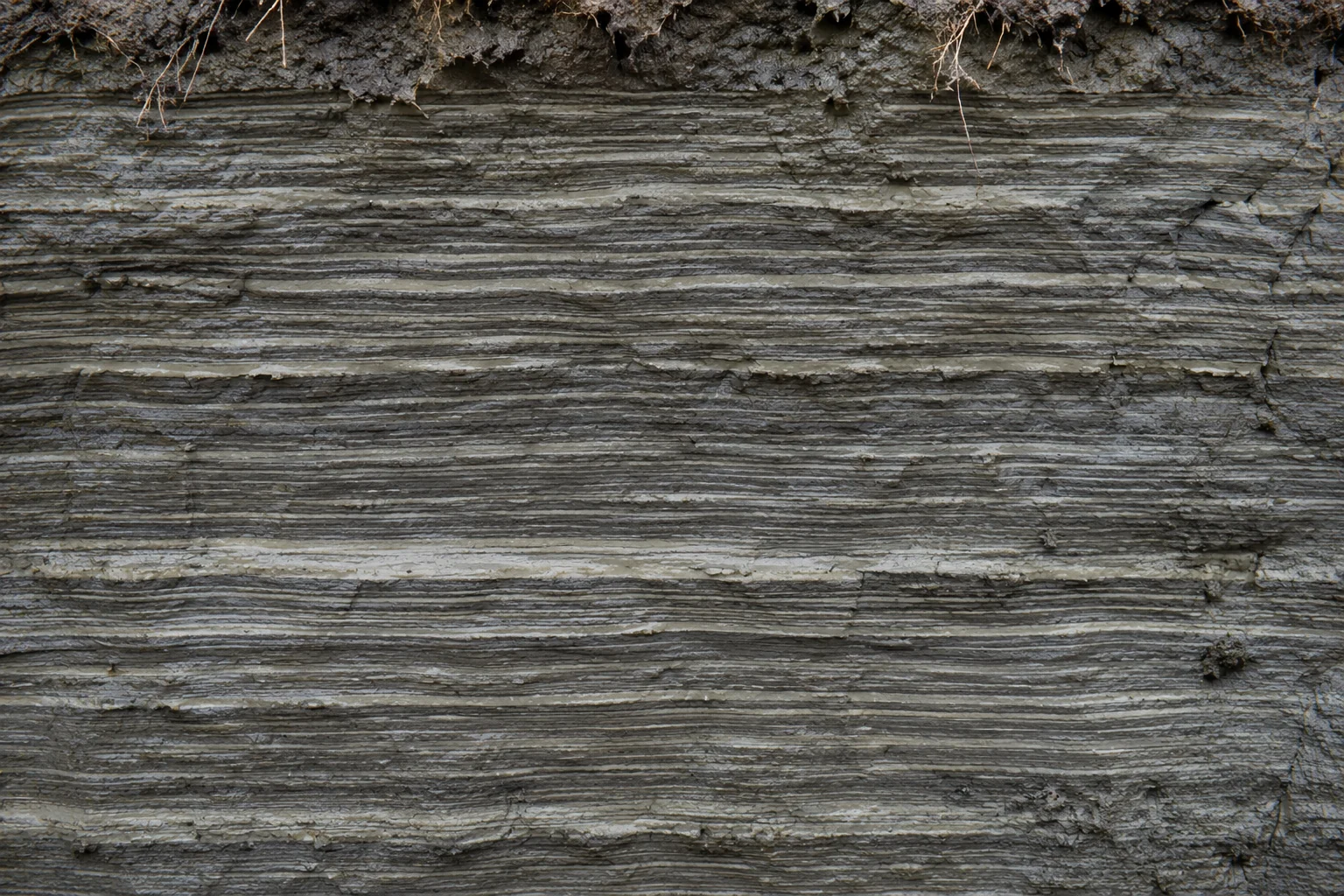
An exposed bank of lake sediment can look like a stack of paper seen edge-on. Some lines are barely visible. Others trace a dark stripe the length of the outcrop. To read a year in those layers, geologists need to know what arrived on the lake floor during a complete cycle of seasons. In many lakes fed by melting glaciers, the annual unit includes a relatively coarse melt-season deposit and a finer layer laid down through the quieter months. Count those units, called varves, and mud can tell you how many winters passed between two events.[1, 2]
Follow the sediment through a single year
Imagine standing beside a lake with a glacier upstream. As melting increases, streams carry mineral grains into the basin. Heavier or coarser particles tend to settle relatively readily. Sediment-laden currents can travel along the bottom and take material farther into the lake. A summer of varying flows can deliver silt in a series of pulses. A core through the resulting deposit might therefore contain several subtle stripes within the material laid down during just one melt season.[1, 4]
When meltwater delivery drops, the supply of new sand and silt falls away. Very small clay particles still suspended in the water have time to settle out. A fine layer accumulates over the preceding silt. It can appear as a dark band, especially when a cut face dries enough for differences in moisture and texture to show. The next energetic influx brings coarser material on top of that clay. From one such return of melt-season conditions to the next, a full year has elapsed in this model of the lake.[1, 4]
Winter and summer are convenient names for the two parts. They do not require a particular date for the first rush of meltwater or for the last small current to cross the bottom. The length of the local melt season can vary. So can the distance from the ice front to the place where sediment accumulates. Two researchers sampling the same lake at different points could recover layers of distinctly different thickness even though they are looking at precisely the same sequence of years.[1, 2, 4]
Why ten visible stripes might mean fewer than ten years
Consider a pale unit split by two fine streaks, followed by a smooth clay band, then another pale unit with no streaks at all. You might count half a dozen changes in colour across that small section. Under magnification, the first two streaks could prove to be separate silt pulses within the first summer’s deposit. The smoother overlying clay might be the only sustained winter interval in that portion. Texture, boundaries and the order of deposits give a geologist more to go on than the number of dark lines visible in a photograph.[1, 3, 4]
Preservation matters as much as deposition. Animals burrowing in the floor of a lake can mix freshly settled particles and blur a boundary. A current may remove part of a layer before the next one is laid down. Under other conditions an exceptional flood may leave a thick and sharply bounded bed during a single season. To treat a sequence as an annual record, researchers seek evidence that the repeating units really have an annual cause and examine the places where the pattern breaks down. Regular-looking stripes by themselves do not establish a calendar.[2, 3]
Finding the same winter in two places
Lay out a sequence of widths from one core beside a sequence from a second core. Both may show two relatively thin years, a thick one, four of middling thickness and then an exceptionally thin year. The ratio of widths will seldom match exactly, but a long run of shared variations can be distinctive. One thick layer alone is a poor match. Many summers could have deposited more sediment than their neighbours. A run of changes in a particular order gives the proposed match numerous opportunities to fail.[2, 4]
Matching a sequence also makes an awkward layer worth revisiting. Suppose the distinctive run lines up well on both sides of one point but one core seems to contain an extra year. A researcher can return to the physical specimen and inspect the suspect boundary. Perhaps a thin winter deposit was missed in the second core. Perhaps a small event bed was counted twice in the first. If the evidence at that level remains ambiguous, neighbouring records help show how much of the chronology depends on that one decision.[2, 3, 4]
A year count still needs a calendar address
Imagine a perfect count of 150 annual units in a core whose top and bottom have no known date. That count tells you the duration represented by the sequence. It cannot, on its own, tell you which century contains year 100. Geologists call an unattached sequence a floating chronology. To anchor it they need a tie to evidence whose age can be independently constrained. Even after the tie is established, uncertainties in the age of that evidence and in individual layer counts still deserve to be recorded.[2, 3, 5]
Lake Suigetsu in Japan illustrates how researchers build such a connection. A team studying a long core there combined layer counts with radiocarbon measurements and studies of volcanic ash, among other evidence. The upper portion of the core used for a key link lacked annual layers. Radiocarbon information helped tie a distinctive flood horizon to an external timescale. Counting supplied the year-by-year spacing in the laminated portion. Other evidence supplied a way to place that spacing in time.[5]
Lake Suigetsu also illustrates a broader point about the word varve. An annual sediment layer can form in settings with a very different seasonal rhythm from a glacier-fed lake. The materials deposited during the year depend on what is living in the water, what enters from outside and what conditions prevail on the bottom. A careful reader first asks what makes one year recognizable in this particular lake. Once that question has an answer, a modest thickness of mud can separate events just a few seasons apart in a landscape that vanished thousands of years ago.[1, 3, 5]
Related reading
Sources
- Tufts University — What are glacial varves?
- Tufts University — What is varve chronology?
- Zolitschka and colleagues — Varves in lake sediments
- Ridge and colleagues — The North American varve chronology
- Staff and colleagues — Dating the Lake Suigetsu sediment core
Keep exploring.
We’ll email you when the first edition is ready.
Last updated November 26, 2026.

Barnakle Editorial Team
Barnakle Editorial Team is the collective byline used for Barnakle’s editorial articles. The contributor profile explains the team identity and links to the publication’s editorial policies.
More from the editorial team →