A small capsule hidden beneath the sand offered a northern sea robin nothing to see and no shell to feel. Yet the fish stopped over it and dug. The capsule contained chemicals associated with food. Bury a similar capsule filled with seawater and the fish left it alone. The clue it was following had travelled through wet sand to the surface, where six narrow, leg-like parts of its fins could sample the bottom as the animal walked.[1, 3]
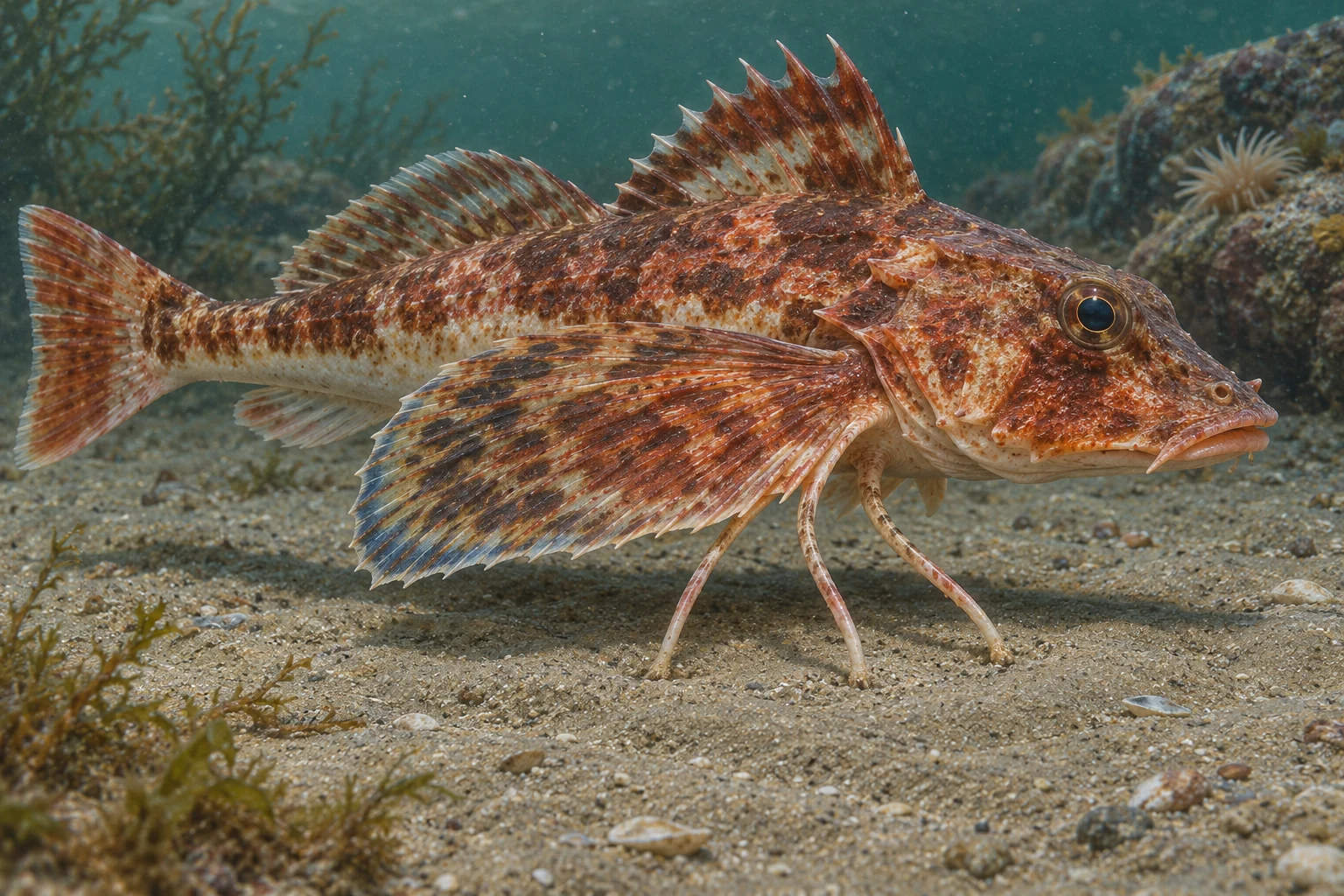
Sea robins are bottom-dwelling fish with broad pectoral fins just behind the head. On each side, three fin rays separate from the rest of the fin during development. Each can move independently enough to make the animal look as if it is walking on fingers. The rays remain parts of a fish fin in origin. What makes the northern sea robin particularly interesting is a second use for these appendages. They help it decide where a mouthful of sand is worth turning over.[2, 3]
A search that begins before the bite
In tank observations, northern sea robins alternated between swimming across the tank and slower bouts of walking. As they walked they probed or scratched the sediment with their free fin rays. That sequence suggests a search with two scales. Swimming can bring the fish to another patch of ground. A walking pass brings the sensitive tips close to small variations at the surface. To see whether those variations actually guide the animal, investigators had to give it a target that looked no different from the sand around it.[1, 4]
They first used buried food such as mussels. A mussel is a complicated target, however. It has a particular shape, disturbs the sand, and releases a mixture of substances into the water. Finding it does not reveal which clue the fish followed. Using capsules containing mussel extract allowed researchers to keep the chemical cue while removing the shell and animal. Using control capsules containing seawater helped account for the disturbance of burying a capsule at all. A food-associated chemical signal was enough to send the northern sea robins digging.[1, 4]
Then the researchers simplified the mixture further. Fish found capsules containing certain individual substances, including the amino acid alanine. No hidden mussel had moved, opened its shell or provided a meal at that spot. The result matters because observers might otherwise mistake the last step of feeding for the first. When the fish first chooses the location, its mouth can still be some distance from the source. The rays give it information early enough to direct the digging.[1]
What is on the tips of the rays?
A close view of a northern sea robin’s sensory ray shows small bumps called papillae. These are concentrated on the parts that contact the bottom. They have a nerve supply responsive to touch, and cells in the surface tissue express taste receptors. A single patch of working surface can therefore provide information about physical contact and about dissolved substances. Calling this tasting with the legs describes what the chemical information does for the fish. It does not require a miniature copy of a human tongue on each ray.[1, 3, 4]
Picture the tip contacting sand just beside the buried source. A change in pressure at contact tells the animal something about the surface it has met. A food-related compound at the same place offers a different clue about what lies nearby. Holding these two observations apart helps explain the experimental design. Measuring a nerve response when a ray is touched establishes mechanical sensitivity. Recording a response when the tissue meets a dissolved compound tests chemical sensitivity. Watching an intact fish choose to dig connects those measurements to an action.[1, 2]
The fish that would eat but would not dig
A second species made the story more revealing. Striped sea robins, Prionotus evolans, also walk on separated fin rays. In the researchers’ trials they would eat exposed prey, but they failed to find the same kinds of food when buried. The contrast ruled out one easy explanation. Feeding on a visible item showed that these fish found it edible. Their difficulty arose earlier in the sequence, when a fish had to locate something hidden from view.[1, 4, 5]
The two species also differed in the surface of the rays. The northern sea robin, Prionotus carolinus, had the conspicuous sensory papillae associated with chemical detection and digging. The striped sea robin lacked that arrangement. The comparison is a reason to be careful with photographs. A clear side view might show six free rays and prove that the pictured animal can stand on them. The same view could easily miss the tiny details that distinguish a specialist at finding buried prey.[1, 2, 5]
Why a deeper mussel is harder to find
Chemicals released beneath the sediment move through water between grains and spread out. A shallow, concentrated source has a better chance of producing a detectable concentration near the surface than a weaker or deeper one. In experiments, the fish’s success declined as prey was buried more deeply. That result puts a physical limit on the idea of tasting through sand. The fin ray samples what reaches it. It cannot report the location of a molecule that never arrives at a concentration the fish can detect.[1]
It also changes what counts as an unsuccessful search. There might genuinely be food under a spot where the fish walked on. Bury the same food closer to the surface and the signal available to the animal changes, even though the item is just as edible. In a tank, an experimenter knows the prey’s position before the fish enters. On the seabed an observer sees only a fish passing over sand, with no independent way to inventory all the things it passed.[1, 5]
The revealing moment is the pause just before digging. A sea robin out in open water might draw attention for its broad, colourful fins. On the bottom, the small rays below those fins are doing the finer work. In the northern species, a few steps over a patch of apparently featureless sand can supply evidence that the next useful move is down.[1, 3]
Related reading
- How Do Harbour Seals Follow Underwater Trails With Their Whiskers?
- How Taste Receptor Cells Renew Themselves
Sources
- Evolution of novel sensory organs in fish with legs
- Ancient developmental genes underlie evolutionary novelties in walking fish
- Sea Robin | Marine Biological Laboratory
- Harvard Gazette — An idea with legs
- ABC Science — How sea robins taste prey beneath the sand
Keep exploring.
One remarkable idea at a time—nature, science, history and beyond.
Last updated November 22, 2026.

Barnakle Editorial Team
Barnakle Editorial Team is the collective byline used for Barnakle’s editorial articles. The contributor profile explains the team identity and links to the publication’s editorial policies.
More from the editorial team →