A crystal’s journey through a cloud writes its shape
A snowflake starts as a crystal
In atmospheric science, a snow crystal is a single crystal of ice, while a falling snowflake may be one crystal or an aggregate of several. The distinction matters because the familiar fluffy clump and the symmetrical microscopic star are related but not identical objects.
Cold cloud does not mean instant ice
Liquid droplets can remain supercooled below 0°C. Ice formation usually begins around a suitable aerosol particle called an ice nucleus, or through interaction with existing ice. Cloud temperature, droplet availability and particle properties influence when the ice phase appears.
Water vapour deposits onto ice
Once an ice embryo exists, water vapour can move directly from gas to solid at the crystal surface. In mixed-phase clouds, vapour may preferentially feed ice while supercooled droplets evaporate. This Wegener–Bergeron–Findeisen process helps crystals grow large enough to fall.
Why six sides appear
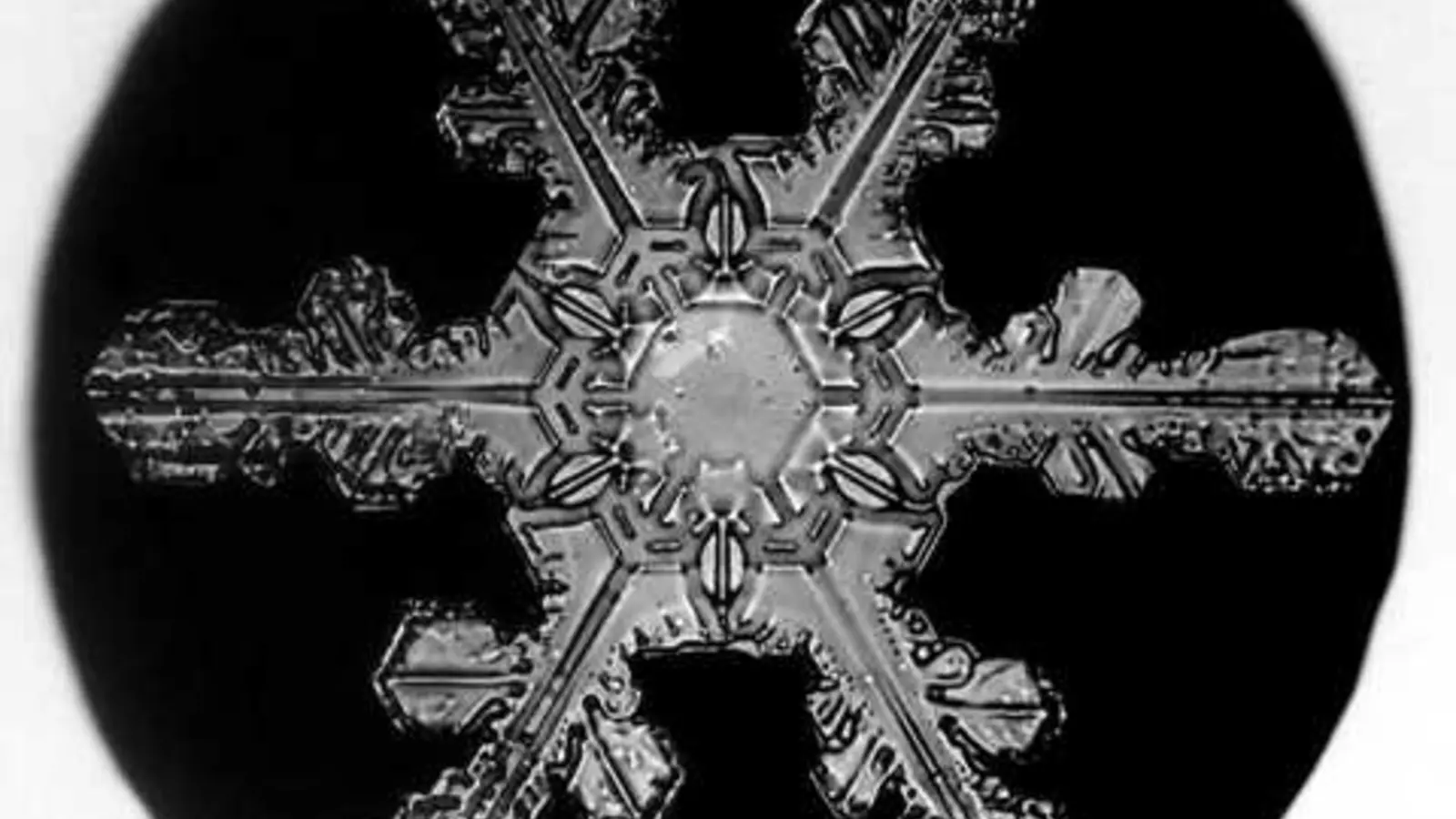
Ordinary atmospheric ice has a hexagonal crystal lattice. Molecular bonding makes growth directions repeat every 60 degrees around the main axis. Sixfold symmetry therefore comes from crystal structure, not from a template in the cloud or from six independent droplets colliding.
Symmetry does not mean perfect identity
The six arms of one crystal experience nearly the same changing environment because they are close together. They often respond similarly, producing approximate symmetry. Tiny differences, collisions and turbulent paths break perfect correspondence. Real snow crystals display defects as well as remarkable order.
Temperature changes crystal habit
Laboratory growth diagrams show that modest temperature differences favour plates, columns, needles or more complex forms. The relation is not a simple colder-means-more-branches rule. Molecular attachment rates differ between the basal and prism faces of ice, and those rates change with temperature.
Humidity controls growth speed and branching
Supersaturation describes how much water vapour is available beyond equilibrium. Higher supersaturation can drive faster growth and morphological instability, helping corners extend into branches. Lower values often favour compact plates or columns. Temperature and supersaturation act together.
Branching amplifies small differences
A protruding corner reaches slightly farther into moist air and can collect vapour faster than a recessed region. The protrusion then grows even farther, an instability that produces dendrites. Side branches can repeat the same process, generating elaborate fernlike patterns without a central designer.
The path through a cloud is a history
A crystal falls, rises in an updraft and crosses layers with different temperature and humidity. Its growth mode can change repeatedly. A capped column or plate with sectorlike branches may preserve this environmental sequence, although researchers cannot reconstruct every moment from shape alone.
Riming makes graupel
Supercooled droplets can freeze on contact with a falling crystal. Light riming decorates its edges; heavy riming obscures the original form and can produce rounded graupel pellets. Graupel is different from hail, which typically grows in strong thunderstorm updrafts through repeated wet or dry accretion.
Crystals can collide and aggregate
Falling crystals collide more readily near temperatures where surfaces become slightly sticky. Aggregates create the large flakes visible during mild snowfalls. A single star-shaped crystal may be only millimetres wide, while an aggregate can be much larger and irregular.
Are any two snowflakes identical?
The number of possible growth histories and microscopic arrangements is enormous, so complex natural crystals are extraordinarily unlikely to match in every detail. Simple laboratory crystals can look nearly identical at ordinary resolution. The popular claim is best treated as a statement about probability and measurement, not a mathematical impossibility.
Why snow looks white
Clear ice crystals have many air–ice boundaries and orientations. Light is repeatedly reflected and scattered across visible wavelengths, so a snowbank appears white. Deep snow can look blue where longer paths absorb more red light, while dirt or algae can change the colour.
How scientists photograph and classify snow
Researchers capture crystals on cold surfaces, use microscopes and high-speed cameras, and record temperature, humidity and airflow. Classification systems name plates, stellar dendrites, columns, needles, aggregates and rimed forms. Categories help comparison, but nature produces continuous variation and hybrids.
Key takeaways
- Ice crystal structure produces sixfold symmetry.
- Temperature and supersaturation control growth form.
- Branching, riming and aggregation are different processes.
- A snowflake can be one crystal or an aggregate.
Continue exploring
Sources and further reading
Keep exploring.
One remarkable idea at a time—nature, science, history and beyond.
Last updated October 27, 2026.

Barnakle Editorial Team
Barnakle Editorial Team is the collective byline used for Barnakle’s editorial articles. The contributor profile explains the team identity and links to the publication’s editorial policies.
More from the editorial team →