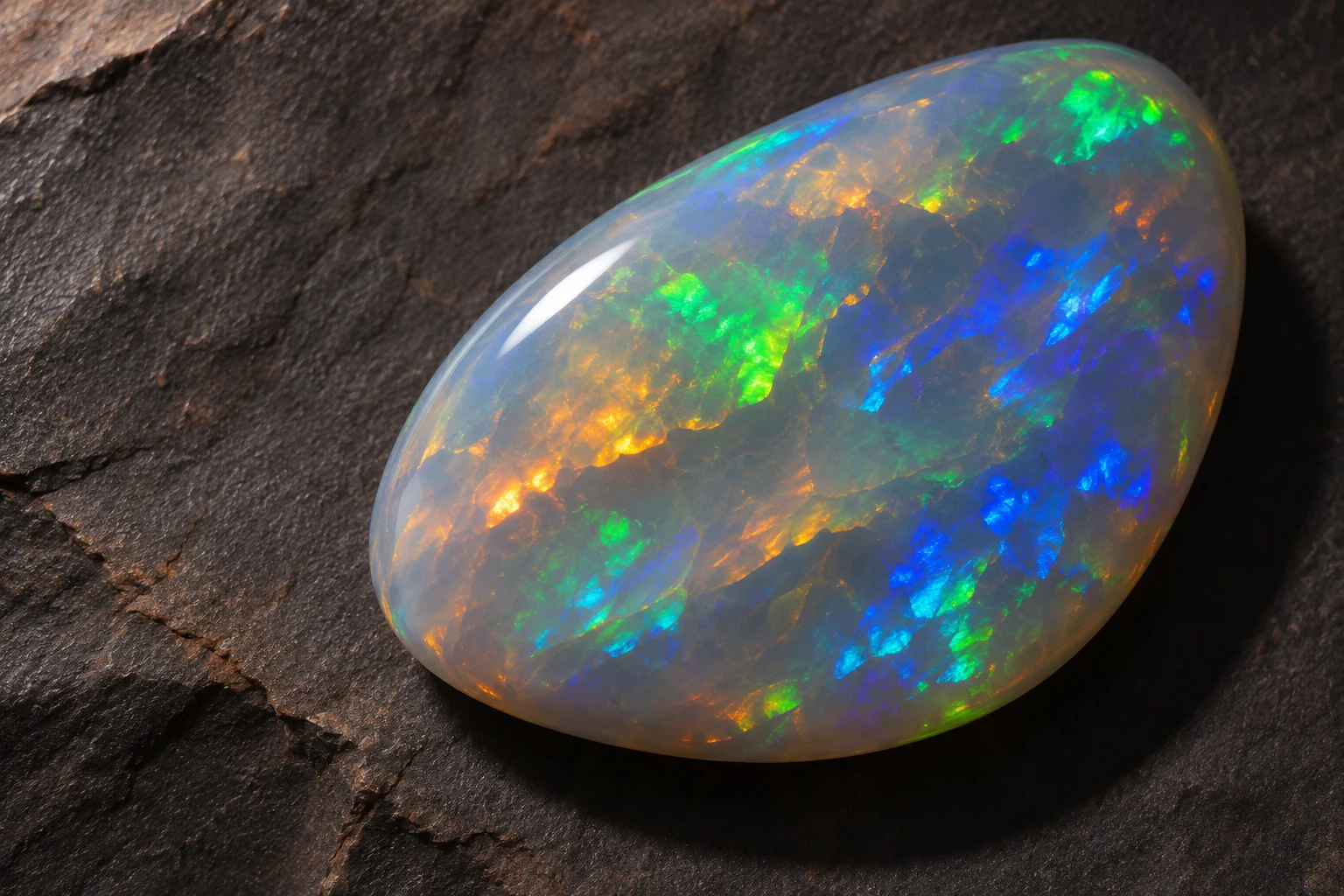
Tilt a polished opal slightly under a lamp. A patch the colour of a kingfisher’s back can blink out while an orange fleck appears a little farther along. Tilt the stone back and the blue returns to its place. Gemologists call the shifting display play-of-colour. Its repeatability is a clue to its cause. In a typical precious opal, microscopic spheres of silica sit in orderly arrays. Their spacing and orientation help determine which wavelengths of light reach your eye from any one patch.[1, 2]
There are two colours to keep track of in that first glance. Look at the stone between flashes and it may have a fairly steady white, grey or dark background. That is its body colour. The flash layered over it can change dramatically as you turn your wrist. You can give quite a good description of an opal by recording the background first and then describing what appears, and where, as the stone moves under the light.[2, 3]
A pattern smaller than the eye can see
Opal is hydrated silica. Water carrying dissolved silica through the ground can leave deposits in cracks and cavities. In some deposits, tiny silica particles of similar size settle into regions with repeating internal arrangements. A polished face may cut through many such regions. At the scale of an ordinary hand lens the result still looks like a continuous solid. At the far smaller scale at which visible light interacts with it, the distinction between a repeating arrangement and a jumble is decisive.[1, 3, 4]
Imagine dropping marbles of equal size into a shallow tray. Within one patch, the rows tuck neatly into the gaps between the rows below. Start a second patch at another edge, and its rows may run in a slightly different direction. There is no need for the two patches to match across their boundary for each to have a regular spacing of its own. The analogy describes order and orientation. In an actual gem the relevant distances are small fractions of a micrometre, comparable in scale to the wavelengths involved.[1, 2, 5]
Why one direction singles out a colour
White light brings many wavelengths to the stone at once. As light scatters from a succession of regularly spaced planes, contributions coming from slightly different depths travel slightly different distances. In some directions, for a particular wavelength, the extra distance brings waves back into step. Their contributions reinforce one another. Other wavelengths at the same viewing angle reinforce less strongly. This selective reinforcement in a repeating structure is diffraction. It lets a small region return an intense spectral colour to an observer in a suitable position.[1, 4, 5]
Two aspects of that description can be tried separately in imagination. Keep the viewing geometry and change the spacing between the planes. A different wavelength will meet the reinforcement condition. Now keep the spacing and change the angle between the planes and the light. The path differences change again. This time you have altered the colour without rearranging anything inside the stone. The first comparison helps explain differences between opals. The second explains what your hand can accomplish in the space of a second.[1, 2, 5]
Larger, regularly spaced spheres can allow flashes at the red end of the visible spectrum. Smaller spacings favour shorter wavelengths such as blue. A red-capable patch need not show red from every direction, and a blue flash alone is too little information to measure a sphere diameter. You would also need to know the geometry that produced it. Neighbouring regions can catch the same light at different angles, so the brightest part of the display can seem to jump from one side of a stone to the other.[1, 2, 4]
Why an orange opal can stay orange
The word precious has a particular job in this context. It identifies opal with play-of-colour. Common opal lacks that display, even though the material can be vividly coloured and attractive. Uneven particle sizes or a disordered arrangement can prevent a visible flash. A repeating spacing can also be unsuitable for the visible wavelengths. Composition gives a geologist good reason to put two specimens in the opal family without requiring them to look alike when someone tilts the sample tray.[1, 2, 5]
Fire opal is a particularly good test of the vocabulary. The name describes a warm body colour, often orange or red. Such a stone can have play-of-colour, but many examples do not. Compare an orange that persists over most of the gem with a sharp red speck that disappears on rotation. One is part of the stone’s persistent appearance under that illumination. The other reveals the particular relationship between its internal order, your eye and the light. A still photograph can easily leave you guessing which you see.[2, 3]
What an opal photograph leaves out
Consider two hypothetical photographs of one polished stone on a black stand. In the first, a blue patch appears on the left. In the second, taken after a small turn, the left side looks dull and a green patch is bright near the top. Matching the outline and the marks in the background stone would identify the specimen in both pictures. Matching only the brightest flecks could give a surprisingly poor result. They record a viewing arrangement every bit as much as they record the material in front of the lens.[2, 5]
A pale body and a dark one can also make a similar flash look quite different. Against a dark background a small bright region has little competition for the eye. In a white opal, pale light from the surrounding area remains part of the view even when a saturated patch appears. In a boulder opal some of the host rock can remain attached to the precious seam in the finished piece. The brown rock, milky body and momentary flash can all be visible together, each telling you about a different part of what you are holding.[1, 2]
Under the lamp, try following the boundary of one patch as you turn the stone back to its starting position. The blue can go missing and return without the boundary travelling anywhere at all. What has moved is the direction from which that little ordered region sends strongly reinforced blue light. For an instant your eye is in exactly the right place to receive it again.[1, 4]
Related reading
Sources
- Opal – The Australian Museum
- Gemological Institute of America — Opal description
- Opal Gemstone | Opal Stone – GIA
- Opal | Geoscience Australia
- Gems & Gemology — Fall 2013, opal structure and play-of-colour
Keep exploring.
One remarkable idea at a time—nature, science, history and beyond.
Last updated November 22, 2026.

Barnakle Editorial Team
Barnakle Editorial Team is the collective byline used for Barnakle’s editorial articles. The contributor profile explains the team identity and links to the publication’s editorial policies.
More from the editorial team →