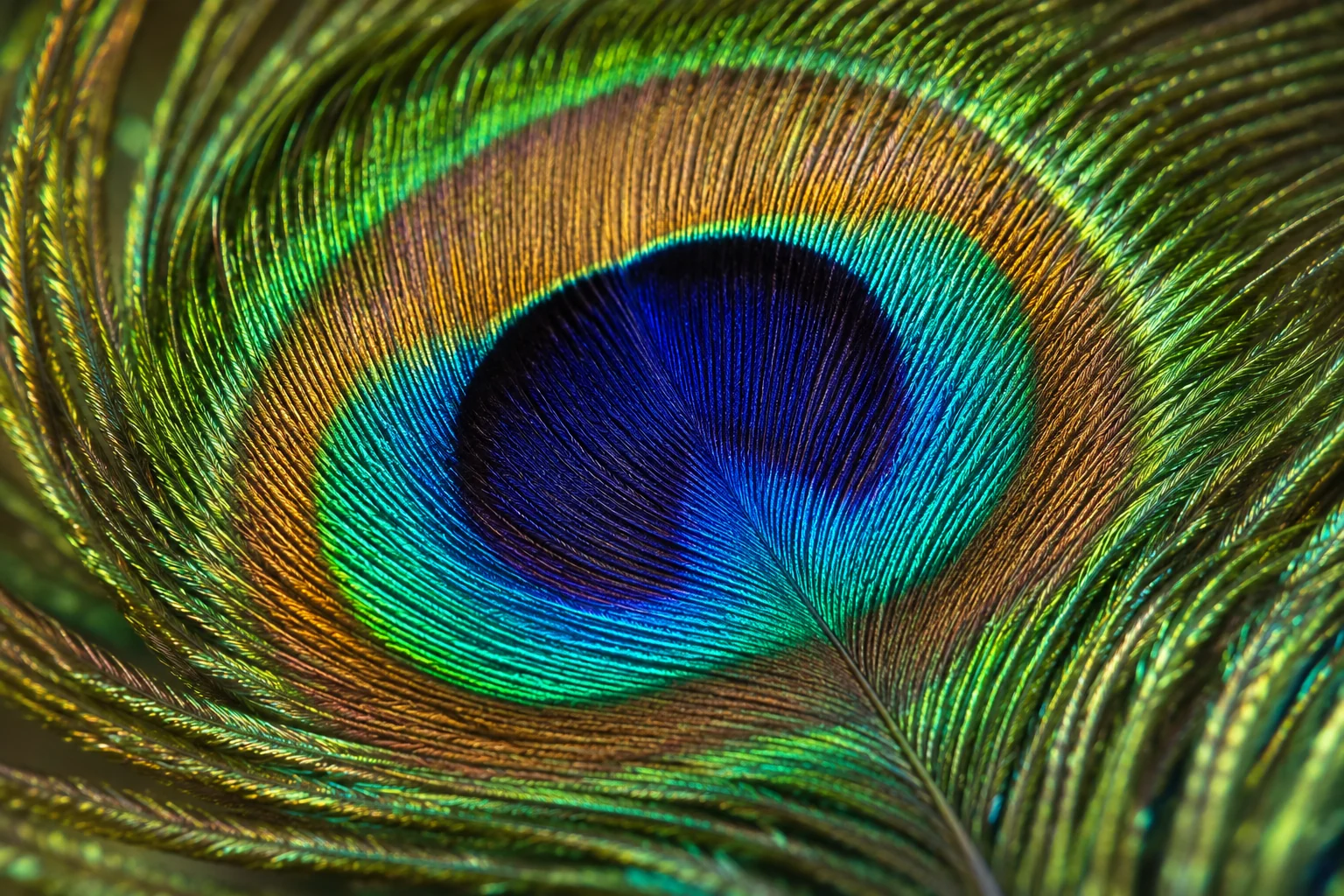
Turn a peacock feather in the light and its colours can brighten, darken or shift. The feather is not replacing its pigments each time it moves. Its microscopic architecture makes the light reaching your eyes depend on the viewing geometry.
Why do peacock feathers shimmer? Tiny arrangements of melanin-containing structures, keratin and air selectively reflect light. Their spacing and organization help determine which wavelengths are strongly reflected. Changing the angle of illumination or observation changes the reflection, producing iridescence. Pigment and structure work together rather than providing mutually exclusive explanations. [3]
Pigment changes light by absorption
A pigment absorbs some wavelengths more strongly than others. Light that is not absorbed can be reflected or scattered toward an observer. The resulting mixture determines the colour seen under a particular light source. Pigment is therefore one way of changing the spectrum of light, but it is not the only way.
Bird feathers use several routes to colour. Cornell Lab’s overview distinguishes pigments from structural effects and explains why some structural colours change with angle while others do not. This matters because a blue feather need not be carrying a blue pigment, and a feather made partly colourful by its structure need not be free of pigments. [5]
A peacock is a particularly striking example because the visible result can look metallic. A photograph captures one combination of light, feather orientation and camera position. The same feather can look quite different when one of those conditions changes.
The structure is inside tiny feather branches
A feather has a central shaft, branching barbs and still smaller branches called barbules. In iridescent regions, the barbules contain organized structures at scales far below what a person can resolve by looking at the whole feather. Their composition and arrangement influence the way incident light is reflected.
The American Museum of Natural History describes how melanin-containing structures in feather barbules contribute to iridescent colour. Melanin has an absorptive role as well as being part of the optical architecture. The materials provide different optical properties, and their arrangement supplies the geometry. Together those properties determine how the feather handles light. [4]
That is why “the colour is structural” should not be translated as “there is no pigment.” A dark, pigment-containing component can be an essential part of a structure that reflects a bright colour. Describing the arrangement and describing the ingredient answer different parts of the same question.
How microscopic spacing selects colours
Light behaves as a wave. Reflections from different parts of a repeating structure can reinforce one another for some wavelengths and reduce one another for others. The result depends on the optical path lengths and on how light interacts with the materials it passes through. A structure can therefore favour particular reflected wavelengths without manufacturing new light.
In their 2003 study of green peacock display feathers, Zi and colleagues investigated ordered melanin rods in a keratin-based structure containing air. They related differences in the arrangement to different colours in the feather’s eye pattern. Their work is a concrete explanation of colour selection in a biological structure, rather than merely a comparison to a shiny surface. [1]
The familiar word “photonic” refers to this influence on light. It does not mean the feather is electronic, self-illuminating or made of glass. A biological material can have an optical structure whose small-scale organization matters just as much as its overall shape.
Why moving the feather changes the reflection
Changing the angle changes the geometry of the paths light takes through and between the reflecting structures. The wavelengths reinforced toward a particular observer can consequently change. This dependence on viewing conditions is the defining feature of iridescence. A turn of the bird or a shift in the observer’s position can reveal a different reflection without any new feather growth.
A 2018 study of blue peacock neck and breast feathers examined their optical behaviour with microscopy and reflection measurements. These feathers are a different anatomical region from the long display train, but the study helps connect organized melanin structures with the observed direction-dependent reflection. It also illustrates why identifying the feather region and species matters when describing an experiment. [3]
A feather can appear dark when its strong reflection travels away from your eyes. That does not mean its colour has vanished from the material. Light must arrive from suitable directions and then reach the observer. The brightest view is only one possible view.
Why different parts of an eyespot have different colours
The rings in an eyespot are not simply identical structures turned at slightly different angles. Studies of peacock feather optics examine changes in the internal geometry across differently coloured regions. Rod dimensions, spacing, air channels, surrounding keratin and the number of repeated layers can all influence the reflection.
A 2020 Royal Society of Chemistry paper models and investigates several of these parameters in diversely coloured peacock feathers. Its central implication is that there is no need to invoke a separate paint for every visible colour. Changes in an optical structure can change its reflected spectrum. Equally, no single spacing value alone describes every part of a complex feather. [2]
It is useful to separate two questions. Differences between regions can arise from their structures. Changes in the appearance of one region can arise from the direction of the light and the observer. Both can contribute to the spectacle seen when a bird moves its display.
How researchers test the structural explanation
Microscopy can reveal an ordered arrangement, but a picture of that arrangement is only part of the evidence. Researchers also measure the wavelengths and directions of reflected light, compare observations with optical models, and examine how changing the optical surroundings affects the result.
The 2003 study used liquid infiltration as one test: changing the material occupying spaces in the structure changed its optical behaviour. That links colour to the interaction between the structure and its constituent materials. It is stronger evidence than judging by the metallic appearance alone. The result concerns controlled research measurements, not a suggested treatment for feathers. [1]
These complementary methods are important because a broad visual label such as “blue” can conceal a complicated spectrum. A photograph cannot by itself identify the precise dimensions or composition that produced a colour.
What materials researchers learn from this
Natural structural colours show that controlling arrangement can be a route to controlling visible appearance. Cambridge researchers describe materials inspired by nature’s bright structural colours, including approaches using organized cellulose. Such work draws on a general optical principle rather than requiring a synthetic material to contain the same ingredients as a feather. [6]
The inspiration has limits. A feather is a biological structure with its own shape, flexibility and growth process. An engineered film has different manufacturing and performance requirements. Calling an effect nature-inspired does not establish that a material will behave identically, resist every kind of damage or retain its appearance under every lighting condition.
Frequently asked questions
Are peacock feathers making their own light?
No. Their shimmer is a reflection effect. They need incoming illumination; they are not glowing through the light-producing process used by bioluminescent organisms.
Are the bright colours entirely pigment-free?
No. Melanin-containing structures participate in the optical system and also absorb light. Structure and pigment can work together. [4]
Is every blue bird feather iridescent?
No. Structural colour can occur without a strong colour shift with viewing angle. The organization of the light-scattering material matters. [5]
Does a peacock actively rebuild the feather to change colour?
The rapid shimmer seen as a feather turns does not require rebuilding its microscopic structure. Changing the illumination and viewing directions is enough to change the observed reflection.
Keep exploring
Sources and further reading
- Zi and colleagues (2003), PNAS — Coloration strategies in peacock feathers
- Royal Society of Chemistry (2020) — Biophotonics of diversely coloured peacock tail feathers
- Research paper (2018) — Reflections on iridescent neck and breast feathers of the peacock, Pavo cristatus
- American Museum of Natural History — Feathers and fur: composition and structure
- Cornell Lab of Ornithology — How birds make colourful feathers
- University of Cambridge — Taking inspiration from nature’s brightest colours
Reference review: November 10, 2026.
Keep exploring.
One remarkable idea at a time—nature, science, history and beyond.
Last updated November 12, 2026.

Barnakle Editorial Team
Barnakle Editorial Team is the collective byline used for Barnakle’s editorial articles. The contributor profile explains the team identity and links to the publication’s editorial policies.
More from the editorial team →