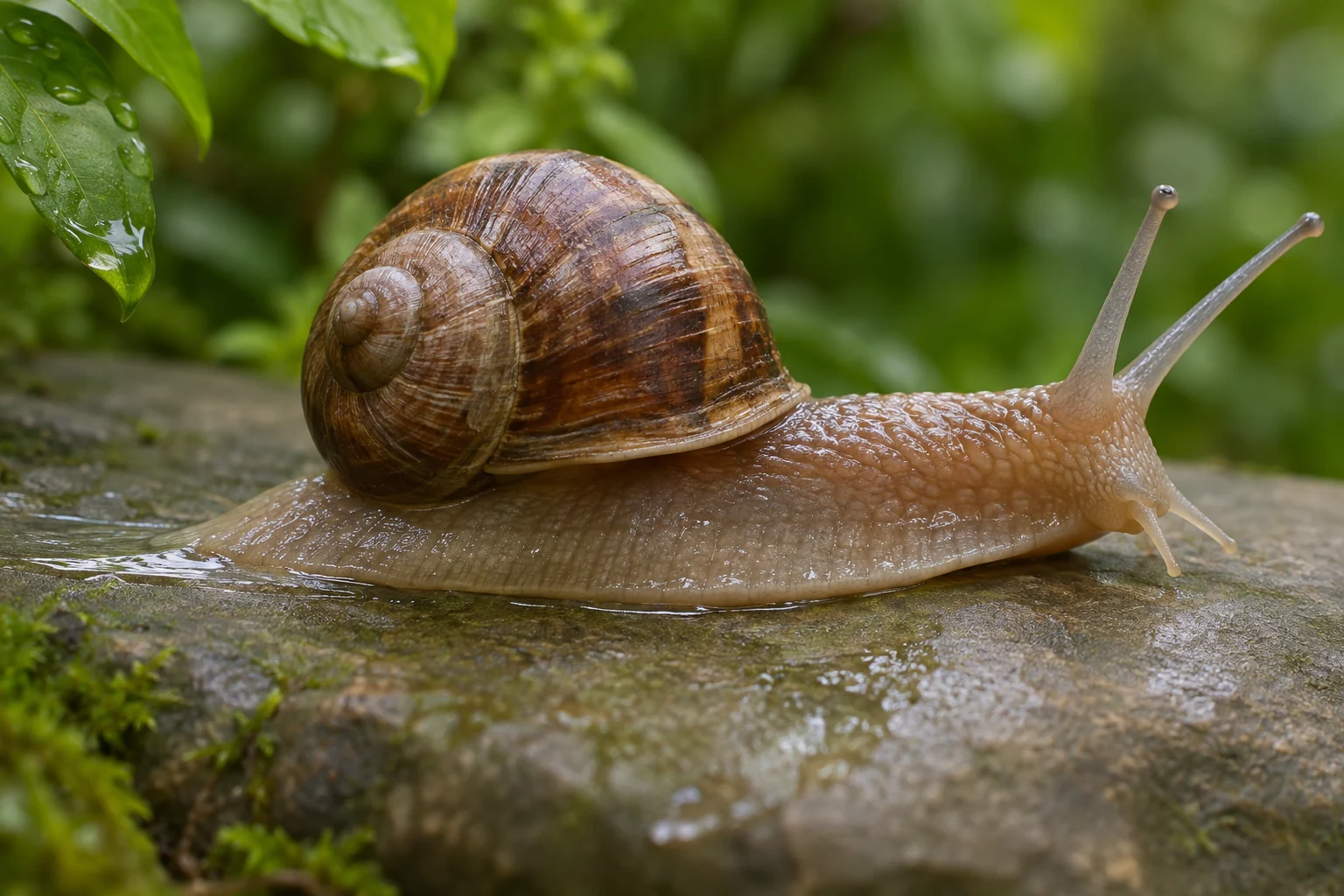
A snail seems to slide along without taking a step. Beneath its body, however, there is a coordinated system of muscular movement, changing contact and mucus that helps transmit forces to the ground.
How do snails crawl without legs? Land snails use travelling contractions in a broad muscular foot. Different parts of the foot engage with the surface as waves pass along it. A thin mucus layer helps couple those movements to the ground, so muscle activity can produce forward motion rather than simply deforming the animal in place. [1]
The foot is a moving surface
In this context, a foot is the broad muscular underside of the animal, rather than a jointed limb. A land snail can alter the shape and contact of that surface through coordinated contractions. The shell moves with the animal; it is not a wheel, and the snail does not need to drag itself forward by its tentacles.
The travelling contractions are called pedal waves. A wave is a pattern moving through the foot, not a piece of tissue travelling from one end of the snail to the other. The distinction is similar to a wave moving along a rope: the pattern travels while the material makes more local movements. The snail’s actual contact with the ground is more complicated than the rope analogy, but distinguishing pattern motion from tissue motion is essential.
MIT’s fluid-dynamics overview describes how muscular waves interact with a layer of mucus in terrestrial gastropod locomotion. “Gastropod” includes snails and slugs. Related animals can provide useful comparisons, but a result obtained from one species should not automatically be treated as an exact description of every species. [1]
Muscles need something to push against
A muscle can change the shape of a body without moving the whole body forward. To crawl, the animal has to exchange forces with its surroundings. Some parts of the foot need suitable traction while other parts move relative to the surface. Coordination determines whether local deformation produces useful progress.
Research by Lai and colleagues measured the forces involved in terrestrial gastropod movement. Their analysis links pedal waves, traction and changes in the foot’s proximity to the substrate. It provides a more detailed picture than the idea that a snail merely squeezes itself forward on a uniformly slippery film. Local contact and loading matter. [2]
A convenient mental picture is an advancing sequence of engagement and repositioning, spread over a continuous surface. It should not be pushed too literally: a snail has no row of tiny feet taking ordinary steps. The actual mechanism depends on the foot’s deformation and the properties of the material between it and the ground.
Mucus is more than a lubricant
Calling mucus slippery captures one everyday property while missing much of its mechanical behaviour. A simple lubricant reduces resistance to sliding. A crawling snail also needs forces to be transmitted between its foot and the substrate. The mucus participates in both the movement and the contact mechanics.
Models of adhesive crawling examine mucus as a material whose response depends on how it is deformed. Unlike an ideal liquid with a constant viscosity, a biological mucus layer can respond differently to different stresses and rates of shearing. Its mechanical properties help determine how a travelling muscle wave couples to the surface. [4]
This does not mean mucus can be described completely by a universal on–off switch between “solid” and “liquid.” Such shorthand can be useful for introducing the topic, but experiments and models address a richer set of behaviours. The layer’s thickness, loading and interaction with the foot also matter. Different descriptions are attempts to explain measured movement, not evidence that every snail uses an identical material under every condition.
Why foot lifting matters too
It is tempting to explain the entire glide through the chemistry of slime. The mechanics study by Lai and colleagues also considered how portions of the foot lift during passing waves. A region that changes its separation from the surface changes the way forces are transmitted through the material beneath it.
The resulting lesson is that mucus rheology and foot movement should be considered together. A property measured in a mucus sample does not, on its own, specify the animal’s complete gait. Researchers need observations of shape, motion and traction to test whether a proposed crawling mechanism matches the living animal. [2]
For an observer above the snail, this coordinated activity is largely hidden. The shell may travel quite smoothly even while the underside is changing shape. Smooth overall movement is therefore compatible with a highly organized sequence of local events.
A snail can change its gait with the surface
In a 2013 study, McKee, Voltzow and Pernet examined the land snail Cornu aspersum on different substrates. Their public abstract reports adhesive crawling on smooth acrylic and glass, and a loping gait on dry concrete and wood. In the loping gait, parts of the animal’s underside were lifted rather than maintaining the same continuous contact.
The researchers did not find loping to be a faster gait in that experiment. They also reported greater mucus expenditure on absorbent substrates. The important point is the relationship between the surface and the chosen movement pattern. A gait change should not automatically be interpreted as an animal switching to a higher speed. [3]
That finding also explains why “how a snail moves” can have more than one answer even within one species. The ground is part of the mechanical system. A smooth, non-absorbent surface and a rough, absorbent one present different conditions for contact and mucus use.
Why producing a trail has a cost
A trail is material left behind, so crawling can require investment in both muscular work and mucus production. Denny’s research on the energetic cost of gastropod crawling identified mucus production as a major contribution in the slug studied. That is a species-specific experimental result, not a universal numerical price for every centimetre travelled by every snail. [5]
Models also explore how mucus properties could influence the amount required for locomotion. Lauga and Hosoi’s work examines the consequences of mucus rheology for crawling efficiency. Modelling makes it possible to ask how changing a material property would alter the mechanism, while experiments are still needed to establish what a particular animal actually does. [4]
There is therefore more to the trail than a convenient sign of where an animal has been. It is part of an ongoing exchange between movement, material and surface. A thin layer can have a large mechanical role because it lies precisely where the animal interacts with the ground.
Do water snails move the same way?
The explanation here concerns land snails crawling on solid substrates. Some aquatic snails can move along the underside of a water surface, which is a different physical setting. MIT’s engineering explanation discusses this distinction and the study of snail-inspired motion. A liquid–air interface cannot simply be treated as a solid paving stone turned upside down. [6]
The shared word “snail” does not make all forms of locomotion mechanically identical. Habitat, contact surface and species all help determine which explanation applies. Being precise about that scope is more useful than trying to reduce every gastropod’s movement to one slogan about slime.
Frequently asked questions
Does the shell pull the snail along?
No. The muscular foot produces the movement. The shell is carried with the body rather than acting as a wheel or a separate propulsion system.
Does a snail just slide downhill on its mucus?
No. Muscular coordination and forces exchanged with the substrate produce crawling. Mucus helps mediate that contact; it does not replace the animal’s muscles. [1]
Is a loping snail necessarily moving faster?
No. The cited Cornu aspersum experiment found a change of gait with substrate conditions without a corresponding increase in speed. [3]
Is the foot a row of tiny legs?
No. It is a continuous muscular organ. Travelling patterns of contraction and changing surface contact allow it to function without jointed walking limbs.
Keep exploring
Sources and further reading
- MIT Non-Newtonian Fluid Dynamics Group — Slug and snail locomotion
- Lai and colleagues (2010) — The mechanics of the adhesive locomotion of terrestrial gastropods; abstract and figure information
- McKee, Voltzow and Pernet (2013) — Substrate attributes determine gait in a terrestrial gastropod; public abstract
- Lauga and Hosoi — Tuning gastropod locomotion: modelling the influence of mucus rheology on the cost of crawling; MIT repository abstract
- Denny (1980) — Locomotion: the cost of gastropod crawling; abstract
- MIT School of Engineering — Snail motion and the underside of a water surface
Reference review: November 10, 2026.
Keep exploring.
One remarkable idea at a time—nature, science, history and beyond.
Last updated November 12, 2026.

Barnakle Editorial Team
Barnakle Editorial Team is the collective byline used for Barnakle’s editorial articles. The contributor profile explains the team identity and links to the publication’s editorial policies.
More from the editorial team →