
Liquid proteins become strong fibres as they pass through microscopic spinning machinery
The short answer
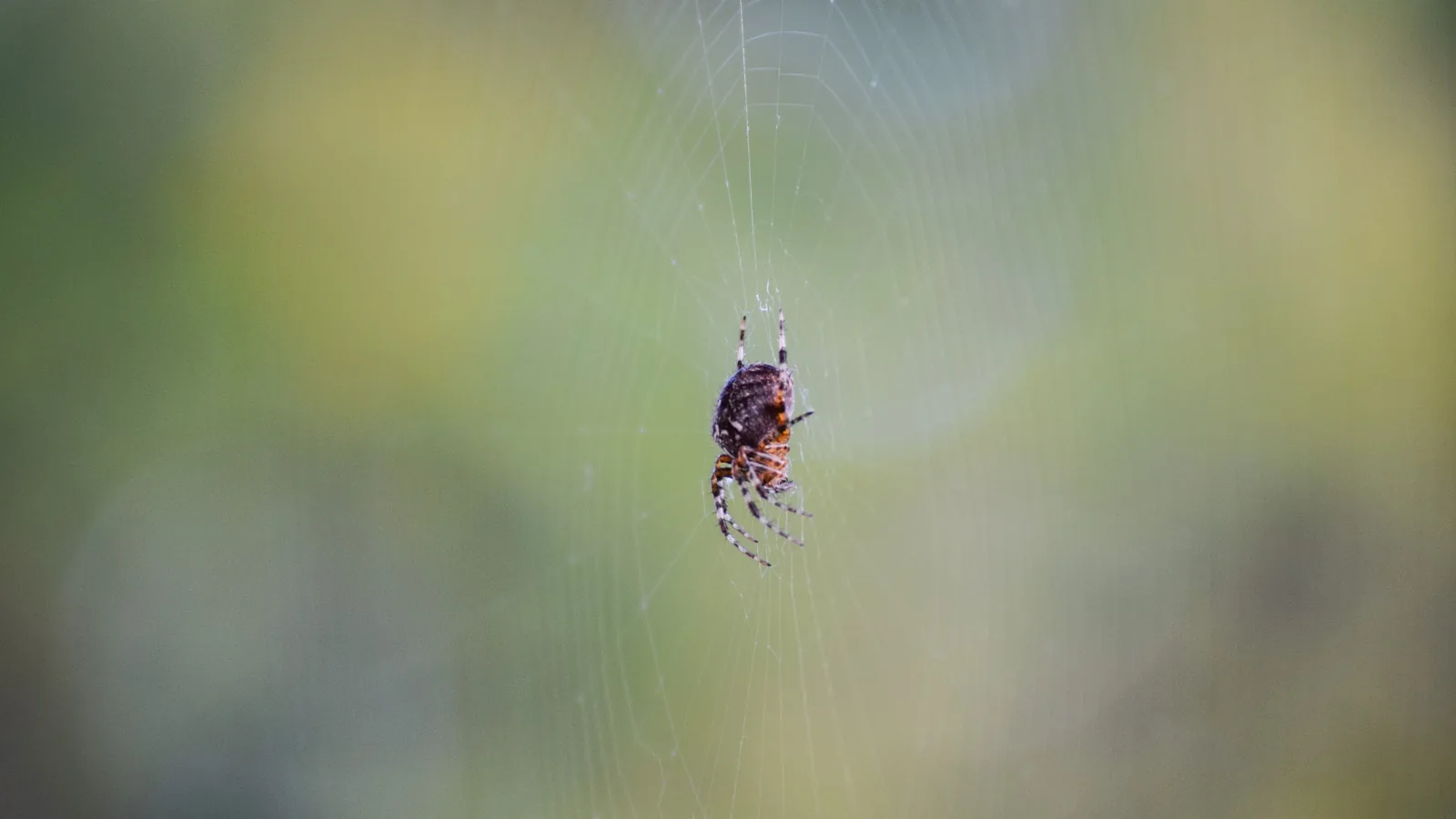
Spiders make silk proteins in abdominal glands, store them as a concentrated liquid and pull the material through ducts and microscopic spigots on spinnerets. Changes in acidity, ion balance, water content and shear help proteins align and lock into a solid fibre. Different glands make silks optimized for draglines, prey capture, egg protection, wrapping and web construction.
A web begins inside the spider as molecular engineering. The animal avoids forming a useless solid in the gland, then triggers assembly during spinning. The resulting fibre combines stiff nanoscale crystals with more flexible protein regions, producing a balance of strength, toughness and extensibility that varies by silk type.
Silk begins as spidroin proteins
Large proteins called spidroins contain repeated amino-acid sequences flanked by specialized terminal regions. Their molecular design allows concentrated storage and controlled assembly.
Understanding Silk begins as spidroin proteins requires separating the immediate physical mechanism from the conditions that make it stronger, weaker or easier to observe. Researchers measure those variables independently, compare natural examples and test whether the same explanation predicts a new result. This approach turns a plausible story into an evidence-based account.
The evidence for Silk begins as spidroin proteins comes from methods that fail in different ways. Direct observation establishes what occurs, instruments quantify timing or structure, experiments isolate candidate causes and models test whether known rules reproduce the pattern. Agreement across those methods is more persuasive than repetition of one dramatic example.
Context also matters for Silk begins as spidroin proteins. Scale, species, location, temperature, geometry and measurement limits can change the result without overturning the underlying mechanism. Careful reporting preserves that variation, states uncertainty and prevents a useful explanation from becoming an exaggerated universal rule.
Abdominal glands divide the work
Orb-weaving spiders may possess several gland types. Major ampullate glands make dragline silk, flagelliform glands make stretchy capture spirals and tubuliform glands help form egg cases.
Understanding Abdominal glands divide the work requires separating the immediate physical mechanism from the conditions that make it stronger, weaker or easier to observe. Researchers measure those variables independently, compare natural examples and test whether the same explanation predicts a new result. This approach turns a plausible story into an evidence-based account.
The evidence for Abdominal glands divide the work comes from methods that fail in different ways. Direct observation establishes what occurs, instruments quantify timing or structure, experiments isolate candidate causes and models test whether known rules reproduce the pattern. Agreement across those methods is more persuasive than repetition of one dramatic example.
Context also matters for Abdominal glands divide the work. Scale, species, location, temperature, geometry and measurement limits can change the result without overturning the underlying mechanism. Careful reporting preserves that variation, states uncertainty and prevents a useful explanation from becoming an exaggerated universal rule.
The dope remains liquid in storage
Inside the gland, silk proteins are densely concentrated without prematurely aggregating. Water, salts, acidity and molecular terminal domains help maintain a spinnable state.
Understanding The dope remains liquid in storage requires separating the immediate physical mechanism from the conditions that make it stronger, weaker or easier to observe. Researchers measure those variables independently, compare natural examples and test whether the same explanation predicts a new result. This approach turns a plausible story into an evidence-based account.
The evidence for The dope remains liquid in storage comes from methods that fail in different ways. Direct observation establishes what occurs, instruments quantify timing or structure, experiments isolate candidate causes and models test whether known rules reproduce the pattern. Agreement across those methods is more persuasive than repetition of one dramatic example.
Context also matters for The dope remains liquid in storage. Scale, species, location, temperature, geometry and measurement limits can change the result without overturning the underlying mechanism. Careful reporting preserves that variation, states uncertainty and prevents a useful explanation from becoming an exaggerated universal rule.
A narrowing duct prepares the fibre
As silk dope travels toward the spinneret, water is removed and chemical conditions change. Flow and shear orient molecules along the direction of the future thread.
Understanding A narrowing duct prepares the fibre requires separating the immediate physical mechanism from the conditions that make it stronger, weaker or easier to observe. Researchers measure those variables independently, compare natural examples and test whether the same explanation predicts a new result. This approach turns a plausible story into an evidence-based account.
The evidence for A narrowing duct prepares the fibre comes from methods that fail in different ways. Direct observation establishes what occurs, instruments quantify timing or structure, experiments isolate candidate causes and models test whether known rules reproduce the pattern. Agreement across those methods is more persuasive than repetition of one dramatic example.
Context also matters for A narrowing duct prepares the fibre. Scale, species, location, temperature, geometry and measurement limits can change the result without overturning the underlying mechanism. Careful reporting preserves that variation, states uncertainty and prevents a useful explanation from becoming an exaggerated universal rule.
Spinnerets provide precise control
Spinnerets are movable appendages bearing many spigots connected to particular glands. A spider can combine threads, place attachment cement and switch materials during construction.
Understanding Spinnerets provide precise control requires separating the immediate physical mechanism from the conditions that make it stronger, weaker or easier to observe. Researchers measure those variables independently, compare natural examples and test whether the same explanation predicts a new result. This approach turns a plausible story into an evidence-based account.
The evidence for Spinnerets provide precise control comes from methods that fail in different ways. Direct observation establishes what occurs, instruments quantify timing or structure, experiments isolate candidate causes and models test whether known rules reproduce the pattern. Agreement across those methods is more persuasive than repetition of one dramatic example.
Context also matters for Spinnerets provide precise control. Scale, species, location, temperature, geometry and measurement limits can change the result without overturning the underlying mechanism. Careful reporting preserves that variation, states uncertainty and prevents a useful explanation from becoming an exaggerated universal rule.
Silk is pulled rather than squirted
The spider draws fibre by moving away, using its legs or letting gravity act. Pulling rate and tension influence alignment and mechanical properties.
Understanding Silk is pulled rather than squirted requires separating the immediate physical mechanism from the conditions that make it stronger, weaker or easier to observe. Researchers measure those variables independently, compare natural examples and test whether the same explanation predicts a new result. This approach turns a plausible story into an evidence-based account.
The evidence for Silk is pulled rather than squirted comes from methods that fail in different ways. Direct observation establishes what occurs, instruments quantify timing or structure, experiments isolate candidate causes and models test whether known rules reproduce the pattern. Agreement across those methods is more persuasive than repetition of one dramatic example.
Context also matters for Silk is pulled rather than squirted. Scale, species, location, temperature, geometry and measurement limits can change the result without overturning the underlying mechanism. Careful reporting preserves that variation, states uncertainty and prevents a useful explanation from becoming an exaggerated universal rule.
Nanostructure creates performance
Ordered beta-sheet crystals provide stiffness and strength, while less ordered regions stretch and dissipate energy. Their arrangement produces toughness rather than one simple super-material property.
Understanding Nanostructure creates performance requires separating the immediate physical mechanism from the conditions that make it stronger, weaker or easier to observe. Researchers measure those variables independently, compare natural examples and test whether the same explanation predicts a new result. This approach turns a plausible story into an evidence-based account.
The evidence for Nanostructure creates performance comes from methods that fail in different ways. Direct observation establishes what occurs, instruments quantify timing or structure, experiments isolate candidate causes and models test whether known rules reproduce the pattern. Agreement across those methods is more persuasive than repetition of one dramatic example.
Context also matters for Nanostructure creates performance. Scale, species, location, temperature, geometry and measurement limits can change the result without overturning the underlying mechanism. Careful reporting preserves that variation, states uncertainty and prevents a useful explanation from becoming an exaggerated universal rule.
Draglines act as safety ropes
Major ampullate silk forms web frames and lifelines. It must support the spider, absorb movement and remain dependable across changing humidity and temperature.
Understanding Draglines act as safety ropes requires separating the immediate physical mechanism from the conditions that make it stronger, weaker or easier to observe. Researchers measure those variables independently, compare natural examples and test whether the same explanation predicts a new result. This approach turns a plausible story into an evidence-based account.
The evidence for Draglines act as safety ropes comes from methods that fail in different ways. Direct observation establishes what occurs, instruments quantify timing or structure, experiments isolate candidate causes and models test whether known rules reproduce the pattern. Agreement across those methods is more persuasive than repetition of one dramatic example.
Context also matters for Draglines act as safety ropes. Scale, species, location, temperature, geometry and measurement limits can change the result without overturning the underlying mechanism. Careful reporting preserves that variation, states uncertainty and prevents a useful explanation from becoming an exaggerated universal rule.
Capture threads manage impact
An aerial insect carries kinetic energy. Stretchy spiral silk and adhesive droplets slow it without immediately bouncing it away or breaking the entire web.
Understanding Capture threads manage impact requires separating the immediate physical mechanism from the conditions that make it stronger, weaker or easier to observe. Researchers measure those variables independently, compare natural examples and test whether the same explanation predicts a new result. This approach turns a plausible story into an evidence-based account.
The evidence for Capture threads manage impact comes from methods that fail in different ways. Direct observation establishes what occurs, instruments quantify timing or structure, experiments isolate candidate causes and models test whether known rules reproduce the pattern. Agreement across those methods is more persuasive than repetition of one dramatic example.
Context also matters for Capture threads manage impact. Scale, species, location, temperature, geometry and measurement limits can change the result without overturning the underlying mechanism. Careful reporting preserves that variation, states uncertainty and prevents a useful explanation from becoming an exaggerated universal rule.
Glue is a separate material
Sticky droplets coating many capture spirals contain glycoproteins and moisture-managing compounds. They remain adhesive under environmental conditions suited to the species.
Understanding Glue is a separate material requires separating the immediate physical mechanism from the conditions that make it stronger, weaker or easier to observe. Researchers measure those variables independently, compare natural examples and test whether the same explanation predicts a new result. This approach turns a plausible story into an evidence-based account.
The evidence for Glue is a separate material comes from methods that fail in different ways. Direct observation establishes what occurs, instruments quantify timing or structure, experiments isolate candidate causes and models test whether known rules reproduce the pattern. Agreement across those methods is more persuasive than repetition of one dramatic example.
Context also matters for Glue is a separate material. Scale, species, location, temperature, geometry and measurement limits can change the result without overturning the underlying mechanism. Careful reporting preserves that variation, states uncertainty and prevents a useful explanation from becoming an exaggerated universal rule.
Spiders recycle some silk
Many web builders eat damaged web sections, digest the proteins and build again. Recycling recovers nutrients but does not mean every molecule returns unchanged to a new thread.
Understanding Spiders recycle some silk requires separating the immediate physical mechanism from the conditions that make it stronger, weaker or easier to observe. Researchers measure those variables independently, compare natural examples and test whether the same explanation predicts a new result. This approach turns a plausible story into an evidence-based account.
The evidence for Spiders recycle some silk comes from methods that fail in different ways. Direct observation establishes what occurs, instruments quantify timing or structure, experiments isolate candidate causes and models test whether known rules reproduce the pattern. Agreement across those methods is more persuasive than repetition of one dramatic example.
Context also matters for Spiders recycle some silk. Scale, species, location, temperature, geometry and measurement limits can change the result without overturning the underlying mechanism. Careful reporting preserves that variation, states uncertainty and prevents a useful explanation from becoming an exaggerated universal rule.
Human-made silk remains challenging
Researchers produce spidroins in microbes, plants and animals, yet matching natural fibre requires both the right proteins and a spinning process that controls structure across scales.
Understanding Human-made silk remains challenging requires separating the immediate physical mechanism from the conditions that make it stronger, weaker or easier to observe. Researchers measure those variables independently, compare natural examples and test whether the same explanation predicts a new result. This approach turns a plausible story into an evidence-based account.
The evidence for Human-made silk remains challenging comes from methods that fail in different ways. Direct observation establishes what occurs, instruments quantify timing or structure, experiments isolate candidate causes and models test whether known rules reproduce the pattern. Agreement across those methods is more persuasive than repetition of one dramatic example.
Context also matters for Human-made silk remains challenging. Scale, species, location, temperature, geometry and measurement limits can change the result without overturning the underlying mechanism. Careful reporting preserves that variation, states uncertainty and prevents a useful explanation from becoming an exaggerated universal rule.
Common misconceptions
Spider silk is not one uniform substance, and it is not simply stronger than steel in every comparison. Strength, stiffness, extensibility, toughness, density and diameter are different properties. A particular silk can excel in one measure while another material wins in another.
A concise explanation is valuable only when it preserves the causal chain. It becomes misleading when it substitutes a memorable label for a mechanism, confuses association with cause or extends evidence beyond the conditions actually studied.
How scientists know
Scientists collect individual silk types, perform tensile tests, analyse proteins with sequencing and spectroscopy, image fibre structure and control humidity. Gene expression identifies gland-specific spidroins, while biomimetic spinning experiments test which chemical gradients and flow conditions reproduce natural assembly.
No single measurement carries the conclusion. Observations, experiments, physical theory and repeated records provide independent checks, while disagreement points to an uncontrolled variable or a question that still needs a better test.
Frequently asked questions
Do all spiders make webs?
All spiders make silk, but many hunt without an aerial prey-catching web and use silk for shelters, eggs, lifelines or dispersal.
Is spider silk sticky?
Some capture threads carry adhesive droplets, while structural and dragline silks are not inherently glue-coated.
Can spiders run out of silk?
Silk production uses resources and takes time, but glands continually synthesize proteins when nutrition and physiology permit.
Why do webs have several thread types?
Frames, radii, capture spirals, anchors and retreats face different mechanical jobs.
Can people manufacture spider silk?
Experimental fibres exist, but reproducing natural scale, consistency and processing economically remains difficult.
Key takeaways
- Spidroins are stored as concentrated liquid in abdominal glands.
- Duct chemistry and pulling align proteins into fibre.
- Different glands produce silks for different jobs.
- Mechanical performance comes from hierarchical molecular structure.
Continue exploring
Sources and further reading
Keep exploring.
One remarkable idea at a time—nature, science, history and beyond.
Sources and further reading
Barnakle uses credible primary and authoritative sources wherever possible.
- Smithsonian — How spiders make webs
- https://www.smithsonianmag.com/smithsonian-institution/ask-smithsonian-how-do-spiders-make-webs-180957426/
- Annual Review — Spider silk properties
- https://www.annualreviews.org/content/journals/10.1146/annurev-ento-031616-035615
- PMC — Spider silk structure and function
- https://pmc.ncbi.nlm.nih.gov/articles/PMC2658765/
- Smithsonian — History of spider silk research
- https://www.si.edu/object/short-history-scientific-interest-spider-silk%3Aslasro_73690
Last reviewed October 3, 2026.

Barnakle Editorial Team
A member of the Barnakle editorial team, exploring remarkable ideas with clarity, curiosity and care.
More from this author →