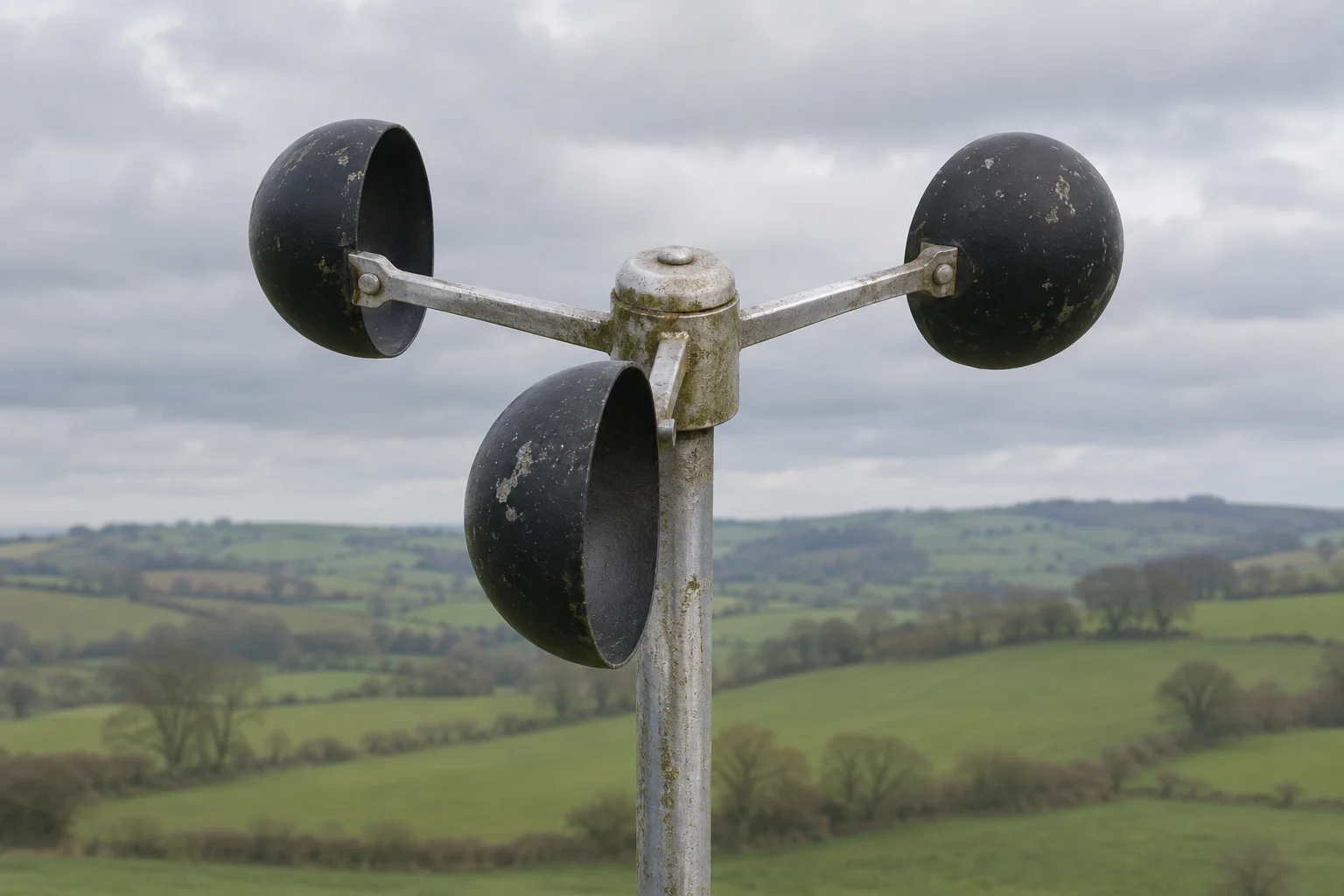
Watch a weather station when the breeze changes direction. The vane swings round, but the little wheel of cups keeps turning the same way. That wheel is a cup anemometer. Its cups offer different resistance to the air depending on which side the wind meets. The resulting turn of the shaft is easy to count. What makes the instrument a measuring device is the next step: comparing its rate of rotation with known wind speeds so that a station can translate turns per second into metres per second or kilometres per hour. [1, 2]
Why the cups turn one way
Look down on a familiar three-cup rotor and follow its circumference with a finger. The openings face around the circle in the same sense. Although a cup on the far side may appear to face the opposite way from the one nearest you, the two are mounted alike in relation to their respective arms. This is the feature a homemade model can easily get wrong. If all the openings faced straight out from the hub like little dishes pointing at the horizon, the rotor would have lost its distinctive handedness. [2, 3]
At rest in a crosswind, a hollow cup with its opening exposed generally experiences greater drag than one presenting its rounded back. Because the cups sit some distance from the shaft, their forces have leverage. As the rotor turns, each cup successively occupies the favourable and less favourable positions. The driving effect across a revolution is enough to maintain rotation. Change the approaching wind from west to north and the position where each cup receives its strongest push moves around the circle. The mounting still favours the same direction of rotation. [2, 3]
Once moving, each cup experiences air flowing relative to its own motion. A cup travelling with the breeze and one coming round into it experience different conditions even when the undisturbed air is blowing steadily. As the wheel accelerates, the balance of driving and opposing forces changes. In steady wind it settles near a repeatable rotation rate. Thinking of a cup as a marker carried along exactly as fast as the air misses the opposing half of the trip around the shaft. [2, 3]
Turning revolutions into a weather observation
A rotor can report turns in several ways. In the Met Office description, the rotation of the spindle produces an electrical signal. Picture the equivalent on a bench with a tiny mark on the spindle, a stationary pointer and a clock. You could count how often the mark passes the pointer in a measured interval. That count contains a speed in revolutions per second. It says nothing in kilometres per hour until you know the relationship between this particular rotor and the air moving past it. [1, 2]
Consider a count of twenty turns in ten seconds. That is two turns a second. Multiplying it by the circumference traced by the cups would give the speed of a point on a cup arm. A weather observer wants the speed of the air before the rotor disturbs it. To obtain that value, a laboratory puts the sensor in a wind tunnel, exposes it to several reference speeds and measures the resulting rotations. Over much of its operating range the points for a well-designed cup instrument lie close to a straight line. [2, 3, 4]
That line has a slope and may have an offset. Two rotors with different cup shapes or arms need not have interchangeable calibration curves, even if both have three cups and both turn freely. At the slow end there is another complication. The air must exert enough turning force to start a resting instrument against friction. A barely stirring leaf below a stationary anemometer therefore need not signal a contradiction. Starting threshold and response in an established flow answer different questions when a laboratory evaluates a sensor. [2, 3, 4]
A gust has a duration
A passerby might watch the cups accelerate and call that moment the gust. A station must decide what number to record. The rotor has mass, so a sharp change in the wind takes time to appear as a change in its rotation rate. The electronics also observe and average over defined periods. These effects are separate. You can change the averaging period in software while leaving the physical cups untouched, or change the rotor and keep the reporting rules exactly the same. [1, 2, 4]
For example, the UK Met Office describes sampling wind every quarter of a second and calculating gust speed from the highest three-second average in the period concerned. Imagine two records with the same single high sample. In one, the surrounding samples are also high. In the other, the peak is surrounded by weaker wind. The first can produce the larger reported gust even though the highest individual sample is identical. A weather report pairs the instrument's response with a definition of what counts as a gust. [1]
Where the mast stands matters
Compare a cup rotor on the open side of a playing field with one tucked behind the clubhouse. Both could have passed the same wind-tunnel test. The one behind the wall will encounter air that has already been deflected and disturbed by the building. Moving it to the roof can introduce yet another pattern where the air crosses the roof edge. A good calibration describes how the sensor responds to its local wind. Exposure determines how well that local wind represents the place named in the report. [1, 3, 5]
This is why the height of a weather station's mast is part of the observation. The familiar reference height for standard surface wind measurements over open terrain is ten metres. On the same mast a vane can supply what the cup count leaves out: the direction the wind is coming from. An east wind and a west wind of equal speed should give comparable cup readings in good exposure, while the vane should point in nearly opposite directions. The apparent indifference of the rotor to compass direction is exactly what makes the pair work. [1, 5]
Watch the cups slow when a gust passes. From the ground you can already read one thing directly: the local horizontal wind has weakened enough for the rotor to lose speed. To put a reliable number on that observation, you would need the rotation count, the calibration and the time interval. To compare it with a station across town, you would want to know something about both masts as well. All of that information sits behind a weather app's single line of wind speed. [1, 2, 5]
Related reading
Sources
- Met Office — How we measure wind
- Risø National Laboratory — The Cup Anemometer and Other Exciting Instruments
- NCAR — Instructor’s handbook on meteorological instrumentation
- ASTM — Measuring cup anemometer performance
- Environment and Climate Change Canada — Manual of Surface Weather Observation Standards
Keep exploring.
We’ll email you when the first edition is ready.
Last updated November 26, 2026.

Barnakle Editorial Team
Barnakle Editorial Team is the collective byline used for Barnakle’s editorial articles. The contributor profile explains the team identity and links to the publication’s editorial policies.
More from the editorial team →