Put a spirit level on a shelf and lift the right end of the shelf. The bubble travels right. Now lift the entire shelf by the same amount at both ends. The bubble stays put. It responds to a change in tilt, even a very small one, while ignoring a change in height. Getting that distinction out of a pocketful of liquid requires a carefully curved inner surface, a pair of reference marks and a reliable connection between the vial and the face resting on the wood.[1, 2]
The highest place in a nearly straight tube
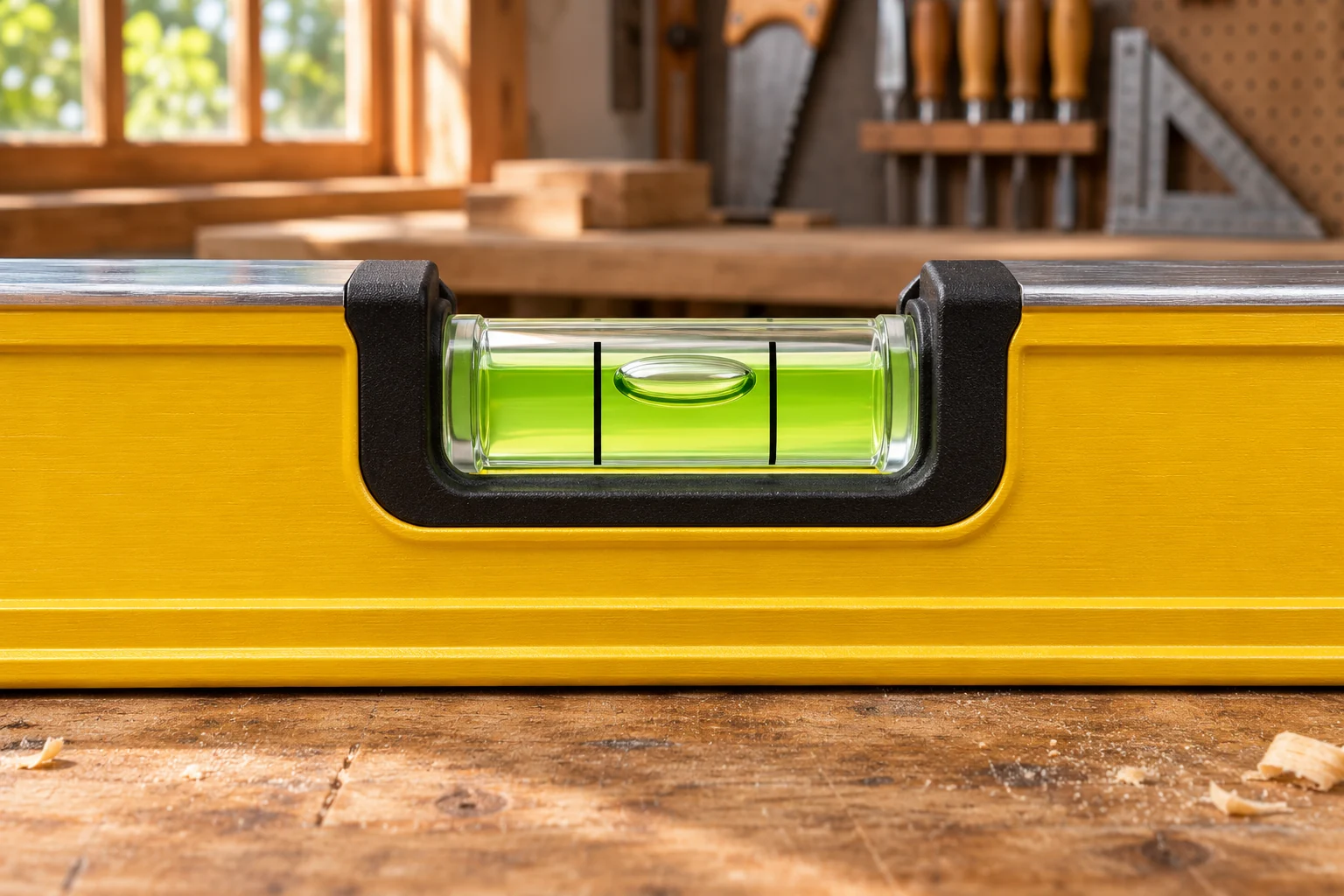
A spirit level contains a sealed vial holding liquid and a bubble of gas. Under gravity the denser liquid settles below the gas. Wherever the gas can rise higher along the top of the vial, some liquid can move into the space it leaves behind. The bubble settles around the highest part available. With the level lying on its measuring face, that point should fall between the index marks when the face is horizontal. The marks have no influence on the bubble. Their position records the relationship the manufacturer intended between the vial and the base.[1, 2, 5]
That explanation leaves a puzzle. In a perfectly straight horizontal tube with a flat, level ceiling, why would the bubble favour the middle? The answer lies in a shallow curve along the inside of a real tubular vial. Its upper surface arches a little higher at the centre. The vial can look rectangular from the outside because an external block protects the curved cavity within it. A small tilt changes which portion of the inner curve sits highest. The bubble follows that point smoothly along the scale.[1, 2]
You can picture the geometry by imagining a very large wheel. The small arc at the very top is nearly flat. Rotate the wheel just a little and a different patch of its rim becomes the topmost patch. Its new top is still at the same height in the room, but it lies a measurable distance around the rim from the old one. A vial with a gently curved interior makes use of exactly that distinction between a small angle and the distance it moves a reference point along an arc.[1, 2]
Why two levels can react differently to the same shelf
Vial makers use the term sensitivity for the change in angle needed to move the bubble a specified distance, often one division. A larger radius of curvature gives a longer distance along the arc for the same angle. On the same slightly sloping surface, a sensitive precision level may show a clear displacement while an ordinary carpenter’s level shows only a small one. A bubble moving farther does not by itself mean that the shelf is steeper. You need the specification for the vial you are reading.[1, 2, 3]
For example, Obishi describes a precision level on which one division corresponds to a rise of 0.05 millimetres per metre. Across two metres a surface continuing at that slope would rise by 0.10 millimetres. The tool can be much shorter than a metre. The unit describes a ratio between rise and horizontal distance, just as a road gradient can be given as a percentage without measuring exactly one hundred metres of road. Ordinary levels with a pair of centring rings need not carry a calibrated scale for reading numerical gradients.[1, 3, 5]
A shelf can be level one way and tilted the other
Rest the tool along the front edge of a wide shelf. A centred bubble tells you about its tilt along that line. The back of the shelf could still be higher than the front, much as a ramp can be perfectly level from side to side while sloping steeply in the direction of travel. Turn the level through a quarter turn and take a second reading front to back. Together the two directions give you information that neither reading could provide alone. A round bull’s-eye vial uses a curved surface in two directions to show both kinds of tilt at once.[2, 5]
The points supporting the tool matter as well. A long level placed across a shallow hollow can touch wood only at the two ends. The bubble then reports the orientation of the straight base bridging those contacts. Place a short level on one side of the hollow and it may tell a different story. Both readings can be reasonable. They describe different stretches of the surface. Look for daylight under the base or a point on which the frame rocks before interpreting a disagreement as an error in either vial.[3, 5]
The end-for-end check
A shifted vial can settle beautifully between its marks while the measuring face is actually tilted. There is a useful check that needs no second level. Find a stable surface and set up the tool so the bubble is centred. Mark the position of the base without disturbing it. Rotate the tool end for end in the horizontal plane, keeping the same measuring face down, and put it back on that mark. Let the bubble settle. A properly aligned horizontal vial should again show centre.[4, 5]
Why reverse the tool? Imagine that one end of the vial sits a little high relative to the frame. In the first position, a slight slope of the support might cancel that error and bring the bubble to centre. Turn the frame around and the same slope of the support now reinforces the mounting error. The bubble moves away from centre. The test works because the support keeps its direction in the room while the assembly error travels with the instrument. It also explains why an unnoticed crumb under one end can spoil the comparison.[3, 4]
The precision job and the household job finish with the same useful question. What two points, or what stretch of surface, did the base actually touch? Once that is clear, the bubble gives a remarkably direct answer. A pocket-sized tool can establish a local horizontal in a room with crooked floorboards, slanting trim and no trustworthy line in sight. The reference it uses is the direction of gravity, carried to an engraved pair of marks by the curve of a tiny sealed chamber.[1, 2, 5]
Related reading
Sources
- Level Developments — Sensitivity and accuracy of level vials
- Elesa — Spirit levels and their sensitivity
- Obishi Keiki — Precision level instructions
- STABILA — How to check a spirit level
- Johnson Level — Questions and answers on levels
Keep exploring.
One remarkable idea at a time—nature, science, history and beyond.
Last updated November 24, 2026.

Barnakle Editorial Team
Barnakle Editorial Team is the collective byline used for Barnakle’s editorial articles. The contributor profile explains the team identity and links to the publication’s editorial policies.
More from the editorial team →