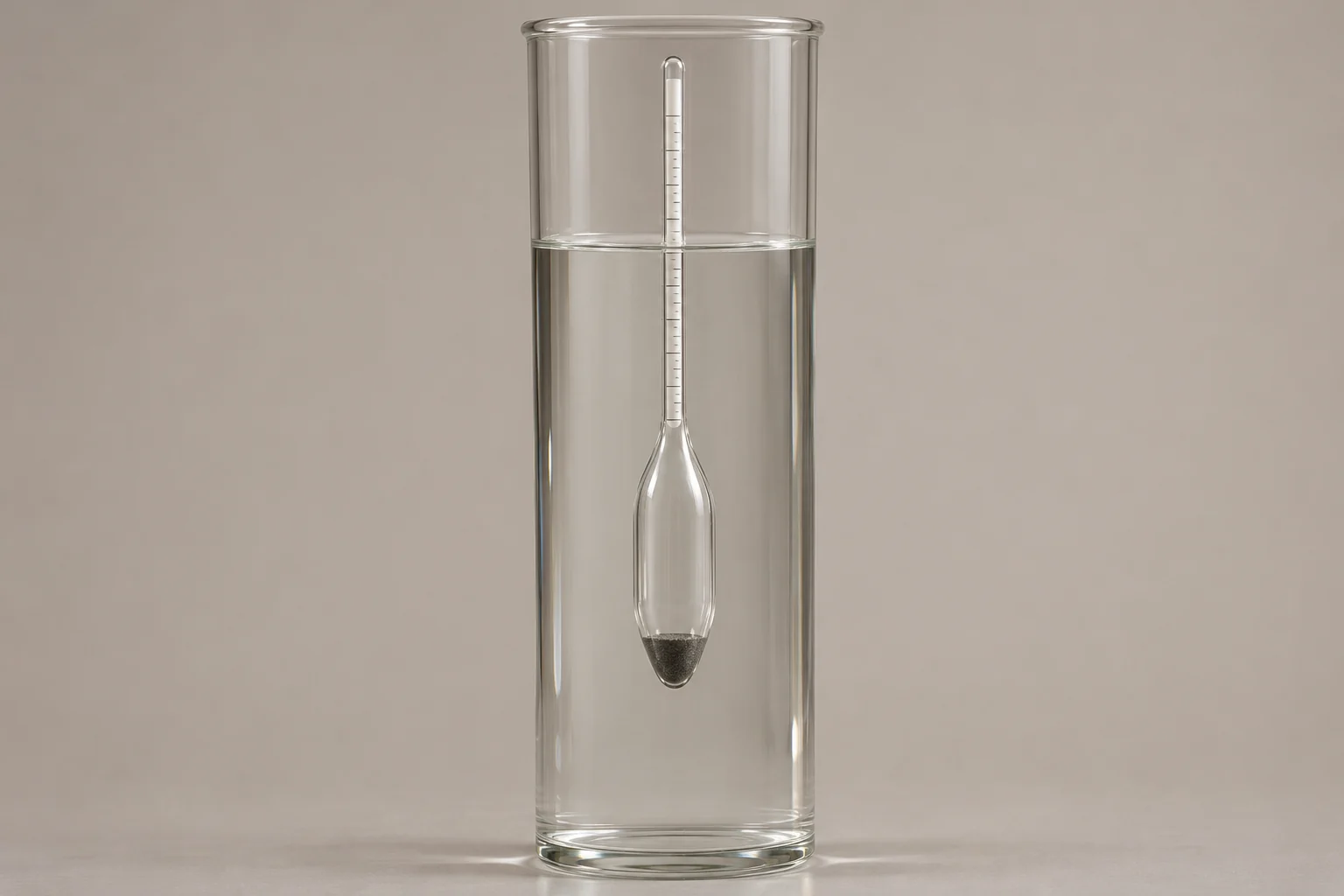
A glass hydrometer floating in grape juice shows more of its stem above the surface than it does in water, provided the juice is denser and the instrument is within range. Nothing inside the glass has changed. The extra sugar dissolved in the juice helps a smaller volume of liquid support the same instrument. The narrow stem turns that small change in submerged volume into a change in height large enough to read by eye. A hydrometer is, in effect, a balance that borrows one side of its weighing mechanism from the sample.[1, 3, 5]
What the floating bulb weighs
First ignore the small forces at the surface of the liquid. A freely floating object settles where the weight of the liquid it displaces equals its own weight. Suppose a hydrometer has a mass of fifty grams and floats in a liquid with a density of one gram per cubic centimetre. It must displace fifty cubic centimetres. Put that same instrument in a liquid with a density of 1.10 grams per cubic centimetre. It now displaces about 45.5 cubic centimetres. The missing four and a half cubic centimetres tell you which way the instrument must move. More of it emerges.[1, 3]
This is an easy result to read backwards. Looking from outside the jar, the instrument floats higher in the denser liquid. Looking at the scale attached to the instrument, the liquid surface now crosses it closer to the bulb. On a conventional density scale, higher density values therefore sit farther down the stem. Which mark lies nearest the table is of little use on its own. What matters is which mark intersects the free surface of the sample once the instrument has come to rest.[1, 2, 3]
The weighted bottom makes the bulb hang upright. The wide submerged body supplies much of the necessary displacement. The narrow stem supplies a long reading surface without adding much volume for each extra millimetre submerged. Picture two stems of equal length, one thin and one thick. To move an extra cubic centimetre of thin stem through the surface takes a greater vertical distance. A designer can use that distance to spread out the scale markings, at the cost of covering a narrower density range on an instrument of manageable length.[1, 3]
Why the rim of the liquid matters
Look closely where water meets a clean glass stem and you see the surface curve upward. That curved region is the meniscus. Two people can describe the same undisturbed float differently if one reads the high point against the glass and the other reads at the level of the liquid farther away. Measurement Canada’s procedure for a transparent sample describes bringing the eye into position to read the bottom of the meniscus. Other instruments and opaque samples may use a different convention. The correct reference comes with the scale and its calibration.[1, 2, 3]
The meniscus also does more than complicate the view. Liquid that wets the glass can exert a downward pull along the circumference of the stem. In precision work that force is large enough to include in the analysis. The US National Institute of Standards and Technology describes how the surface tension of the liquid and its contact with the glass affect hydrometer readings. The visible curve and the force change together. Correctly judging the bottom of the curve solves the reading problem while still leaving the physical surface-tension effect to account for.[1]
A wall is another way the assumed balance can go wrong. If the bulb rests on the bottom of a shallow jar, part of its weight is supported by the jar. If the stem leans against the side, the instrument may hang up as it settles. Both cases can produce a perfectly legible number. Check for clearance around the bulb as well as below it. A stationary hydrometer is useful only when the liquid and the forces appropriate to its calibration are what hold it there.[2, 3]
The number can be written in different ways. A density carries units such as grams per millilitre. Specific gravity is a ratio to a specified reference density, usually that of water at a stated temperature. The numbers can look very similar on a sample label, so copying the heading as well as the digits is worth the effort.[1, 3]
Why the scale needs a temperature
A hydrometer reading brings two temperatures into play. One is the temperature of the liquid you have in the cylinder. The other is the reference temperature for the instrument or reported result. A sample can expand as it warms, changing its density while the amount of dissolved material remains the same. The glass instrument itself also responds to temperature. Recording a stable sample temperature alongside the reading gives someone else a chance to reproduce the result or apply the right correction.[1, 2, 3]
A juice hydrometer shows the practical consequence. A scale marked in degrees Brix relates the density of a sucrose solution to its sugar content under specified conditions. Grape juice contains substances besides sucrose, so such a reading is an estimate when applied to juice. Fermenting juice presents another complication because the formation of alcohol changes the density too. A single floating depth cannot separate the contributions of sugar, alcohol and other dissolved substances. It is the same physical measurement even when the paper scale inside carries a much more specific label.[3, 5]
A float that uses the opposite strategy
The Nicholson hydrometer in Grinnell College’s physics collection illustrates a clever reversal. Its operator adjusts small weights to make the float return to the same index line. A solid sample can be weighed first in a pan above the water and then submerged in a lower holder. The difference in its apparent weight reveals the buoyant effect of the water it displaces. By keeping the float at a fixed depth, the experiment makes added mass, rather than motion along a scale, the quantity the observer reads.[4]
Take another look at an ordinary hydrometer after seeing that alternative. The bulb supplies a known weight, the liquid chooses the volume needed to support it, and the stem reveals the answer. Changing the liquid changes the height. Holding the height fixed and changing the load can expose the same relationship from the other direction. Two instruments of rather different appearance are asking water to perform the same simple service: account for the weight of what has been pushed out of the way.[1, 3, 4]
Related reading
Sources
- NIST — Calibration services for hydrometers
- Measurement Canada — Using a hydrometer for density measurement
- International Organization of Legal Metrology — Density measurement
- Grinnell College Physics Museum — Nicholson’s hydrometer
- Colorado State University — Winery laboratory manual
Keep exploring.
One remarkable idea at a time—nature, science, history and beyond.
Last updated November 23, 2026.

Barnakle Editorial Team
Barnakle Editorial Team is the collective byline used for Barnakle’s editorial articles. The contributor profile explains the team identity and links to the publication’s editorial policies.
More from the editorial team →