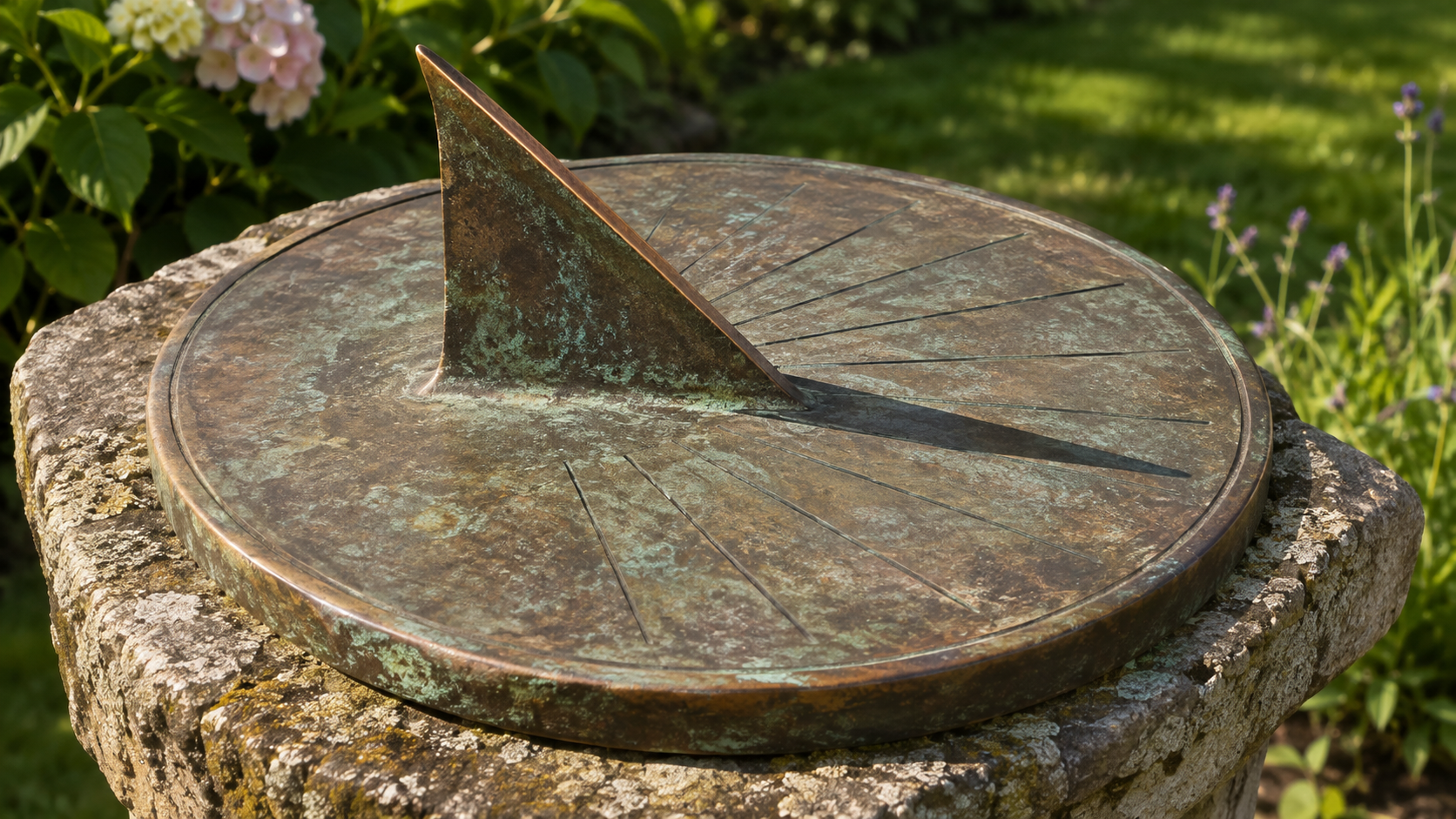
A fixed instrument reads the changing direction of sunlight
A garden sundial has no battery and no moving hands, yet its shadow can progress across an orderly set of hour marks. The mechanism is larger than the object: Earth rotates, the Sun’s apparent direction changes, and the dial turns that changing direction into a readable position.
There is a catch. A sundial does not automatically show the same kind of time as a phone. The distinction between a reference and a convention also matters in GPS timekeeping. Understanding what it measures is as important as understanding the shadow.
Follow the mechanism
- Earth’s rotation changes the Sun’s apparent direction in the sky.
- Sunlight casts a shadow from a fixed gnomon.
- The dial’s geometry maps that direction onto hour lines.
- Corrections may be needed to compare apparent solar time with civil time.
The shadow records direction
A sundial’s shadow depends on the direction from which sunlight arrives and on the shape of the object blocking it. As the Sun appears to move across the sky, the direction and length of that shadow change.
The British Sundial Society explains this through Earth’s rotation: the daily apparent movement can be pictured as about 15 degrees of hour angle per hour. A complete 360-degree turn corresponds to a 24-hour cycle in the simplified solar-time picture.
This does not mean that every shadow on a horizontal surface rotates at a uniform 15 degrees per clock hour. The shadow is a projection onto a particular plane. The distinction becomes important when drawing the actual hour marks.
Sources: [1]
What the gnomon does
The gnomon is the shadow-casting part of the dial. In a common polar-style design, the relevant edge is arranged parallel to Earth’s rotation axis. That orientation helps connect the shadow to solar hour angle.
On an equatorial dial, the marked plane is parallel to Earth’s equatorial plane. The geometry makes regular hour-angle spacing especially easy to visualise. A common horizontal garden dial uses a different plane, so its hour lines are the corresponding projection.
The edge that casts the useful shadow matters more than a decorative overall silhouette. An attractive triangular plate on a random surface is not automatically a working time instrument. The gnomon, the face and the hour markings must belong to the same geometric design.
Why a horizontal dial depends on latitude
For a conventional horizontal polar-style dial, the gnomon’s relevant edge is inclined to the horizontal by the magnitude of the location’s latitude. The poleward orientation also depends on the hemisphere. The British Sundial Society distinguishes this design from vertical and other dial types.
Move a dial designed for one latitude to another and its geometry may no longer match the Sun’s directions in the intended way. Rotating it casually to make one reading agree does not guarantee that the rest of the day will work correctly.
Think of a map projection fitted to a particular surface. A relationship that is correct in one arrangement cannot simply be preserved by changing one label. The sundial’s shape and placement are part of the measurement system, rather than a decorative stand beneath it.
Sources: [2]
| Part or idea | What it does | Common misunderstanding |
|---|---|---|
| Dial geometry or orientation | The instrument may not match its location or alignment. | Every mismatch is caused by the clock. |
| Longitude within a time zone | Civil time is shared across places with different local solar noon. | The Sun crosses every town’s meridian simultaneously. |
| Equation of time | Apparent solar time varies relative to mean solar time through the year. | The difference is one fixed number every day. |
| Daylight-saving convention | Some civil clocks are seasonally advanced. | A shadow automatically follows a legal clock change. |
Solar noon is a local event
Local apparent noon occurs when the Sun crosses the local meridian. NIST defines apparent solar time using the actual Sun’s apparent position, distinguishing it from a uniform mean-solar scale.
Two places at different longitudes do not reach that event at the same instant. A time zone can give them the same civil clock reading while their local solar times differ. That is a convention that helps coordinate people across a region.
As an illustrative angular conversion, a four-degree longitude difference corresponds to sixteen minutes at four minutes per degree. This is a teaching comparison of hour angle and time, not a complete correction for a particular sundial. The date and the chosen civil-time standard still matter.
Sources: [3]
The equation of time explains a seasonal offset
Apparent solar time does not run at exactly the same rate as a uniform mean-solar reference through the year. Earth’s orbital geometry and the tilt of its rotation axis contribute to the difference. The seasonal correction is known as the equation of time.
Royal Museums Greenwich explains why a sundial’s solar reading and mechanical or electrical clock time differ on this basis. The effect is separate from the longitude correction. Combining them into one unexplained “sundial error” hides two different causes.
An analogy is comparing a variable route with a timetable based on an average journey. The differences are not evidence that the route has moved to another town. The analogy is only about a varying offset: the actual solar effect follows predictable astronomical geometry.
Sources: [4]
Daylight-saving time is another layer
Civil time can include a seasonal clock adjustment. A simple sundial has no switch that advances its shadow to match that decision. To compare its reading with a watch, the relevant civil-time convention has to be considered separately.
The University of Hawai‘i’s sundial explanation lays out why a watch comparison needs more than reading the nearest engraved hour. A properly designed dial may be faithfully reporting solar time while disagreeing with a device reporting the local civil standard.
This is a useful general lesson about instruments: two readings can differ because they measure different definitions of a quantity. Before trying to repair one, establish what each is intended to report.
Sources: [5]
Why equally spaced marks can be wrong on a garden dial
Equally spaced 15-degree hour marks make sense in the basic equatorial arrangement. Project those directions onto a horizontal plane and the resulting angles are generally not evenly spaced. The dial face changes the mapping.
The distinction is subtle because a circle divided into equal sectors looks intuitively clock-like. A sundial is not an ordinary clock face waiting for a shadow hand. Its marks come from the intersection of solar directions, the gnomon and the receiving surface.
The British Sundial Society’s examples of horizontal, vertical and polar designs show why the receiving plane must be specified. A construction rule for one dial type is not a universal stencil for every other type.
A useful observation needs a fixed setup
If you have access to an installed dial, note its reading, the date and the civil clock time without moving it. Repeat at another time and, if possible, on a later date. Record cloud conditions and whether the useful shadow is clearly defined.
Those observations separate a changing offset from a single disagreement. They do not establish that the dial is correctly aligned or supply all the astronomical corrections. A decorative garden object may also have markings intended more for appearance than precision.
Read the shadow on the ground or dial rather than looking toward the Sun. Watching the instrument is enough to explore how the direction changes. The goal is to compare a defined reading with a defined time reference, not to force the two into agreement at one convenient moment.
Questions readers ask
Why does a sundial disagree with my watch?
Possible reasons include alignment, latitude, longitude, the equation of time and civil-time adjustments. The dial and watch may also be reporting different definitions of time.
Does the shadow move exactly fifteen degrees each hour?
Solar hour angle changes at that approximate rate in the basic picture, but the shadow angle on a horizontal dial is a projection and is generally not uniformly spaced.
Can I move any sundial to any location?
Not while assuming it will remain correct. Many dial designs depend on latitude, orientation and the receiving plane.
Does it work under cloud?
A simple shadow dial needs a sufficiently distinct shadow. Diffuse light may make a useful reading difficult or impossible.
Does a sundial measure time without any motion?
The dial can remain fixed, but Earth’s rotation and the changing apparent solar direction are essential to its operation.
The clockwork is the changing geometry of sunlight
A sundial translates solar direction into a position on a surface. Its elegance comes from fitting a fixed object to a predictable astronomical relationship.
The more carefully that relationship is defined, the less mysterious its apparent disagreement with a watch becomes. One device follows the local Sun; the other usually follows an agreed civil-time system. Understanding both makes the shadow a more informative measurement.
Continue exploring
Sources and further reading
- British Sundial Society — How Sundials Work, Part 1: Basic Equatorial Dial
- British Sundial Society — How Sundials Work, Part 2: Different Types
- NIST — Time and Frequency from A to Z: Solar Time
- Royal Museums Greenwich — Sundials
- University of Hawai‘i Institute for Astronomy — Why does my sundial not show the same time as my watch?
Keep exploring.
One remarkable idea at a time—nature, science, history and beyond.
Last updated November 6, 2026.

Barnakle Editorial Team
Barnakle Editorial Team is the collective byline used for Barnakle’s editorial articles. The contributor profile explains the team identity and links to the publication’s editorial policies.
More from the editorial team →