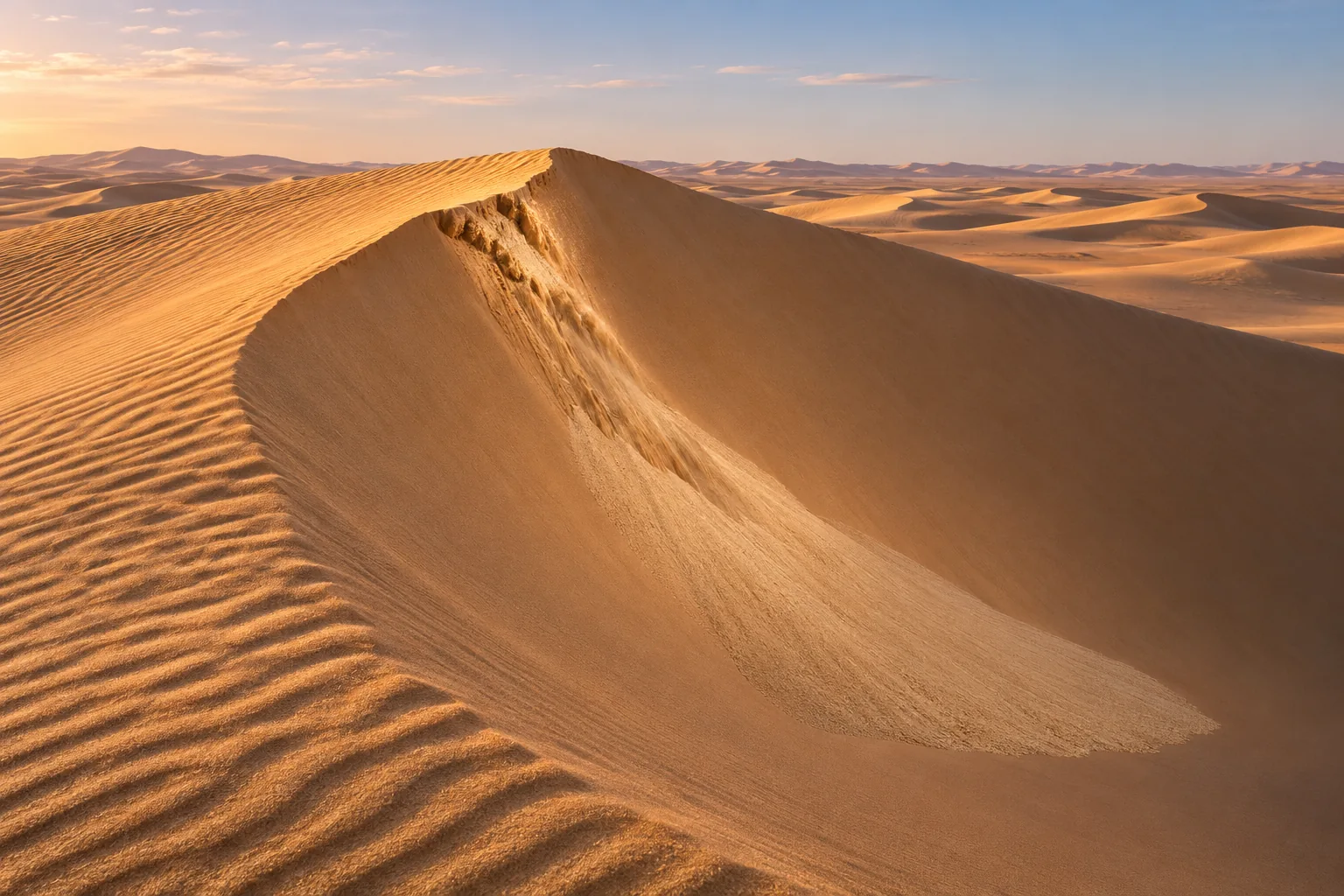
Two recordings of sliding sand can sound like different instruments. A dune near Tarfaya in Morocco produced a steady low note around 105 hertz. At Al-Askharah in Oman, avalanches could make several pitches at the same time. Researchers took sand into the laboratory and separated a sample by grain size. Changing which grains went down the slope together changed what they heard.[1, 2]
The common starting point is a moving layer of dry sand on a steep dune face. Motion among many grains can produce a vibration regular enough for a listener to hear a note. What sets that note has proved a more difficult question. Experiments have tested how grain sizes and the motion within an avalanche affect pitch. Measurements on large dunes have also implicated the structure under the sliding surface. Those studies ask which part of a complicated sound-producing system selects or strengthens a particular frequency.[1, 3, 4]
What the ear picks out of a sand slide
Knock a few loose grains onto a tray and each grain makes brief contacts at irregular times. The result tends toward a rustle. A sustained low tone has a different signature. The pressure of the air at a microphone rises and falls with a recognizable rhythm over many repetitions. A frequency of 100 hertz means roughly a hundred such cycles per second. A slide lasting two seconds could support about two hundred cycles, enough to distinguish a note from a single thump.
It is important to separate that frequency from the speed of the avalanche moving down the hillside. A dark patch on the surface might take a second to travel a visible distance. During the same second, motions inside the moving layer can repeat many times. A camera tracking the front of the slide measures one thing. A microphone recording the pitch measures another. To explain the sound, researchers have tried to connect the two observations without assuming that they are interchangeable.[1, 4]
A recording can contain several peaks even when a listener hears a single main note. Vibrations at twice or three times a fundamental frequency are its harmonics. By contrast, two peaks that move independently or that bear little relation to whole-number multiples may indicate more than one characteristic note. This matters in comparing dunes. A louder recording, a richer harmonic sound and a recording with several independent pitches are three different results.[1, 3]
What happened when the researchers sorted the sand
Near Tarfaya, researchers recorded a relatively consistent note at several positions on the slip face. The local sand contained a narrow range of grain sizes. At the Al-Askharah site the team found a broader spread of grain sizes and a more complicated sound. Geography alone could not identify the cause. Between Morocco and Oman almost everything about a field site can change, including what lies underneath the loose surface sand.[1, 2]
A laboratory slope provided a cleaner comparison. The researchers could slide collected sand in a controlled setup and record its sound away from the original dune. With a mixture of Omani grain sizes, the sound contained several frequencies. After sieving that sand to narrow the range, a more distinct single note emerged. The intervention carries more weight than a resemblance between two field photographs. The researchers changed the composition of the sample and heard a corresponding change.[1, 2]
Picture two labelled jars poured down the same laboratory incline. One contains a broad mixture, the other a selected fraction of that mixture. If they sound different, the dimensions of the distant dune cannot by themselves explain the difference between those two runs. It remains possible for the dune to modify the sound in the field. The tabletop comparison establishes something more specific. Under the conditions of the experiment, the moving sand can produce characteristic pitches away from its original setting.[1]
How can individual grains contribute to one note?
One proposed explanation starts with grains sliding in layers that move at different speeds. Neighbours continually pass and make contact. If motions in enough of the flowing material become synchronized, their small pushes can reinforce each other at a characteristic rate. Work on singing avalanches has explored that synchronization and the connection between the size of grains and how rapidly they rearrange in a flow.[1, 4]
Think of many people tapping on the same tabletop. Irregular taps can be quite loud without giving a clear beat. If a portion of the tappers falls into step, a listener can pick out their rhythm against the remaining noise. The analogy explains why coordination matters. It cannot tell you what coordinates grains, whether all of them share one rhythm or how strongly the sound reaches a listener. Those questions require measurements inside and around the flow.
What the buried part of the dune might contribute
A separate field study examined booming dunes as layered bodies through which vibrations travel. Researchers measured the subsurface and proposed that a dry surface layer bounded by regions with different wave speeds can guide waves. In their interpretation, the depth and mechanical properties of that layer favour particular frequencies. They reported field booms with a dominant audible frequency in the range of about 70 to 105 hertz, accompanied by higher harmonics.[3]
There is a practical difference between the two sorts of test. Change the grain mixture on a laboratory slope, and you can ask whether that mixture produces a given note there. Map wave speeds and layer depths beneath a field site, and you can ask whether that dune favours vibrations of a certain frequency. A microphone held above one avalanche combines the result of the moving source with the material through which the vibrations travelled. A peak on that recording alone cannot assign each part its share.[1, 3]
What to listen for in a recording
First listen for the attack. Does the noise start with a short scrape and settle into something steadier? Then listen past the loudest moment. Does one note persist while the volume fades, or can you hear different notes emerging and receding? A spectrogram makes that distinction visible by plotting frequency against time. A long narrow track indicates that a sustained pitch stayed close to one frequency even as its strength changed.[1]
The Tarfaya and Al-Askharah recordings are interesting because the answer differed from place to place, and the sieved sample let researchers intervene. An ordinary-looking handful of sand held enough of the difference to change what a laboratory avalanche sounded like. The rest of the dune still presents an acoustic question of its own, one that requires looking underneath the slope as well as listening above it.
Keep exploring
Follow how wind transports a dune over time and how a vibrating loudspeaker sets the surrounding air moving.
Sources and further reading
- Dagois-Bohy and colleagues — Singing-sand avalanches without dunes
- American Geophysical Union — Why singing sand dunes hum certain notes
- Vriend and colleagues — Solving the mystery of booming sand dunes
- Douady and colleagues — Song of the Dunes as a Self-Synchronized Instrument
Keep exploring.
One remarkable idea at a time—nature, science, history and beyond.
Last updated November 19, 2026.

Barnakle Editorial Team
Barnakle Editorial Team is the collective byline used for Barnakle’s editorial articles. The contributor profile explains the team identity and links to the publication’s editorial policies.
More from the editorial team →