Watch the musician’s right hand during a long hurdy-gurdy note. The handle may go round several times while the pitch stays in one place. Then the tune climbs through a run of notes with scarcely a change in the cranking. What controls the pitch is largely hidden in the wooden box under the player’s other hand.
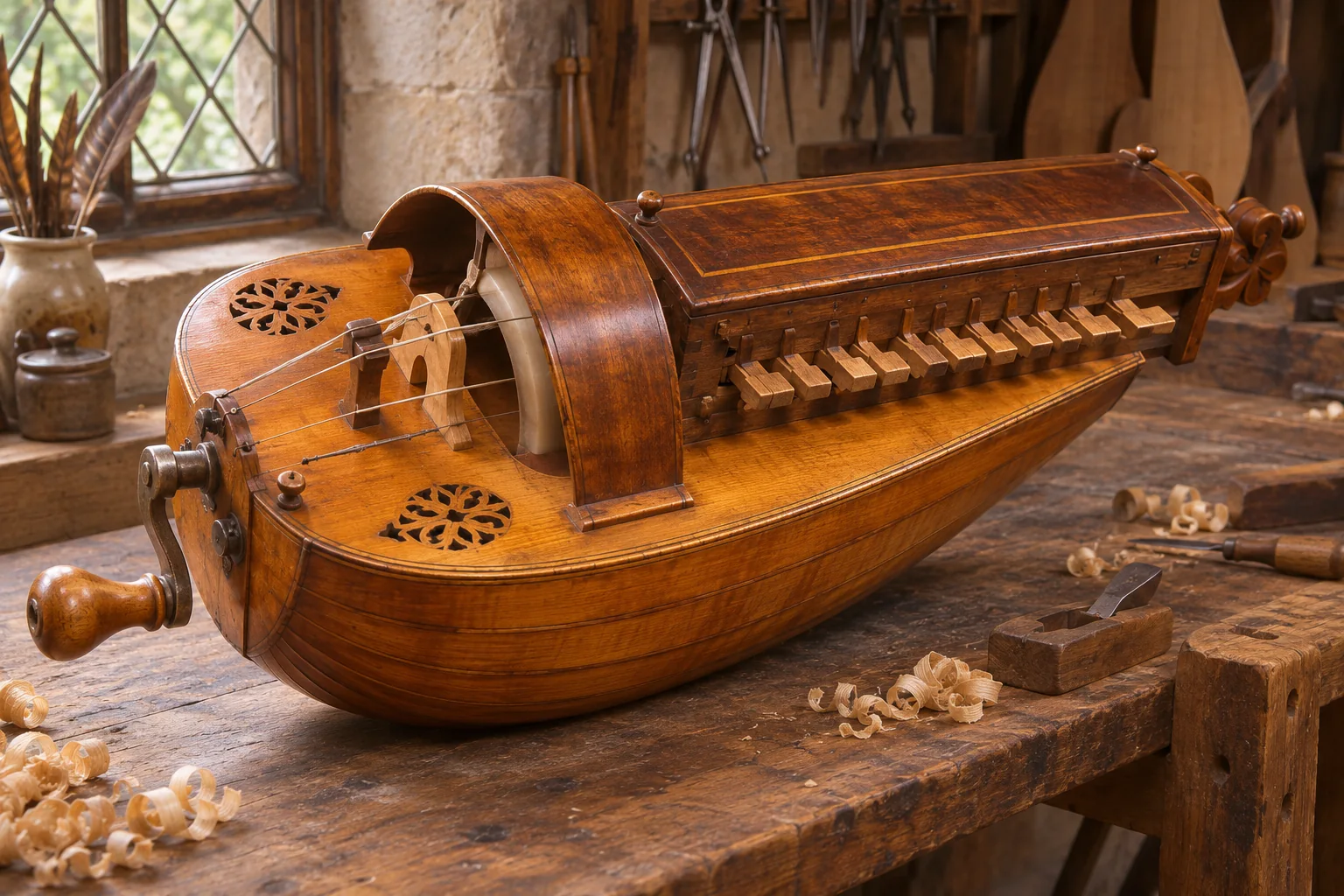
A hurdy-gurdy is a bowed string instrument. Its bow is a wheel with rosin on its rim. Turning the handle draws that rim continuously against the strings. Keys change the vibrating length of the melody strings, while other strings can keep sounding a steady drone. On instruments with a buzzing bridge, a well-timed flick of the cranking hand can add a percussive accent to both. One person can play a tune, hold its accompaniment and mark the beat.[1, 2]
A bow that never reaches its tip
Draw a conventional bow along a violin string and eventually you come to the end of the bow. The player can reverse direction almost inaudibly, or use the change to articulate a phrase. A wheel offers another possibility. At the contact point its rim always travels past the string in the same direction while the crank turns steadily. Follow one spot of rosin around the wheel and it will return. From the string’s point of view, the moving surface keeps arriving.[1]
Rosin helps a vibrating string catch on the rim, move with it briefly, then slip back. These much faster cycles are what matter to the musical pitch. One revolution of the crank is not one vibration of the string. If it were, a person attempting to sound a 220-hertz note would have to turn the handle 220 times every second. A musician can sustain an audible pitch with an easy, unhurried movement because the string sets its own much quicker rhythm.[1, 3]
This gives your ear a way into the music. Listen for a note that lasts across several visible turns of the handle. Small variations in the hand movement can change the tone or the strength of the attack. Yet the note still belongs to a recognisable place in the tune. The wheel supplies energy for as long as the musician wants the string to sing. The length, tension and mass per unit length of that string largely determine its fundamental frequency.[1, 3]
What a wooden key does to a string
A hurdy-gurdy key operates a small piece called a tangent. Press the key and the tangent meets a melody string, setting one end of the length free to vibrate towards the bridge. Another key meets the string at a different place. With the tuning otherwise unchanged, shortening the vibrating length raises the pitch. The key can look rather like a little piano key from a few feet away, but what it does inside the box is closer to a finger stopping a fiddle string.[2, 4]
There is a simple numerical example. Suppose two stretches of the same ideal string have the same tension. If the second stretch is half the length of the first, a wave takes half as long to make the round trip between its ends. The fundamental frequency doubles and the note rises an octave. For a smaller musical interval the change of length is smaller. Several precisely placed tangents can give the player a scale without a finger ever touching the vibrating part of the string.[3]
A French instrument in the Colonial Williamsburg collection makes the arrangement unusually easy to count. It has nineteen keys, each with three adjustable tangents, and three melody strings. Pressing a single key can therefore stop several strings at corresponding places. Four drone strings provide other pitches. The museum records that the strings can be brought into or out of contact with the wheel. A photograph of an instrument with seven strings is not enough to tell how many a player used for a particular tune.[2]
Where the low, steady sound comes from
The drones also meet the wheel, but the melody keys leave their sounding lengths alone. A drone can keep sounding the same pitch beneath an entire phrase. Hum one comfortable note and, while holding it in mind, imagine singing the first three notes of a familiar scale above it. The relationship changes with each successive note, even if the hum never budges. That changing interval gives a drone more musical work to do than the word “background” might suggest.[1, 4]
Listeners sometimes hear a family resemblance to bagpipes. Close your eyes and both can offer a sustained tune against fixed pitches. Open them and the distinction is plain. Air drives the sounding reeds of a bagpipe. On the hurdy-gurdy the player’s turning hand keeps supplying friction to strings. Curators at the Cleveland Museum of Art describe exactly that combination of melody and drones in their eighteenth-century French vielle à roue, literally a vielle with a wheel.[4]
The buzz a player can turn into a beat
Some instruments add a drone called the trompette over a small movable bridge called the chien. During smooth cranking the bridge can sit quietly while the string sounds. A brief acceleration can set the bridge rattling against the soundboard. A player can shape these bursts into rhythmic accents without having to stop the wheel or leave a gap in the melody. The buzz is an intended part of the instrument’s vocabulary.[1]
Once you know it is there, watch a performance twice. The first time, listen only for the low pitch that persists as the tune rises and falls. The second time, look at the cranking wrist when a crisp accent cuts through. Three different musical events become easy to separate. The row of keys explains the changing melody, the uninterrupted wheel stroke explains the sustained sound, and the little pulses of the wrist account for a rhythm you might otherwise have attributed to a second musician.
An early illustration reproduced in Case Western Reserve University’s instrument collection shows two musicians sharing a large medieval relative, the organistrum. One works the handle and the other operates the notes. On a smaller hurdy-gurdy those tasks fit under two hands of the same person. That old arrangement makes a surprisingly good listening guide. You can still hear the two jobs separately, even when one musician is doing both.[5]
Keep exploring
Follow the vibrations into the body of a violin, then compare how a piano player sets a string moving with a key.
Sources and further reading
- P. F. Dobbins, Institute of Acoustics — Introducing the hurdy-gurdy
- Colonial Williamsburg — French hurdy-gurdy with nineteen keys and adjustable tangents
- OpenStax University Physics — Standing waves on strings
- Cleveland Museum of Art — Vielle à roue by Pajot of Jánzat
- Case Western Reserve University — Medieval hurdy-gurdy and organistrum
Keep exploring.
One remarkable idea at a time—nature, science, history and beyond.
Last updated November 19, 2026.

Barnakle Editorial Team
Barnakle Editorial Team is the collective byline used for Barnakle’s editorial articles. The contributor profile explains the team identity and links to the publication’s editorial policies.
More from the editorial team →