A tiny spill reveals a moving liquid conveyor belt
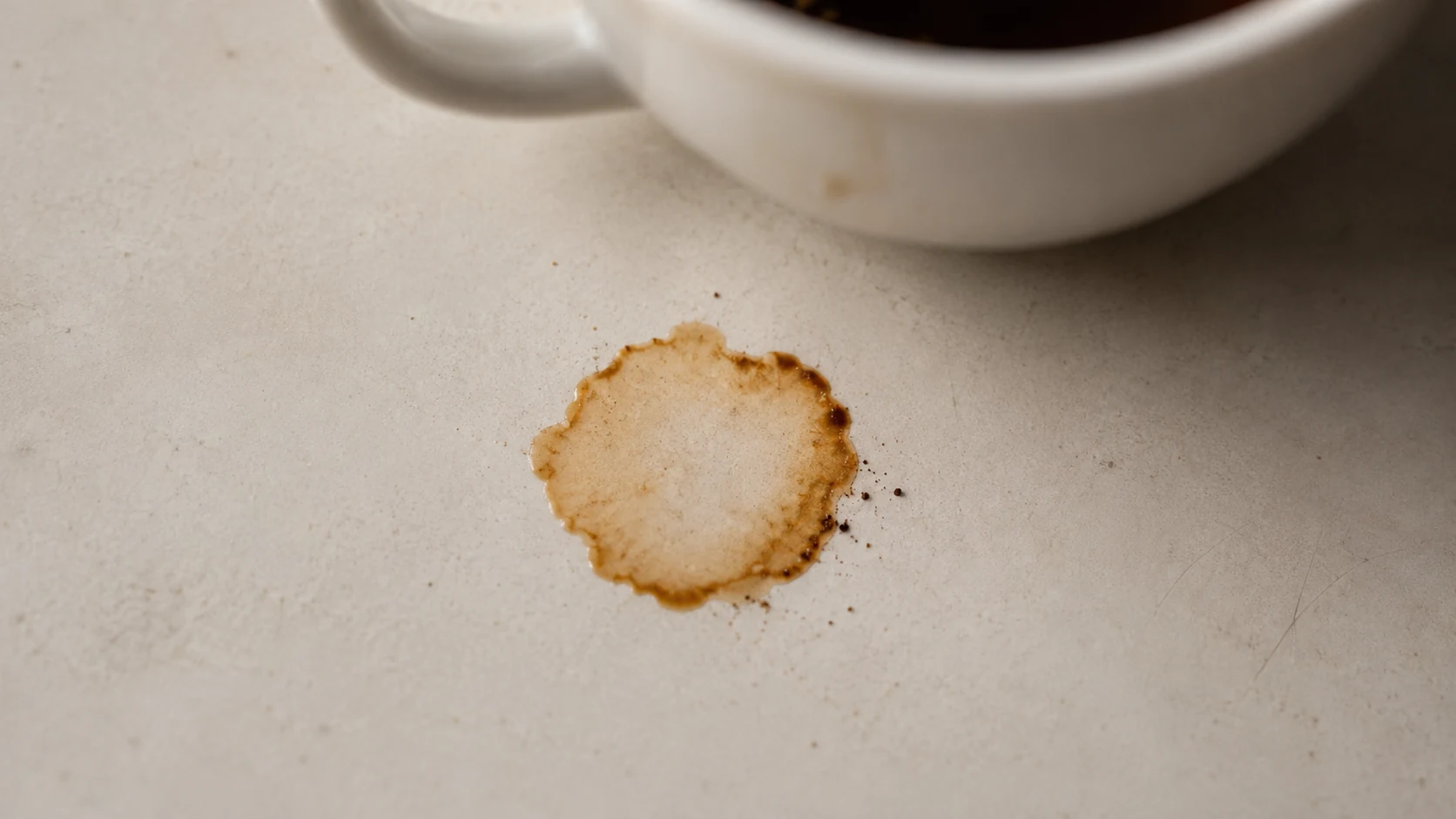
A small splash dries on a smooth table. The water disappears, but the brown material does not settle into an even miniature puddle. Much of it ends up at the perimeter, leaving a rim around a paler centre.
This is the coffee-ring effect. The name refers to the deposit left by a drying drop. A circular mark stamped onto a table by the wet base of a mug has a different immediate origin, even if evaporation later changes that mark too.
The edge can stay in place while the drop gets thinner
Where a liquid droplet, the supporting solid and the surrounding air meet is called the contact line. As the drop dries, that boundary may retreat. It may also remain temporarily stuck, or pinned, while the height and shape of the drop change.
In their foundational 1997 paper, Robert Deegan and colleagues showed how a pinned boundary and evaporation can produce an outward flow that transports suspended material towards the rim. The deposit is therefore a record of motion inside a shrinking drop, not simply a footprint of where the liquid once lay. [1]
Picture a shallow puddle whose outline remains almost unchanged while its volume decreases. That outline tells you where liquid touches the surface. It does not tell you that the liquid inside is still.
Evaporation sets the liquid moving
For the familiar thin, pinned droplet, evaporation is especially important near the edge. Liquid from farther inside moves outward to replace what is being lost there. Suspended particles can travel with this flow until they become crowded or deposited at the perimeter.
Subsequent experiments and modelling described the connection between solvent loss, the fixed boundary and the growing deposit. The explanation is not that the coffee grains are deliberately seeking the outside, or that gravity rolls all of them downhill. The flow carries material. [2]
The water and the solid residue have different destinations. Water enters the air as vapour. Much of the visible material remains on the surface. A final stain can consequently reveal where the liquid transported particles before the last water disappeared.
Pinning is an interaction, not a permanent clamp
A contact line can catch on features of the surface, and the particles in a drying drop can influence the boundary too. Deegan’s work on pattern formation examined the competition between pinning and movement of the edge, including the role of deposited material. Different histories can produce different patterns. [3]
That is why the simple picture should be read as a mechanism, not a promise that every drop must leave one perfectly circular line. A boundary can stick for a while, move and stick again. The final pattern records that changing history.
Imagine comparing a droplet on two different smooth-looking surfaces. To your eye, both may seem equally flat. To the contact line, their chemistry and small-scale irregularities can make them very different places to dry. “Smooth table” is useful everyday language, but it is not a complete experimental specification.
Other flows can compete with the outward current
A liquid’s surface tension need not be identical everywhere along its surface. Differences can drive surface motion, called Marangoni flow, with circulation inside the drop. This can redistribute particles and compete with the flow that builds an edge deposit.
Hu and Larson’s 2006 research showed that this competition matters: pinning alone is not always enough to produce the classic ring when Marangoni circulation remains strong. The useful lesson is that one drop can contain more than one transport process. [4]
For the wider surface-tension story, see why bubbles are round. The coffee stain adds a further complication: the liquid is disappearing and carrying particles as it does so.
| Condition | What it changes | Likely significance |
|---|---|---|
| Pinned edge | The boundary remains in place as liquid is lost | Can support transport towards the rim |
| Moving edge | The wet footprint contracts or changes | Can change where material accumulates |
| Surface-tension gradients | Circulation within the liquid | Can compete with edge-directed transport |
| Different particle shapes | How particles interact near the surface | Can alter the final distribution |
| Absorbent support | Liquid enters the material as well as evaporating | Introduces another route for flow |
Particle shape can change the outcome
In 2011, researchers tested drying suspensions containing particles of different shapes. Elongated particles interacted differently at the liquid surface from spherical ones and could produce much more uniform deposits under the studied conditions. The research showed that particle shape can matter alongside the behaviour of the liquid. [5]
The University of Pennsylvania’s account of the team’s work describes elongated particles forming loose structures at the interface. That arrangement changes how material is transported and deposited as the drop dries. [6]
This is an experimental result about particular suspensions. It does not establish a household rule that adding any long, thin ingredient to coffee will erase a stain. Real drinks contain multiple substances, and a useful industrial formulation needs more control than a kitchen analogy supplies.
Why paper is a different experiment
A tabletop and a paper towel give the liquid different escape routes. On an absorbent material, liquid can enter pores as well as evaporate into the air. Research on coffee stains on porous surfaces examines how this additional process changes particle transport and deposition. [7]
This means a spreading brown patch on paper does not disprove the pinned-droplet explanation for a hard surface. It asks a different question. The support is now participating in the movement of the liquid rather than merely holding it up.
A useful comparison is a shallow dish versus a sponge. Neither analogy captures all the microscopic details, but it keeps the pathways separate: evaporation removes liquid into the air; absorption moves it into the supporting material.
A simple observation that separates the questions
If you already have a little cooled black coffee, place a small drop on a washable, nonporous plate and let it dry undisturbed. Observe the wet outline from above at intervals. The question is whether the boundary stays roughly in place while the interior becomes thinner.
For comparison, put a similar drop on plain absorbent paper. Look for spreading into the material. Keep the observations descriptive: note the support, the approximate drop size and whether the liquid had visible sediment. Do not expect a home comparison to isolate every variable.
The final marks can suggest which processes deserve attention. They do not measure the internal flow speed or prove that only one mechanism operated. This is a way to notice a phenomenon, rather than a substitute for the controlled measurements in the research papers.
Why a coffee stain matters to printing and coatings
Many technologies deposit small volumes of liquid containing useful material. If drying concentrates that material at the edges, a supposedly uniform dot or film can end up with an uneven distribution. The Penn researchers connected their particle-shape work to the challenge of controlling such deposits. [6]
The engineering target is not always to eliminate every ring. It is to control where material ends up for a particular purpose. A visible coffee mark is a familiar entry point into that wider problem: liquid placement and final solid placement are not necessarily the same thing.
Frequently asked questions
Is the effect unique to coffee?
No. Coffee gives it a memorable name, but the mechanism concerns drying droplets carrying particles. The cited studies also use controlled suspensions to investigate transport and deposition. [2]
Why is the middle often lighter?
Outward flow can move suspended material away from the interior and concentrate it near the boundary. The exact contrast depends on the drop and surface, so a pale centre is a familiar outcome rather than a required one. [1]
Does every drying droplet leave a ring?
No. Edge motion, competing circulation, particle interactions and absorption can change the pattern. A missing ring is a reason to investigate the conditions, not to assume evaporation stopped working.
Can soap change a coffee stain?
Changing a liquid’s composition can alter its surface behaviour, but there is no universal promise that a household addition will produce a uniform deposit. Surfactants and surface-tension effects need to be considered in the context of the particular liquid and support. [4]
Keep exploring
Sources and further reading
Research and institutional references checked on November 7, 2026. Journal abstracts and public research summaries are distinguished from full-text papers in the references where applicable.
- Deegan et al., Nature (1997) — Capillary flow as the cause of ring stains from dried liquid drops
- Deegan et al., Physical Review E (2000) — Contact line deposits in an evaporating drop (PubMed abstract)
- Deegan, Physical Review E (2000) — Pattern formation in drying drops
- Hu and Larson, Journal of Physical Chemistry B (2006) — Marangoni effect reverses coffee-ring depositions (PubMed abstract)
- Yunker et al., Nature (2011) — Suppression of the coffee-ring effect by shape-dependent capillary interactions
- University of Pennsylvania — Penn Physicists Undo the Coffee Ring Effect
- Physical Review E (2012) — Formation of coffee stains on porous surfaces (PubMed abstract)
Keep exploring.
One remarkable idea at a time—nature, science, history and beyond.
Last updated November 8, 2026.

Barnakle Editorial Team
Barnakle Editorial Team is the collective byline used for Barnakle’s editorial articles. The contributor profile explains the team identity and links to the publication’s editorial policies.
More from the editorial team →