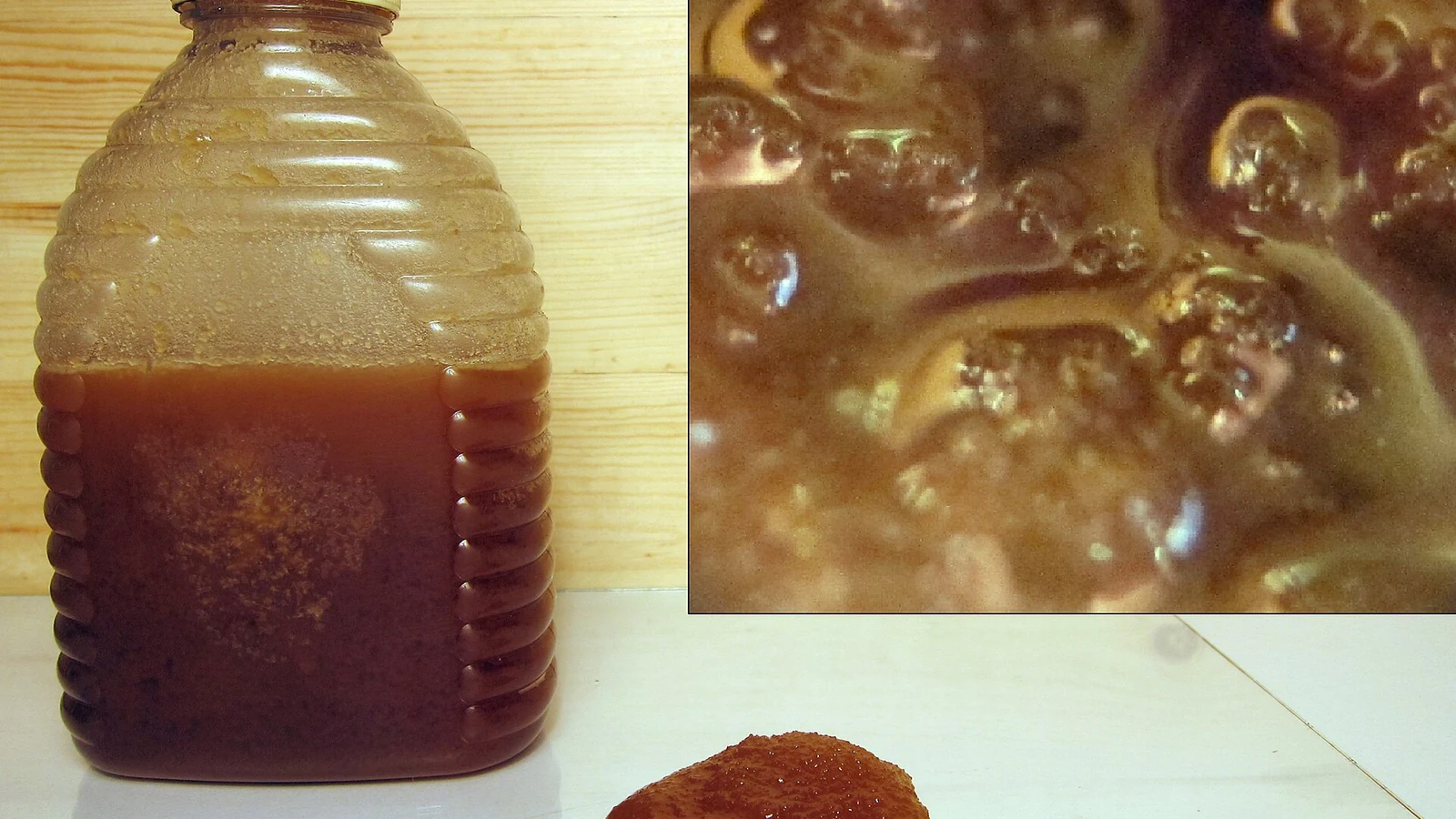
A supersaturated sugar solution naturally reorganizes into solid glucose crystals
A clear jar of honey can turn cloudy and eventually hold its shape on a spoon. The bees' work has not been reversed, and the jar has not necessarily spoiled. Much of what you are seeing is glucose leaving a concentrated solution and arranging itself into crystals. The texture is a record of the honey's composition and storage history.
Why honey can stay liquid while ready to crystallize
Bees reduce nectar water content and add enzymes, producing a mixture dominated by fructose and glucose with smaller quantities of water, acids, minerals, proteins and aromatic compounds.
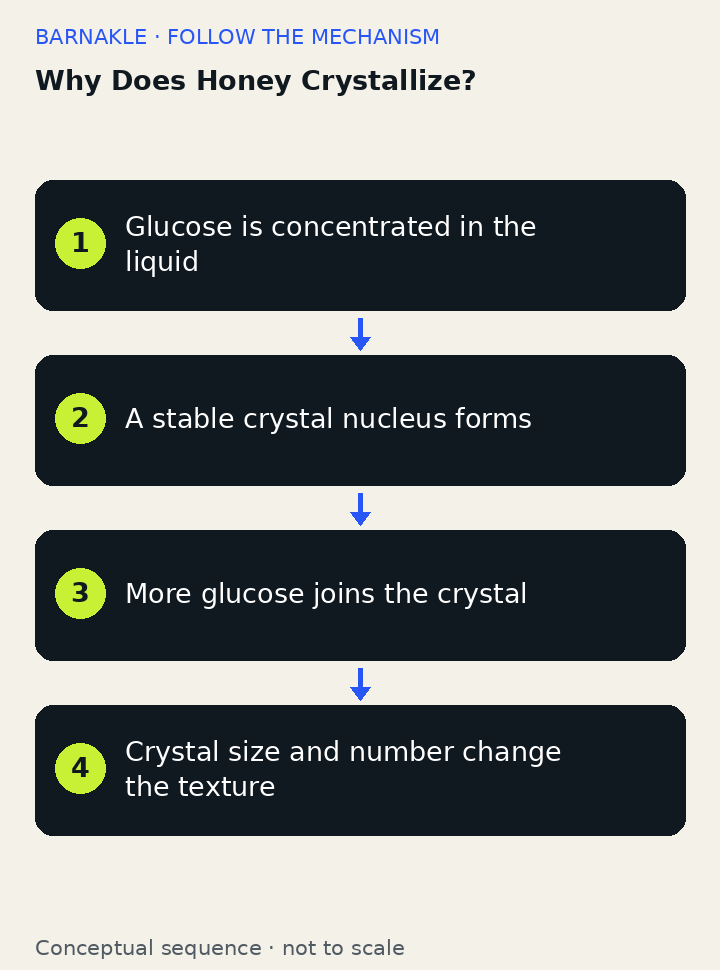
At storage temperature, honey can contain more glucose than would remain dissolved in an ordinary equilibrium solution. The viscous liquid can persist temporarily because crystal formation needs a starting event and molecular rearrangement.
Glucose has lower solubility in honey water than fructose. Honeys relatively rich in glucose therefore tend to crystallize sooner, while high-fructose varieties can remain fluid for longer under comparable conditions.
Supersaturation describes a liquid containing more dissolved material than would remain in solution at equilibrium under the same conditions. It does not mean that the jar must crystallize immediately. The transition still requires an ordered nucleus to form and molecules to reach it. Honey's viscosity helps make that delay observable on a kitchen shelf.
Sources: [1]
How the first crystals begin to grow
Pollen, wax fragments, dust, air bubbles or microscopic glucose crystals can reduce the energetic barrier to an ordered crystal lattice. Fine filtration removes some nuclei and may delay visible crystallization without changing the basic chemistry.
Once a nucleus is stable, additional glucose molecules attach in an ordered pattern. Water and most fructose remain in the surrounding liquid, so the jar develops a mixture of solid crystals and concentrated syrup.
Once a viable nucleus exists, it provides a template for further growth. Glucose molecules join the solid while the remaining liquid changes composition. A jar can therefore contain crystals and syrup together. The apparent whitening comes partly from light interacting with many small crystals rather than a new white ingredient being added.
Composition and temperature set the pace
Warmth increases solubility and motion, while very low temperature slows molecular rearrangement. Intermediate cool storage can favour nucleation and growth, although the exact rate depends on composition and prior crystal seeds.
Plants produce nectars with different sugar ratios and minor components. As a result, canola honey may crystallize quickly while some acacia-type honeys remain liquid much longer. Colour alone cannot predict the rate reliably.
Heating increases glucose solubility and can return crystals to solution. Excessive or repeated heat may alter aroma, colour and heat-sensitive components, so food-safety and producer guidance should be followed.
Temperature has competing effects: it changes solubility and also changes how readily molecules move through the viscous liquid. That is why the rule 'colder always means slower crystallization' is unreliable. Two honeys stored side by side can also behave differently because their sugar ratios, water contents and populations of nuclei are different.
Texture is not a purity or safety test
Many small crystals create smooth creamed honey; fewer large crystals feel coarse or gritty. Producers seed honey with fine crystals and control temperature to guide crystallization into a consistent spreadable texture.
A deliberately fine crystalline structure can produce smooth creamed honey. Large crystals can instead feel gritty. Neither texture establishes authenticity on its own. Crystallization and fermentation are different processes, and food safety requires more than a visual judgement about grains. As glucose crystallizes, the remaining liquid can become relatively richer in water, which can favour fermentation when other conditions permit. A partly crystallized jar therefore still needs appropriate storage. Honey should never be given to children younger than 12 months, regardless of texture.
Why two jars can crystallize at different rates
Two jars may look equally clear when purchased. One later develops a fine cloudy texture while the other stays fluid. That observation is compatible with differences in floral source and glucose-to-water balance; it does not demonstrate that either jar is fake. To test authenticity, laboratories need evidence beyond whether crystals appear on a consumer's preferred schedule.
Crystallization, fermentation and authenticity
| Term or component | What it means here |
|---|---|
| Crystallization | Glucose forms an ordered solid phase. |
| Fermentation | Microorganisms change the food chemically. |
| Authenticity testing | Requires more evidence than the presence or absence of crystals. |
Crystals alone do not prove purity or spoilage
Crystallized honey is not automatically adulterated, spoiled or unsafe. Fermentation is a different process associated with sufficient available water and yeast activity, often accompanied by foaming, pressure or off odours. Crystallization can occur in authentic honey and does not prove purity by itself.
How honey crystallization is measured
Food scientists measure water content, water activity, glucose and fructose ratios, viscosity, crystal size and thermal transitions. Microscopy reveals nucleation and growth, while controlled storage experiments compare temperature, filtration and floral origin.
Honey crystallization questions
Can crystallized honey be eaten?
Crystallization alone is normally a texture change, provided the honey was stored properly and shows no signs of fermentation or contamination. Honey in any form must not be given to infants younger than 12 months.
Can it be made liquid again?
Gentle, controlled warming can dissolve crystals; follow packaging guidance and avoid overheating.
Does refrigeration prevent crystals?
Not necessarily. Cool conditions can promote crystallization, though very low temperatures slow molecular movement.
Texture records crystallization, not a purity verdict
Honey is a useful reminder that a familiar food can be a changing physical system. Its crystals reveal nucleation and growth in a concentrated sugar mixture. Treat texture, spoilage and authenticity as separate questions, and use the producer's handling advice rather than overheating a jar in pursuit of permanent clarity.
Continue exploring
Sources and further reading
Keep exploring.
One remarkable idea at a time—nature, science, history and beyond.
Last updated November 6, 2026.

Barnakle Editorial Team
Barnakle Editorial Team is the collective byline used for Barnakle’s editorial articles. The contributor profile explains the team identity and links to the publication’s editorial policies.
More from the editorial team →