
Whales evolved from four-legged mammals in South Asia roughly 50 million years ago. Fossils record increasingly aquatic bodies, while anatomy and DNA place cetaceans among even-toed hoofed mammals, with hippos as their closest living relatives—not their ancestors.
- No single fossil “turned into” a whale; branching populations accumulated changes across millions of years.
- Specialized ear bones, ankle fossils, oxygen isotopes and limb anatomy reveal how early whales lived.
- Modern whales retain mammalian traits: lungs, warm blood, milk and a land-mammal skeletal inheritance.
- Baleen whales and toothed whales later followed different feeding and sensory paths.
The impossible-looking animal that is not impossible
A blue whale seems built from a different plan than any land mammal. Its forelimbs are flippers, its hind limbs are hidden remnants, its nostrils open on top of the head and its tail moves vertically. Yet it breathes air, nurses its young and carries the same basic forelimb bones found in a human arm, a bat wing and a cat leg.
Evolution did not aim a land animal toward the ocean. Populations living near water encountered opportunities and pressures. Variations that improved feeding, swimming, hearing or reproduction could spread. Across many generations, a shoreline mammal lineage became increasingly aquatic.
Pakicetus and the first cetacean clues
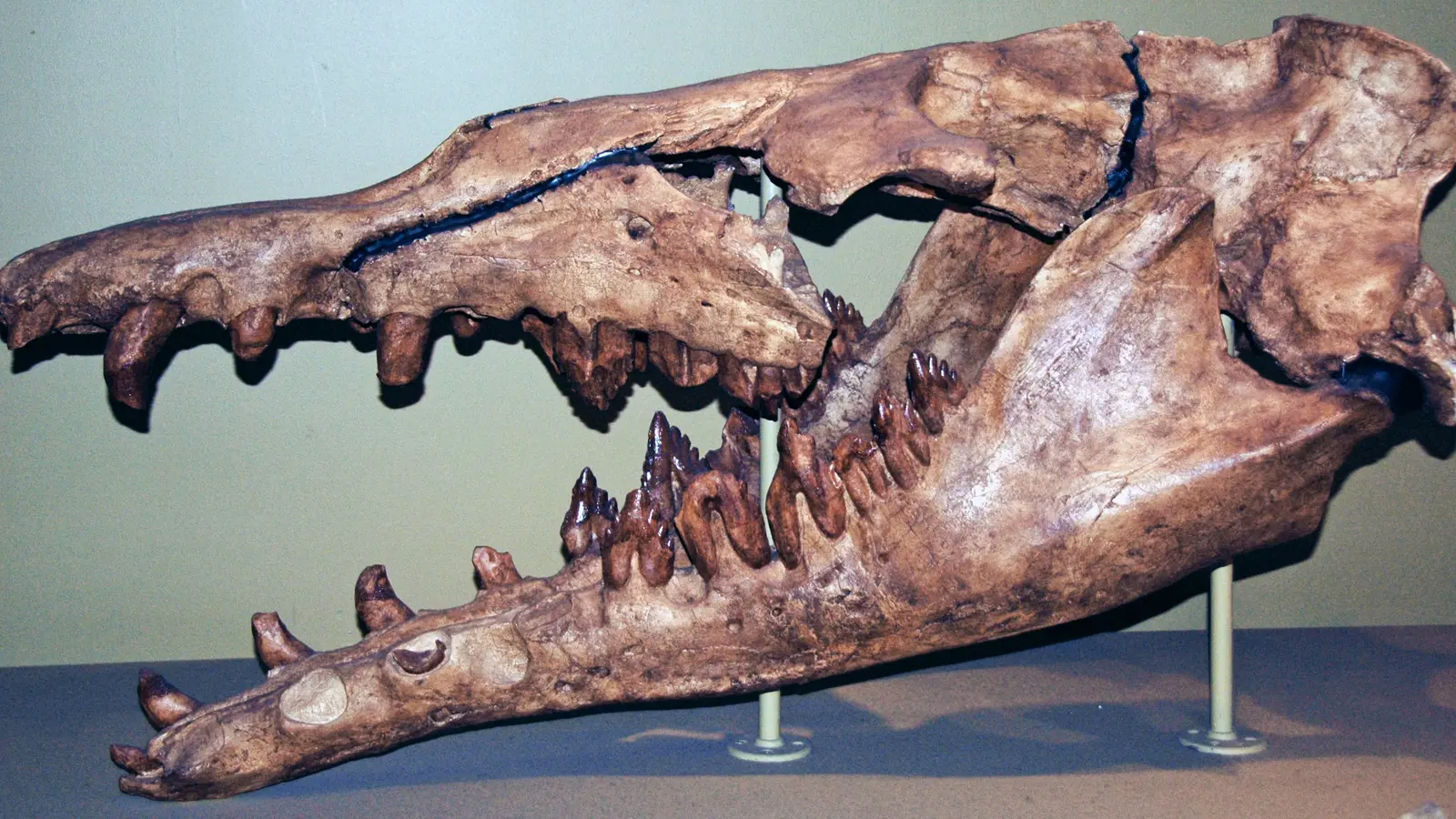
Pakicetids lived about 50 million years ago in what is now Pakistan and India. Their bodies were capable of walking, and popular reconstructions can look dog-like. The decisive evidence is not resemblance. Features of the ear region link them to cetaceans, while teeth and limb bones reveal a terrestrial animal associated with river or coastal environments.
Calling Pakicetus “the first whale” can create a false picture of a modern whale on legs. It was an early branch near the base of cetacean evolution. Its importance is anatomical: a combination of traits that connects later aquatic whales with terrestrial artiodactyl relatives.
An ankle bone changed the family tree
For years, researchers debated which living mammals were closest to whales. Molecular evidence connected cetaceans with even-toed ungulates. Fossils then supplied a striking anatomical link: early whales possessed a distinctive double-pulley ankle bone associated with artiodactyls.
Hippos are the closest living relatives of whales, but whales did not evolve from modern hippos. Both descend from an older shared ancestor. This distinction—closest living relative versus ancestor—is essential when reading evolutionary trees.
From wading to powerful swimming
Ambulocetids had robust limbs and could move on land, but their bodies also show adaptations for swimming. Later protocetids became more committed to water and spread through marine environments. Pelvic connections weakened, hind limbs became less useful for supporting weight and the spine contributed more to propulsion.
By the time of basilosaurids such as Dorudon, whales were fully aquatic. Their tiny hind limbs could not carry them ashore. Tail-driven swimming and flipper-like forelimbs were established, while birth and nursing had to occur in water.
How scientists know where an animal lived
Bone shape is only one line of evidence. Oxygen isotopes in fossil teeth can reflect the water an animal encountered while its teeth formed. Sediments and associated fossils reveal whether remains accumulated in river, estuary or marine settings. Wear patterns and stable isotopes can inform diet.
Each method has limits. A skeleton may be incomplete; a carcass can move after death; chemical signals can be altered. Confidence grows when independent evidence points toward the same ecological transition.
Moving the nose and rebuilding the ear
Across whale fossils, the nasal opening shifts backward along the skull toward the blowhole position. The change involved skull telescoping and rearrangement rather than a nose simply sliding across an unchanged head. Underwater hearing also demanded major changes because sound behaves differently in water and air.
Toothed whales eventually evolved echolocation systems involving specialized sound production and reception. Baleen whales developed plates for filtering prey and, in some lineages, enormous body sizes. These later radiations came after the original land-to-sea transition.
The legs did not simply disappear
Modern whales usually retain small pelvic bones inside the body. These structures are reduced relative to walking ancestors but are not necessarily useless; they anchor muscles associated with reproduction. Rare developmental variations can produce external hind-limb structures, offering clues about suppressed developmental pathways.
Evolution modifies inherited systems. A flipper still contains an upper arm bone, two forearm bones, wrist elements and digits. The arrangement is remodeled for steering in water, preserving history inside a new function.
Why this transition matters
The whale record is unusually rich because changing bodies were often preserved in sedimentary environments. It demonstrates how fossils, living anatomy, development, geology and genetics can test the same historical explanation.
The story is not a ladder from primitive to advanced. Early forms were successful animals in their own environments, and many branches ended without descendants. Modern whales occupy surviving twigs of a much larger tree—and their present conservation depends on oceans transformed far faster than their bodies can evolve.
Sources and further reading
Keep exploring.
One remarkable idea at a time—nature, science, history and beyond.
Sources and further reading
Barnakle uses credible primary and authoritative sources wherever possible.
- Smithsonian NMNH; Smithsonian Ocean; Thewissen et al.; NOAA
Last reviewed September 17, 2026.

Barnakle Editorial Team
A member of the Barnakle editorial team, exploring remarkable ideas with clarity, curiosity and care.
More from this author →