
Multiple outer-solar-system moons have evidence for oceans beneath ice. Europa and Enceladus are leading targets because liquid water, chemical ingredients and energy may coexist. An ocean can be potentially habitable without evidence that it is inhabited.
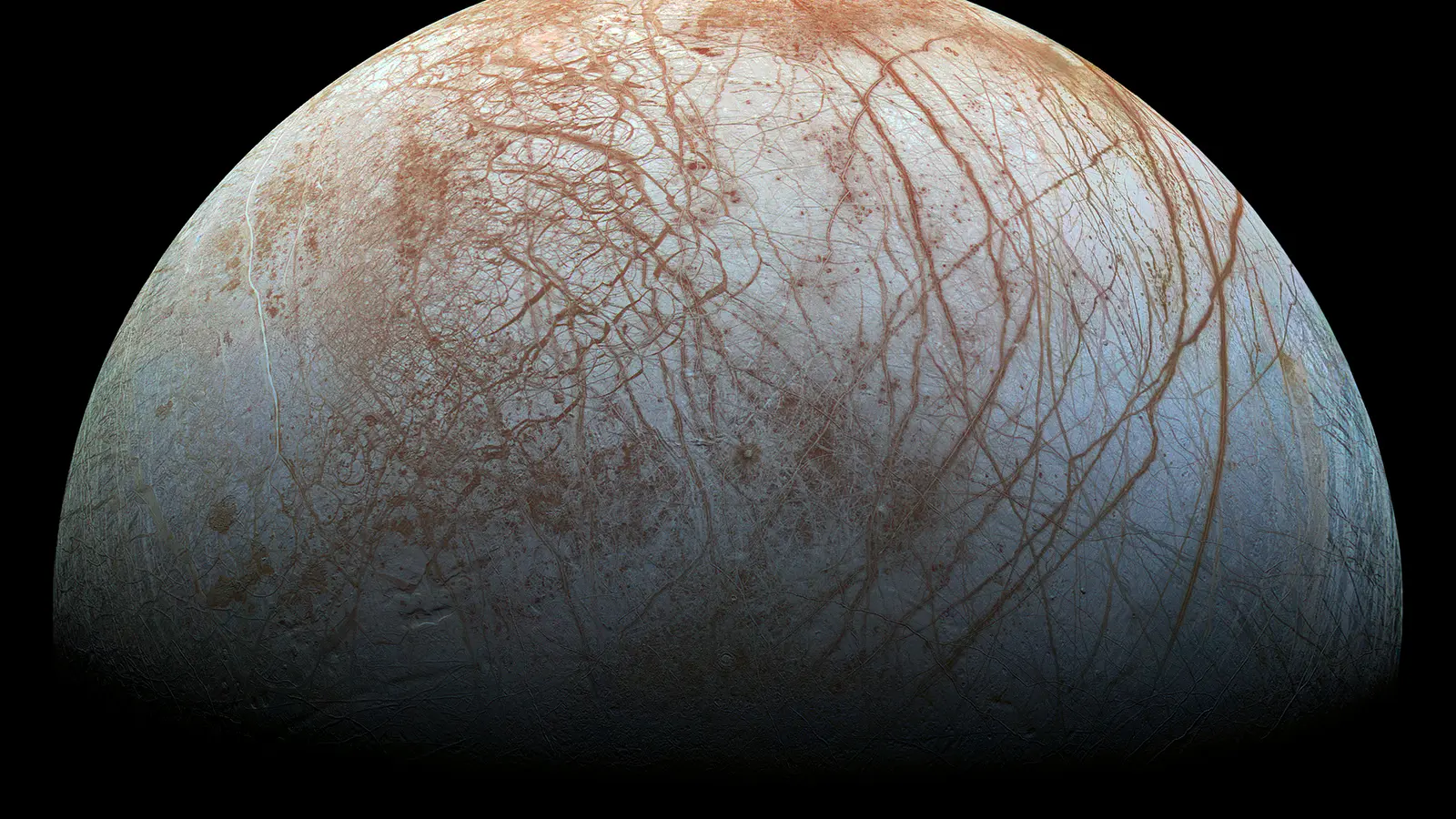
- Europa’s induced magnetic signal, geology and tidal behavior support a salty subsurface ocean.
- Cassini sampled material escaping Enceladus and detected water, salts, organics and products consistent with hydrothermal activity.
- Ganymede, Callisto and Titan also hold deep water layers, though accessibility and chemistry differ.
- Missions search for habitability and evidence—not a predetermined discovery of life.
An ocean without a sky
On Europa, the “surface of the ocean” may be sealed beneath kilometers of ice. On Enceladus, a smaller moon of Saturn, fractures near the south pole spray ocean-derived material into space. These worlds overturn the familiar rule that liquid water needs sunlight and a mild surface.
The heat can come from inside. Repeated gravitational flexing changes a moon’s shape as it travels through its orbit. Friction and deformation dissipate energy. Radioactive decay and the history of formation can contribute additional warmth.
Europa’s magnetic clue
NASA’s Galileo spacecraft detected a changing magnetic response near Europa. A globally connected, electrically conductive layer offers the best explanation, and salty liquid water is a strong candidate. Surface fractures, ridges and disrupted terrains also suggest an active ice shell interacting with material below.
Scientists combine magnetic measurements, gravity, imaging and thermal models. None alone functions as a direct photograph of the ocean. Their agreement makes the case powerful while leaving the ice thickness, ocean depth and local structure open.
Why Jupiter both helps and harms
Jupiter’s gravity flexes Europa and can help maintain internal heat. Jupiter’s magnetic environment also bombards the surface with radiation, altering surface compounds and creating hazards for spacecraft. Material transported between surface and ocean could carry useful chemistry in either direction.
Europa Clipper is designed to make repeated flybys rather than orbit Europa itself. Its instruments will examine ice, composition, gravity, magnetic response and possible active regions while limiting time in the harshest radiation zones.
Enceladus brings the ocean to the spacecraft
Cassini flew through plumes emerging from fractures nicknamed tiger stripes. Instruments detected water vapor, ice grains, salts, organic compounds and silica particles. The silica evidence is consistent with warm water interacting with rock on the seafloor, while molecular hydrogen provides a possible chemical energy source.
This is one reason Enceladus is so compelling: a spacecraft can sample ocean-related material without drilling through the shell. But plume material may be processed during transport, and detecting organics is not the same as detecting biology.
Titan, Ganymede and Callisto
Titan has a dense atmosphere and hydrocarbon lakes on its surface, plus evidence for a deep water ocean below. Ganymede likely contains a complex stack of ice and liquid layers and generates its own magnetic field. Callisto’s magnetic response also supports a conductive subsurface layer.
These oceans are not interchangeable. Pressure, salts, rock contact, temperature and energy sources shape habitability. An ocean trapped between high-pressure ice layers may have less direct interaction with a rocky seafloor than one resting on rock.
What life would need
Liquid water is only the beginning. Life as we know it requires usable energy and chemical building blocks, sustained under conditions that permit complex reactions. Rock-water interaction could produce chemical gradients. Surface oxidants delivered downward might expand the available energy.
Scientists therefore look for a system: water, chemistry, energy, stability and exchange. A single organic molecule is not a biosignature by itself because nonliving chemistry also produces organics.
How to explore through ice
Radar can probe structures within an ice shell. Magnetometers test conductive layers. Gravity measurements reveal mass distribution. Spectrometers identify surface and plume chemistry. Cameras map young terrain and change. Future landers or cryobots would face contamination control, communication and immense engineering challenges.
Planetary protection matters in both directions. Spacecraft should not carry Earth microbes into an environment that might preserve its own record, and samples returned to Earth would require careful containment and assessment.
A new map of where oceans belong
Earth’s oceans are exposed to sunlight, wind and atmosphere. Icy-moon oceans are dark, enclosed and maintained by internal energy. They may collectively contain more liquid water than Earth, expanding the possible settings in which habitable environments can persist.
The discovery is already profound even if every ocean proves sterile. It shows that worlds can remain geologically and chemically active far from the Sun, and that the search for life is increasingly a search beneath surfaces.
Sources and further reading
Keep exploring.
One remarkable idea at a time—nature, science, history and beyond.
Sources and further reading
Barnakle uses credible primary and authoritative sources wherever possible.
- NASA Ocean Worlds; Europa Clipper; Ocean Worlds Roadmap; JPL
Last reviewed September 17, 2026.

Barnakle Editorial Team
A member of the Barnakle editorial team, exploring remarkable ideas with clarity, curiosity and care.
More from this author →