A fast vibration becomes a readable measure of elapsed time
The hand on a simple quartz watch may move just once a second. Inside the case, its timing reference is repeating thousands of times faster. The visible tick is the last stage of a chain, rather than the crystal physically nudging the hand once per second.
That chain separates three jobs: supplying energy, establishing a rhythm and showing the accumulated count. Understanding the distinction explains why a watch needs a battery even though quartz is piezoelectric, and why a digital watch can use the same timing principle as one with hands.
Follow the mechanism
- Stored electrical energy powers an oscillator circuit.
- A shaped quartz resonator provides a repeatable vibration.
- Electronic dividers turn the fast rhythm into useful timing intervals.
- Counters and a display system show the accumulated time.
The crystal is a resonator, not a miniature battery
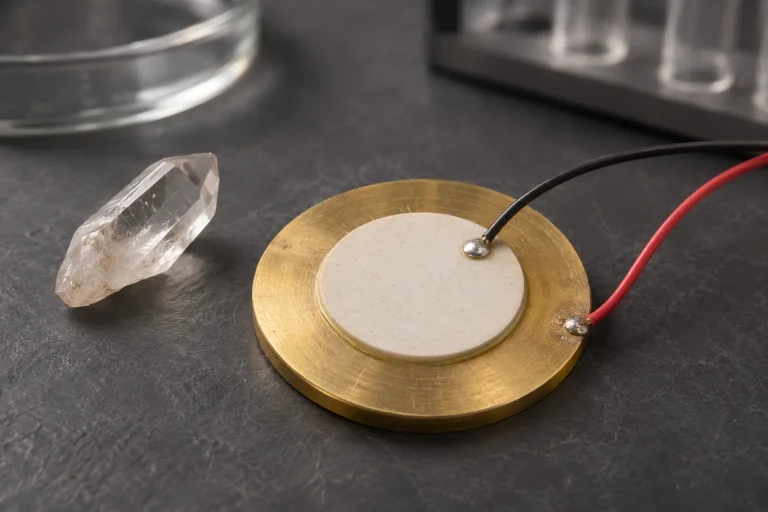
Quartz is piezoelectric: mechanical deformation and electrical effects are coupled in the material. Suitable electrical excitation can produce mechanical motion, and mechanical motion can produce an electrical signal. A carefully shaped piece therefore lets a circuit interact with a repeatable vibration.
This does not make quartz a continuous source of free energy. A resonator loses energy, just as a ringing tuning fork eventually quiets. The powered circuit sustains the oscillation. The crystal helps determine the rhythm; the energy supply keeps the system operating.
Seiko Instruments distinguishes a crystal resonator from an oscillator that combines a resonator with an oscillation circuit. That distinction prevents a common shortcut in explanations: the crystal alone is not the complete electronic clock. The useful object is the connected system.
Why 32,768 is such a useful number
NIST identifies 32,768 hertz as a usual quartz-watch reference frequency. A hertz is one cycle per second. The number is useful because 32,768 is exactly 2 to the power of 15.
A sequence of fifteen divide-by-two stages turns 32,768 into 16,384, then 8,192 and eventually 1. The resulting one-hertz signal repeats once per second. The divider does not slow the crystal itself; it produces a slower electrical signal by counting the faster one.
Think of a person marking every fourth beat of a metronome. The metronome continues at its original pace, while the marks follow a slower pattern. The watch performs an electronic version of this counting task, with far more cycles and a much smaller circuit. The analogy describes frequency division, not the internal design of a particular chip.
How the count becomes moving hands or changing digits
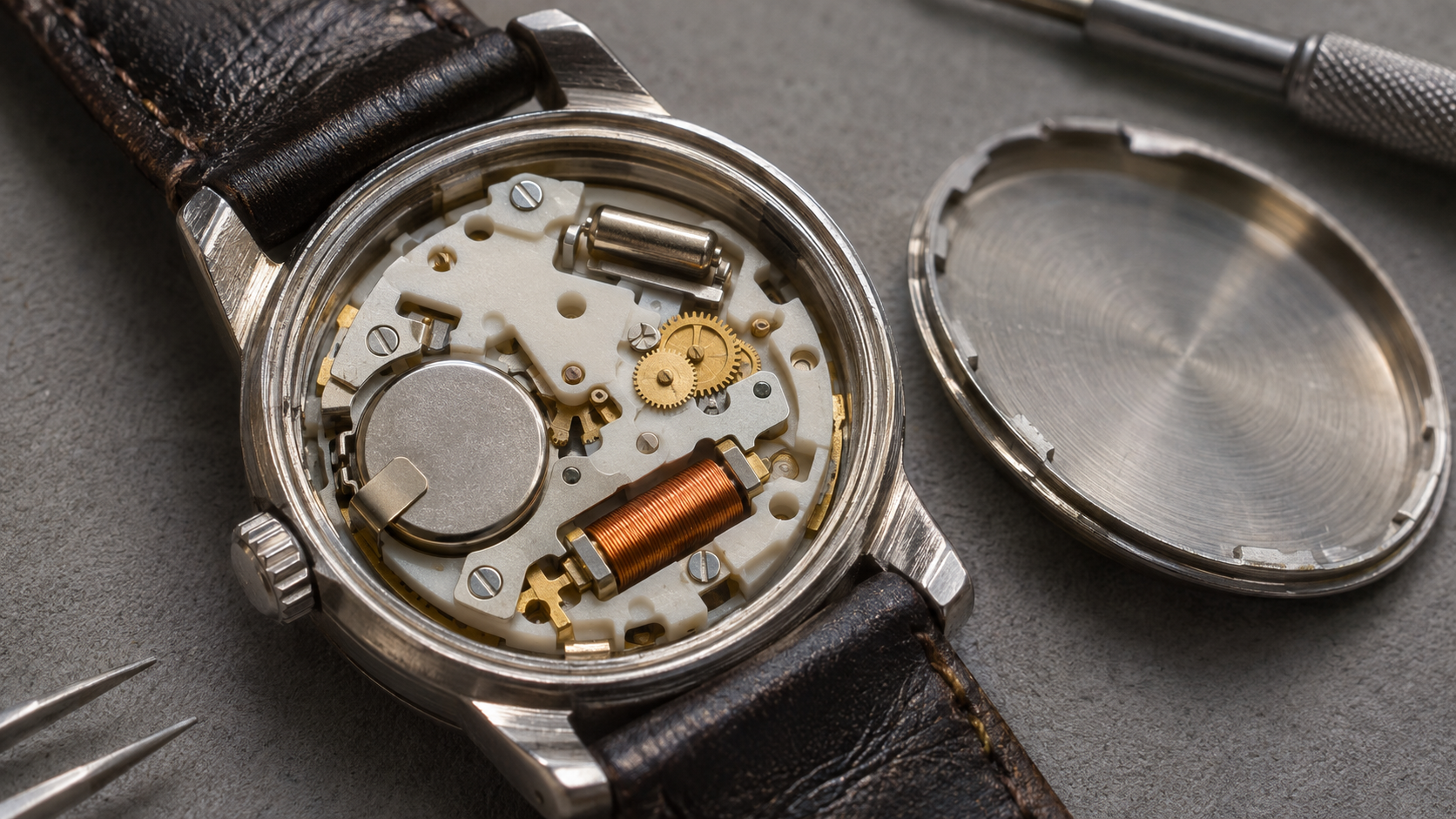
In an analogue quartz movement, a drive circuit can send pulses to a small stepping motor. A gear train transfers that motion to the hands. Seiko’s account of its quartz-watch development identifies the tuning-fork-shaped crystal, integrated circuit and step motor as separate technologies that had to fit inside a wristwatch.
A digital display takes another route. The switching circuitry relies on electronic components such as transistors. Electronic counters and display-driving circuitry select the visible digits. The Seiko Calibre 0124A technical manual provides a concrete example: it describes oscillator, divider and decoding or driving blocks connected to a liquid-crystal panel.
Neither display type defines the timing reference. Hands do not prove that a watch is mechanical, and digits do not prove that its time is being received from a remote clock. To understand a timepiece, ask both what provides its rhythm and how it presents the result.
| Part or idea | What it does | Common misunderstanding |
|---|---|---|
| Energy supply | Powers the circuitry and display or motor. | The crystal supplies unlimited energy. |
| Quartz resonator | Provides a frequency-selective mechanical reference. | It moves the second hand directly. |
| Divider and counter | Convert cycles into intervals and accumulated time. | Division repairs an inaccurate reference. |
| Display mechanism | Shows the count with digits or hands. | Every quartz watch must tick once per second. |
An exact divider does not make an imperfect rhythm exact
Suppose an imaginary reference produces 32,768.32768 cycles in a true second. That is ten parts per million faster than the intended 32,768. Dividing it by 32,768 gives 1.00001 timing cycles per true second. The fractional error is still ten parts per million.
Over 86,400 true seconds, that simple rate error accumulates to 0.864 seconds. This is a worked example using invented values, not a specification for a watch. It shows why counting more cleanly cannot remove a systematic error in the rhythm being counted.
The distinction is useful when comparing accuracy claims. A circuit can divide by an exact integer while its physical reference remains affected by operating conditions. Accurate timekeeping requires attention to the reference and its behaviour, as well as the counting logic.
Why temperature and ageing still matter
A quartz resonator is a physical object. Its frequency depends on its cut, dimensions and environment, rather than on the label “quartz” alone. NIST’s history of quartz clocks describes temperature sensitivity and ageing among the limits to their accuracy.
Some oscillator systems compensate for temperature. Seiko Instruments lists temperature-compensated oscillators that combine a temperature sensor and stored compensation information. Such a product is evidence of a design approach, not proof that every inexpensive wristwatch contains the same correction system.
This is why a single accuracy figure should not be applied to all quartz watches. A model’s specification, its stated conditions and the period over which error is measured belong together. A second per day and a second per month describe very different performance, even though both figures contain the word “second”.
Keeping a steady rate differs from knowing the correct time
Imagine two otherwise ideal watches that run at exactly the same rate. Set one five minutes late and leave the other correctly set. Their rate performance can be identical while their displayed times remain five minutes apart.
This thought experiment separates a frequency reference from a time setting. Counting cycles tells a device how much time has elapsed from a starting point. It does not, by itself, supply the date or the local time zone.
The difference also explains what to record when checking your own watch. Note the initial offset against a reference, then compare again after a known interval. The change in offset tells you more about rate than a single glance does. A casual observation is useful for noticing drift, but it is not a calibrated laboratory measurement.
Questions readers ask
Does quartz vibrate only once each second?
Usually the opposite: a common reference oscillates 32,768 times per second. Electronic division creates a slower signal suitable for timekeeping.
Why does a quartz watch need electrical power?
The oscillator must replace energy lost by the resonator, and the counting and display systems also need energy. Piezoelectric coupling does not remove that requirement.
Is every quartz second hand a one-second tick?
No. The visible movement depends on the motor, drive and movement design. A familiar display pattern is not a universal rule for every quartz timepiece.
Are quartz watches atomic clocks?
No. Their reference is a manufactured quartz resonator. Atomic standards use an atomic transition as the reference; NIST’s clock FAQ explains the distinction.
Does a digital display make a watch more accurate?
The display format alone does not establish accuracy. The reference, circuitry, compensation and conditions determine how reliably elapsed time is counted.
A wristwatch is a chain of controlled repetition
The useful insight is that timekeeping is a counting problem built around a physical rhythm. Quartz supplies a compact resonant reference, electronics maintain and count it, and a display translates that count into something a person can read.
Once those jobs are separated, the small tick becomes less mysterious. It is an output chosen by the movement, produced from a much faster process that remains hidden beneath the dial.
Continue exploring
Sources and further reading
Keep exploring.
One remarkable idea at a time—nature, science, history and beyond.
Last updated November 6, 2026.

Barnakle Editorial Team
Barnakle Editorial Team is the collective byline used for Barnakle’s editorial articles. The contributor profile explains the team identity and links to the publication’s editorial policies.
More from the editorial team →