Dense fur, trapped air and an unusually demanding energy budget
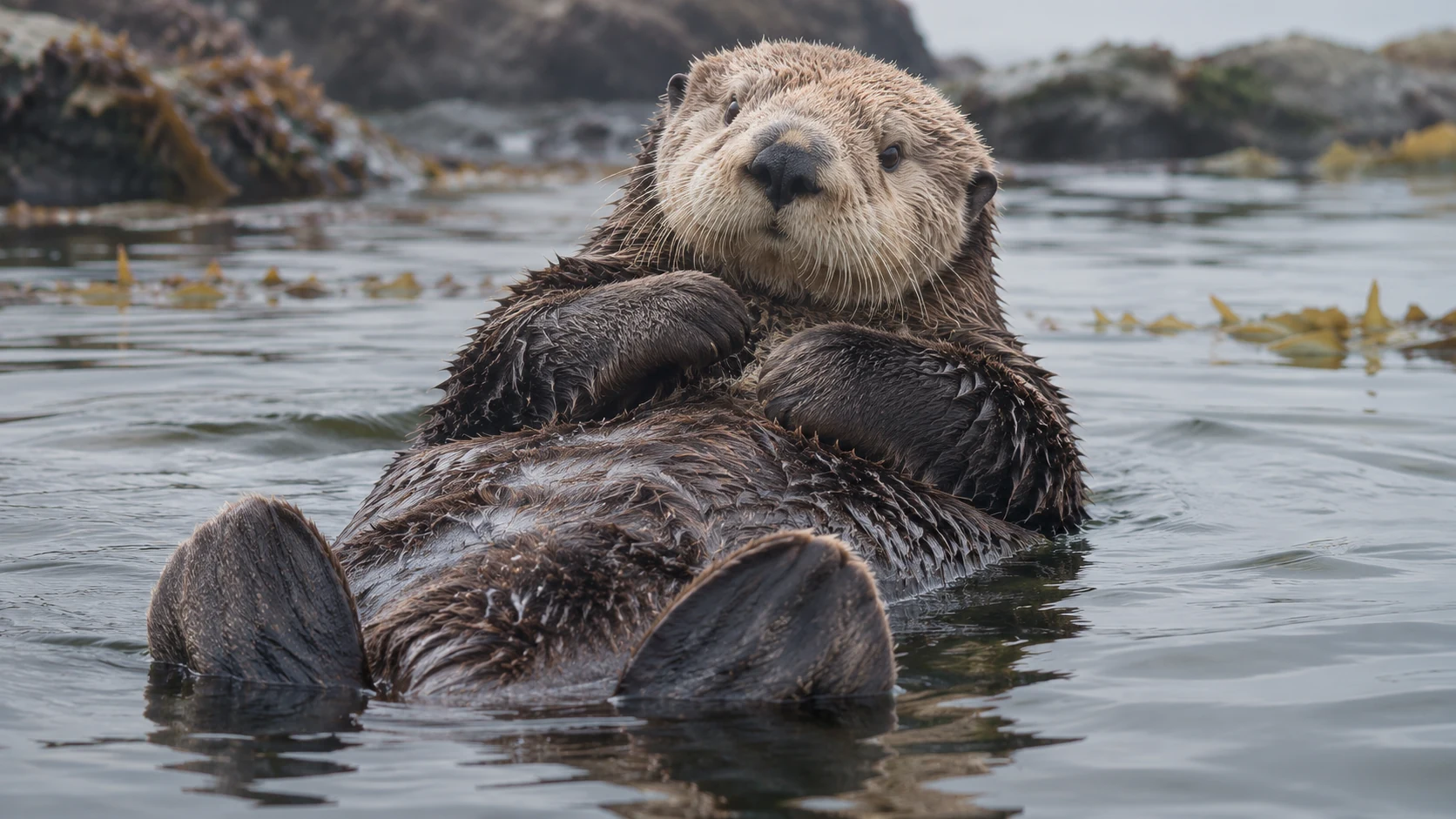
A sea otter floating on its back can look wonderfully relaxed. Keeping a small mammalian body warm in coastal water, however, is demanding work. The calm surface view hides a system that depends on coat condition and a continuing supply of energy.
The explanation has two parts. The otter must slow the loss of heat it already has, and it must produce enough additional heat to balance what escapes. Fur helps with the first job; metabolism helps with the second.
Why the fur matters so much
Many people picture marine-mammal insulation as a thick layer of blubber. Sea otters take a different approach. NOAA’s description of their anatomy emphasizes dense fur instead of the thick blubber coat familiar from other marine mammals. [1]
That makes the coat a working part of the animal’s thermal protection. It is not simply a decorative layer wrapped around an otherwise ordinary marine-mammal body plan.
The Monterey Bay Aquarium describes the sea otter’s coat as extraordinarily dense. Rather than treating a single hair-count statistic as a complete explanation, it is more useful to ask what that density allows the coat to do in water. The arrangement helps maintain an insulating barrier close to the animal. [2]
The important insulation includes air
The American Museum of Natural History explains that air held in the coat helps protect a sea otter from cold water. The functional system is therefore fur plus the air it retains, rather than a mass of hair acting alone. [3]
Picture the difference between a lofted insulating layer and one that has collapsed. The material may still be present in both cases, but its structure changes how well it performs. That analogy helps explain why seeing fur on an animal does not, by itself, establish that the insulation is working properly.
It is also easy to overstate the idea as “sea otters never get wet.” The animal is in the water; the useful question is how the coat maintains its protective structure and the air layer within it.
Grooming is maintenance of a life-supporting surface
Grooming helps maintain the fur’s condition and air-trapping function. Canada’s sea otter recovery account describes actions that preserve the coat’s loft and introduce air. Cleaning and arranging the fur are part of the animal’s thermal routine, rather than merely a finishing touch after feeding. [4]
An otter rubbing its coat is therefore doing something with a direct physical purpose. The animal is tending the barrier between warm tissue and cold surroundings.
This is a useful distinction when watching wildlife footage. The same visible action can be described as “cute grooming” or as maintenance of insulation. The second description connects the behaviour to a problem the animal has to solve.
Good insulation does not manufacture heat
A warm coat can reduce heat loss, but it cannot create an unlimited supply of heat. A sea otter still needs metabolism: the chemical processes that use energy and release heat within the body.
The U.S. Fish and Wildlife Service identifies both clean, dense fur and a high metabolic rate as important to southern sea otters. Its species account also describes a substantial food requirement, with adults commonly eating roughly 20 to 30 percent of their body mass per day. The amount is an approximate biological range, not a daily quota that applies to every individual. [5]
Consider two separate questions: how quickly does heat escape, and how quickly can the animal replace it? Better insulation improves the first answer. Finding and processing enough food helps support the second. A complete explanation needs both.
Muscle can produce heat without constant swimming
A 2021 study in Science investigated how sea otters sustain unusually high metabolism. Researchers used high-resolution measurements of muscle respiration and found a high capacity for heat-producing mitochondrial leak. Their analysis linked this capacity to the otter’s elevated metabolic demands. [6]
Mitochondria are cellular structures involved in converting energy into forms cells can use. In this context, “leak” describes a route in energy conversion that allows more energy to be released as heat rather than captured in ATP, the cell’s immediate energy currency.
The important insight is that muscle is not only a motor for movement. It can also contribute to heat production. A floating otter need not be swimming furiously at every moment for its muscle tissue to matter to its energy budget.
A later paper by the researchers places the finding in the wider context of muscle plasticity and thermogenesis. It discusses how muscle properties can support heat production, rather than reducing the entire story to visible exercise or shivering. [7]
| Part of the system | Main contribution | Why it needs the others |
|---|---|---|
| Dense, air-holding fur | Reduces heat loss | Does not supply unlimited new heat |
| Grooming | Maintains the coat’s function | Requires a functioning coat to maintain |
| Metabolic heat production | Replaces heat lost to the surroundings | Depends on energy availability |
| Feeding | Supplies energy for the animal’s activities and metabolism | Does not make insulation unnecessary |
Why oil threatens more than the coat’s appearance
Oil can disrupt the fur’s thermal function. Research published in Conservation Physiology examined southern sea otter fur across age classes and under oiling conditions. It directly investigated coat performance, rather than inferring insulation from how a pelt looked. [8]
This is why “the animal still has its fur” is not reassuring on its own. A structural insulating system can be present and still perform poorly when contaminated.
Canada’s sea otter status assessment also treats oil contamination as a serious threat in the context of the species’ dependence on its coat. The risk connects a physical change at the surface to the animal’s ability to maintain heat balance. [9]
It would be misleading to turn that explanation into instructions for handling or washing a wild otter. The scientific point here is narrower: keeping the coat’s air-holding function intact is central to the animal’s thermal protection.
Young otters add another reason to avoid one-size-fits-all numbers
The fur study’s comparison of age classes highlights that coat properties change during development. An adult’s appearance and performance should not automatically be assigned to a pup. [8]
Likewise, the Science researchers found substantial thermogenic capacity in very young animals. That result concerns the measured capacity of tissue, rather than proof that every young otter faces identical conditions or has the same total energy budget. [6]
Those distinctions are useful whenever a wildlife fact is reduced to one impressive number. A species average, a laboratory measurement and an individual animal’s needs describe different things.
How to read a relaxed floating otter
From a photograph alone, you can usually say much more about posture than about heat balance. A visible grooming action fits the known importance of coat maintenance. It does not tell you the exact thickness of the air layer or the animal’s current metabolic rate.
The same caution applies to a still image used to illustrate this article. It can show the appearance of an otter and its coat. It cannot serve as a measurement of the microscopic insulating structure or the cellular mechanisms described in the research.
The underlying physics is familiar from another everyday question: why metal feels colder than wood. What matters is the movement of heat, not simply whether an object or animal looks warm.
Frequently asked questions
Do sea otters have blubber?
They do not rely on the thick insulating blubber layer associated with many other marine mammals. Their dense fur and high metabolism are central to their thermal strategy. This is not a claim that an otter contains no body fat at all. [1]
Why do sea otters spend time grooming?
Grooming helps maintain the coat’s structure and insulating function. For an animal that depends on air held within dense fur, coat care has a practical role in staying warm. [4]
Why do sea otters need so much food?
Their high metabolic demands require a substantial energy supply. Food needs vary, so a published percentage of body mass should be read as an approximate range rather than a fixed prescription. [5]
Is fur alone enough to explain their survival in cold water?
No. The useful explanation combines insulation, its maintenance and internal heat production. Leaving out metabolism makes the coat sound like a self-powered heater; leaving out the coat ignores the importance of limiting heat loss.
Keep exploring
- Why Does Metal Feel Colder Than Wood?
- How Do Vacuum Flasks Keep Drinks Hot or Cold?
- How Kelp Forests Reshape Coastal Ecosystems
Sources and further reading
Research and institutional references checked on November 7, 2026. Journal abstracts and public research summaries are distinguished from full-text papers in the references where applicable.
- NOAA Ocean Today — Sea Otter Anatomy
- Monterey Bay Aquarium — Sea otter
- American Museum of Natural History — Sea Otter
- Government of Canada — Sea Otter Recovery Strategy, Chapter 1
- U.S. Fish and Wildlife Service — Southern Sea Otter
- Wright et al., Science (2021) — Skeletal muscle thermogenesis enables aquatic life in the smallest marine mammal (PubMed abstract)
- Wright et al. (2022) — Skeletal muscle plasticity and thermogenesis: Insights from sea otters
- Conservation Physiology (2023) — Effects of ontogeny and oiling on the thermal function of southern sea otter fur
- Government of Canada — COSEWIC Sea Otter assessment and status report 2022
Keep exploring.
One remarkable idea at a time—nature, science, history and beyond.
Last updated November 8, 2026.

Barnakle Editorial Team
Barnakle Editorial Team is the collective byline used for Barnakle’s editorial articles. The contributor profile explains the team identity and links to the publication’s editorial policies.
More from the editorial team →