Aerogel is not a cloud pretending to be solid. It is a solid network arranged around an extraordinary amount of pore space.
Quick answer
Aerogel is a highly porous material with a solid framework and gas-filled pores. It is commonly made by removing the liquid from a gel while preserving much of that framework. Its low bulk density comes from the small amount of solid distributed through its volume. Nanoscale structure can also make it an effective thermal insulator, although performance depends on composition and processing.
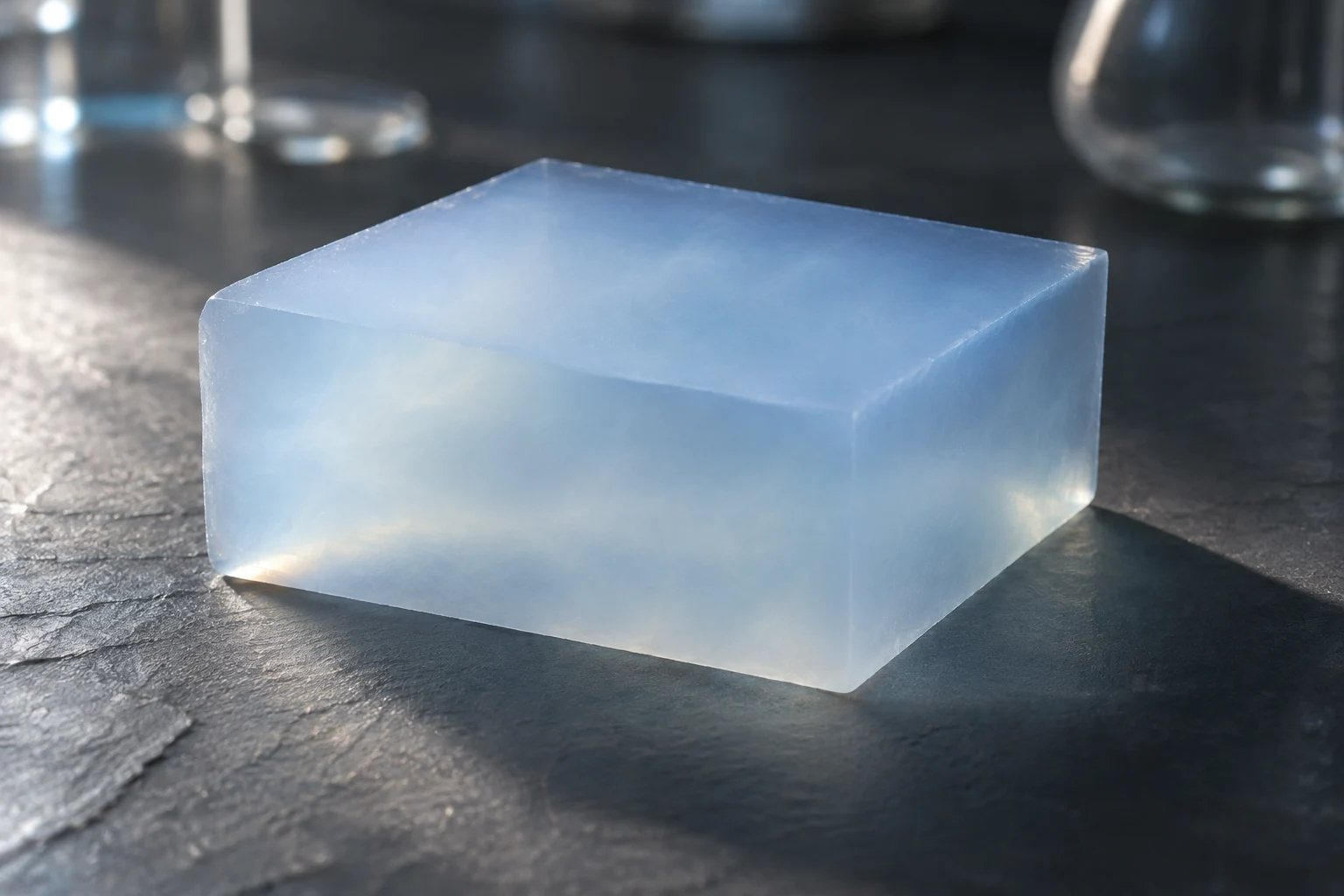
A pale, translucent aerogel sample can look like a piece of captured mist. The impression is striking because the object occupies a clear volume while containing remarkably little solid material. Its appearance invites a reasonable question: what, exactly, is holding it together?
The answer is architecture. Aerogel combines a connected solid skeleton with an extensive network of pores. Knowing what the skeleton is made of explains only part of its behaviour; knowing how little of it occupies the sample is equally important.
What the word aerogel means
IUPAC defines aerogel as a gel consisting of a microporous solid with a gaseous dispersed phase. In practical terms, its structure contains solid material and gas, rather than being an ordinary wet gel full of liquid. The name does not identify one chemical formula. [1]
Silica aerogel is a familiar example, but the category includes other compositions. Lawrence Livermore National Laboratory describes aerogels as open-porous materials with exceptionally small pores. They are a family of structured materials, not one universal substance with identical properties. [2]
That distinction is like the difference between “foam” and the ingredient used to make a particular foam. A structural description tells you about the arrangement of matter; a chemical description tells you what that matter is.
Why most of the volume can be gas
A connected framework does not need to fill every space within an object’s outline. A bridge spans a much larger volume than the metal in its beams. An aerogel applies the same general idea at much smaller scales: sparse solid connections maintain a porous structure.
Bulk density is mass divided by the total external volume, including pore space. The density of the skeleton’s material is a different quantity. A silica-based aerogel can therefore have a very low bulk density without requiring silica itself to become a weightless substance.
For a deliberately simplified example, imagine a structure in which solid occupies only three per cent of the external volume. Ignoring gas mass, it contains roughly three per cent of the mass of a fully dense block made from the same material and having the same outside dimensions. The example illustrates volume accounting, not the composition of every commercial aerogel.
How a wet gel becomes a dry porous object
In a wet gel, a solid framework extends through liquid. Removing the liquid without preserving that framework can make the object shrink or collapse. Aerogel manufacture therefore focuses on drying routes that retain much of the delicate network. NASA describes supercritical-fluid processing among the methods used for silica aerogels. [3]
Ordinary evaporation creates liquid–gas interfaces inside tiny pores. Surface-tension forces at those interfaces can stress a fragile skeleton. A suitable process must manage those forces rather than simply heat the gel until everything wet has disappeared.
Supercritical drying is one approach, but not the only one. Empa’s production work includes silica aerogel granulate made through ambient-pressure drying with appropriate processing and surface chemistry. The route depends on the material and desired product. [5]
This is an important manufacturing lesson: removing an ingredient is not enough if doing so destroys the structure responsible for the final properties. The pathway from starting material to product matters.
Why tiny pores can reduce heat transfer
Heat can move through solids, gases and thermal radiation. Aerogel’s sparse skeleton provides relatively little solid material for conduction, while very small pores restrict heat transfer through the gas. The pore scale is important, not merely the total quantity of air. [4]
A large empty air gap and a network of nanometre-scale pores do not behave identically. Within tiny pores, gas molecules interact frequently with surrounding surfaces, changing gas-phase heat transport. Large circulating convection currents are also strongly restricted.
Imagine comparing one spacious room with a building divided into an enormous number of tiny passages. Equal total empty volume does not guarantee equal movement through that volume. This is only a scale analogy: gas molecules do not walk through corridors, but subdivision changes the available transport processes.
Insulation does not mean heat can never get through
Aerogel still has finite thermal conductivity. Radiation can also carry energy through a material, and formulation choices may reduce that contribution. Aerogel Technologies describes infrared opacifiers used in some insulation products to manage radiative transfer. [4]
“Good insulator” therefore means a material slows heat flow under specified conditions. It is not a claim that the other side can never warm up. Time, thickness, temperature difference, contacts and the surrounding construction all affect the result.
This distinction matters when viewing photographs of dramatic demonstrations. A short event and a particular sample thickness cannot establish unlimited protection. Insulation performance is measured in a defined arrangement rather than inferred from an impressive image.
Is aerogel always fragile?
Traditional silica monoliths can be brittle, but reinforcement and alternative compositions change mechanical behaviour. NASA’s work includes polymer-reinforced silica aerogels and polymer aerogels with improved strength and flexibility. A familiar delicate-looking block does not represent every member of the family. [3]
NASA also illustrates flexible aerogel products. These may be composites rather than unsupported transparent monoliths. The fibres, binders or reinforcement in a finished material affect handling, strength and overall density. [8]
There is a trade-off to manage. Adding material to strengthen a structure can change its mass and heat-transfer pathways. Engineers optimize a set of properties instead of maximizing emptiness without regard for durability.
Does it tolerate any temperature?
No. A porous structure can densify or otherwise change when exposed to sufficiently high temperatures. NASA’s research on thermally stable aerogels treats composition and phase changes as practical limitations for aerospace insulation. A material’s porosity is useful only while that structure remains suitable for the conditions. [6]
Aerogel is therefore not synonymous with “fireproof” or “indestructible.” The response of a silica monolith, a polymer aerogel and a reinforced commercial blanket can differ. Product-specific measurements matter more than a generic photograph.
Why NASA used aerogel to collect comet dust
Stardust collected cometary and interstellar particles using aerogel. Its low-density collector offered a way to capture fast-moving tiny particles for return to Earth, showing that insulation is not the material family’s only useful role. [7]
The application depends on interaction with a sparse solid network, not on an invisible force field. A particle entering a collector encounters material and transfers energy. The mission needed a collector selected for that demanding task, rather than any aerogel sample chosen solely for looking light.
What “mostly air” does not mean
It does not mean the object is simply an inflatable bag. In open-porous aerogels, the gas occupies connected spaces within a solid network. It also does not mean all samples have the same pore fraction, colour or stiffness. [2]
Nor does low density automatically make the object buoyant in air. Floating requires a comparison between the total object’s weight and the weight of air it displaces. Being far lighter than ordinary glass is a different claim from being lighter than the surrounding atmosphere.
The most useful way to understand aerogel is to keep three levels separate: the chemistry of the skeleton, the geometry of the pores and the construction of the finished product. Each changes what the material can do.
Frequently asked questions
Is aerogel a new state of matter?
No new state of matter is required to explain it. Its unusual behaviour comes from a porous solid structure containing gas, with properties that depend on composition and scale. [1]
Is all aerogel blue and transparent?
No. Composition and structure vary, and reinforced or composite products can look very different from the familiar translucent silica sample. [3]
Does a vacuum flask contain aerogel?
A vacuum gap and aerogel use different structures to reduce heat transfer. A vacuum gap removes most gas; aerogel manages transport through a gas-filled porous network. A particular product may combine insulation approaches.
Why is it so light?
Very little solid material occupies a comparatively large volume. The skeleton is real; the low bulk density comes from how sparsely it is distributed.
Keep exploring
Sources and further reading
- IUPAC Gold Book — Aerogel definition
- Lawrence Livermore National Laboratory — Aerogel technology suite
- NASA — Aerogels: thinner, lighter, stronger
- Aerogel Technologies — Technical frequently asked questions
- Empa — Silica aerogel production concepts
- NASA — Thermally stable aerogels for aerospace applications
- NASA Jet Propulsion Laboratory — Stardust mission
- NASA — Flexible aerogel
Reference review: November 10, 2026.
Keep exploring.
One remarkable idea at a time—nature, science, history and beyond.
Last updated November 12, 2026.

Barnakle Editorial Team
Barnakle Editorial Team is the collective byline used for Barnakle’s editorial articles. The contributor profile explains the team identity and links to the publication’s editorial policies.
More from the editorial team →