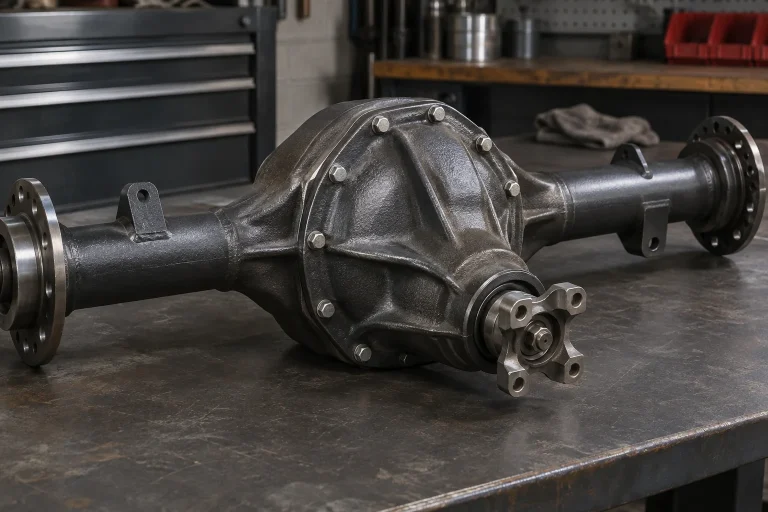
Pressing a brake pedal does not send a mechanical rod all the way to every wheel. In a conventional hydraulic system, a liquid transmits the pressure change that makes the wheel brakes apply force.
How do hydraulic brakes work? An input piston raises pressure in confined brake fluid. That pressure acts on pistons at the brakes, producing force over their surface areas. In a disc brake, the resulting clamp presses friction pads against a rotating disc. The hydraulics transmit and multiply force; friction provides the resistance that slows rotation. [1]
Start with pressure rather than fluid rushing around
Pressure is force per unit area. When a piston presses on confined fluid, it changes the pressure within the connected system. Pascal’s principle describes how an applied pressure increase is transmitted through a confined fluid. NASA’s explanation makes an important distinction: it is the pressure increase that is transmitted, even if initial pressures differ because of height. [2]
A brake system therefore should not be imagined as a tiny waterwheel driven by a stream. Some fluid displacement is needed to move its pistons and accommodate deformation, but the useful output is force on the brake components. The pressure-carrying liquid links an input mechanism with actuators at other locations.
The difference between pressure and force is central. Equal pressure acting on two different areas does not produce equal forces. That is precisely what makes a hydraulic arrangement useful.
From the pedal to the wheel
In a conventional arrangement, the pedal provides leverage and acts on a master cylinder. Its piston develops pressure in the fluid connected to the wheel brakes. OpenStax uses hydraulic braking as an example of the combination of a lever and hydraulic mechanical advantage. [1]
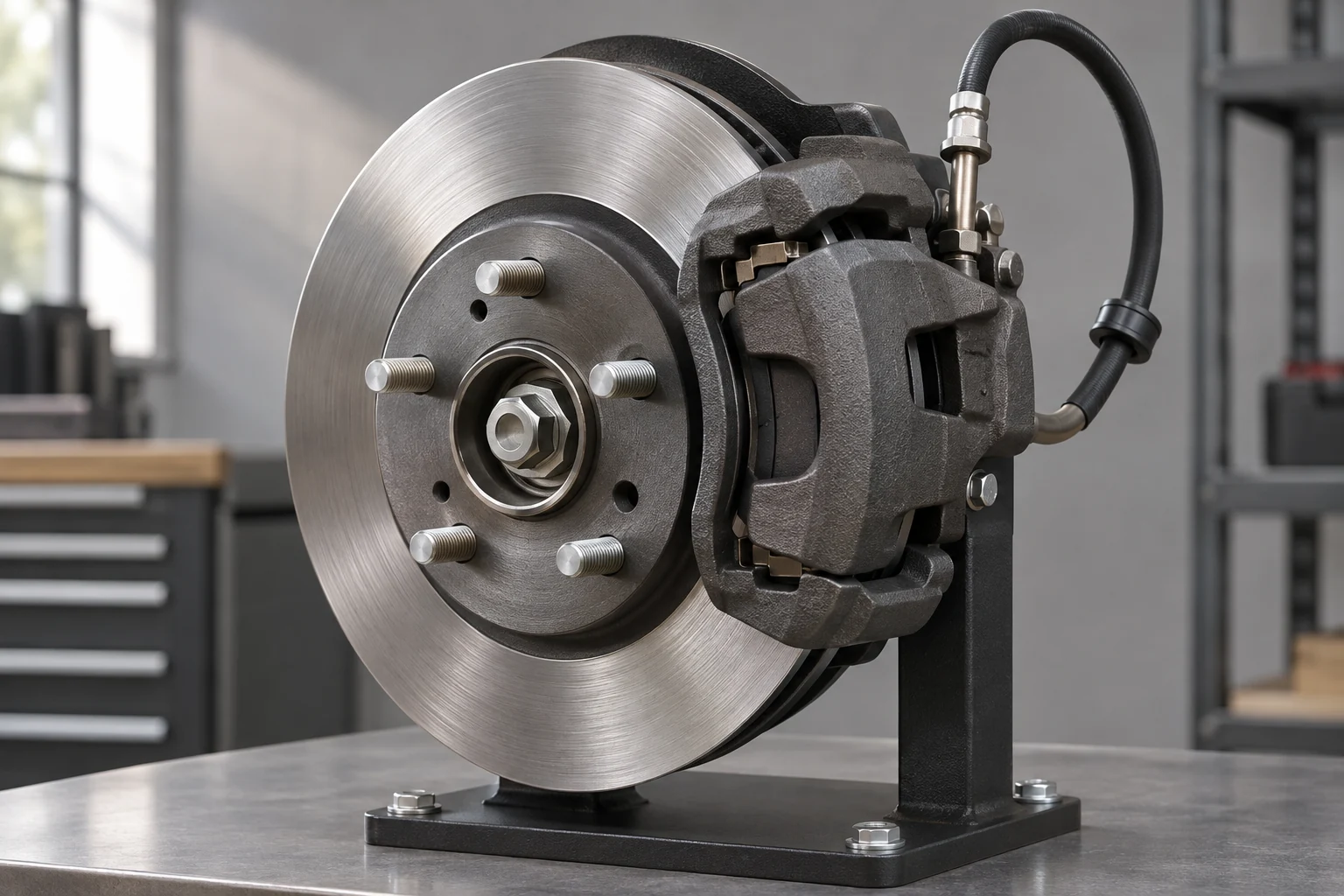
At a disc brake, the caliper straddles the rotor. Pistons and the caliper arrangement apply a clamp through the pads. The rotor turns with the wheel, so friction between the pads and disc resists that rotation. These components have different jobs: the hose carries the hydraulic connection, the piston converts pressure into force, and the friction surfaces provide braking resistance.
Brembo’s component explanation identifies the piston and its seals as important parts of pressure transmission and piston movement. Their material properties and compatibility with the fluid are part of the engineered system. A brake is not simply a loose piston placed against a disc. [6]
How piston area changes force
The ideal relationship is simple: force equals pressure multiplied by area. If an input piston establishes a given pressure, a larger output piston experiences a larger force at that same pressure. Consider a purely illustrative system with an input area of one square centimetre and an output area of four square centimetres. Ignoring losses and other mechanisms, the output force is four times the input force.
The example does not mean the pressure has become four times greater at the output. The pressure is the shared quantity; area changes the force obtained from it. Confusing those statements makes hydraulic systems seem more mysterious than they are.
NASA’s hydraulic example also shows the corresponding trade-off in distance. A larger output area means less output travel for the same displaced volume. Greater force does not arrive with unrestricted extra movement. [2]
Force multiplication does not create energy
An ideal hydraulic machine exchanges distance for force. An input piston moving through a longer distance can move a larger output piston through a shorter one. Input work and output work are linked, and real systems also have losses and elastic deformation. The pressure relationship is not a way of obtaining unlimited energy from a small foot movement.
Braking adds a second energy question: where does the moving vehicle’s energy go? In friction braking, mechanical energy is converted largely into thermal energy at the brakes. The driver’s input controls the process; it does not have to supply energy equal to all the motion being removed. A small control input can govern the dissipation of much greater stored kinetic energy.
Why the disc radius and friction material matter
A force acting farther from the rotation axis produces a greater turning effect. Brembo describes braking torque in terms of effective disc radius, caliper clamping force and friction coefficient. Those quantities explain why hydraulic pressure alone is not a complete description of braking performance. [3]
Imagine the same tangential resisting force applied at two different radii. The larger radius provides more torque. Now hold the geometry fixed but change the friction behaviour of the contact materials: the relationship between clamp force and tangential resistance changes. Finally, change the clamping force, and the system responds again.
This is why a statement such as “more pistons always means better brakes” leaves out too much. Geometry, total effective piston area, materials, temperature and the rest of the system need to be considered together. Counting visible components is not the same as analysing their combined effect.
Why bubbles change the hydraulic response
Liquids resist compression much more strongly than gases under the relevant operating conditions. A gas bubble can therefore absorb part of an input movement by shrinking, instead of that movement producing the intended response at the brake. “Incompressible” is a useful idealization for the liquid, not a claim that every part of a real assembly is perfectly rigid.
Brembo describes vapour lock as a problem arising when fluid boils and vapour bubbles form in the circuit. Its explanation connects the bubbles’ compressibility with a loss of effective hydraulic response. This is a consequence of the physical state of the fluid, distinct from the friction behaviour at the pad and disc. [4]
This article explains the operating principle rather than providing repair or adjustment procedures. The distinction matters because the behaviour of the complete system depends on its particular design and condition.
How ABS changes the picture
Pascal’s principle explains pressure transmission, but a modern braking circuit is not always one uninterrupted chamber with identical pressure everywhere. Antilock braking systems include controlled valves and a pump. Bosch describes wheel-speed sensors feeding a control unit that adjusts the pressure at individual wheels when locking threatens. [5]
The system can reduce pressure and then increase it again as conditions change. Electronic control is managing a hydraulic mechanism. There is no conflict with the underlying pressure law: valves alter which parts of the circuit communicate and how the pressures evolve.
That combination is a useful engineering pattern. A physical principle supplies the means of producing force, while sensors and controls decide how that force should be applied over time.
Frequently asked questions
Does the fluid directly rub against the disc?
No. The fluid acts on pistons. Pads contact the rotor and provide frictional resistance through the brake mechanism.
Is pressure multiplied at a larger piston?
In the ideal connected hydraulic example, the pressure increase is transmitted. The larger area produces a greater force at that pressure. [1]
Do bigger output pistons move farther?
For a fixed displaced volume, greater total output area means less output travel. Force multiplication comes with a movement trade-off.
Does ABS replace the hydraulic brakes?
In the system described here, it controls their pressure through valves, a pump and electronic feedback rather than replacing the basic mechanism. [5]
Keep exploring
Sources and further reading
- OpenStax — Pascal’s principle and hydraulics
- NASA Glenn — Pascal’s principle and hydraulic mechanical advantage
- Brembo — Disc radius, clamping force and braking torque
- Brembo — Brake fluid and vapour bubbles
- Bosch Mobility — Antilock braking system operation
- Brembo — Caliper pistons, seals and their functions
Reference review: November 10, 2026.
Keep exploring.
One remarkable idea at a time—nature, science, history and beyond.
Last updated November 12, 2026.

Barnakle Editorial Team
Barnakle Editorial Team is the collective byline used for Barnakle’s editorial articles. The contributor profile explains the team identity and links to the publication’s editorial policies.
More from the editorial team →