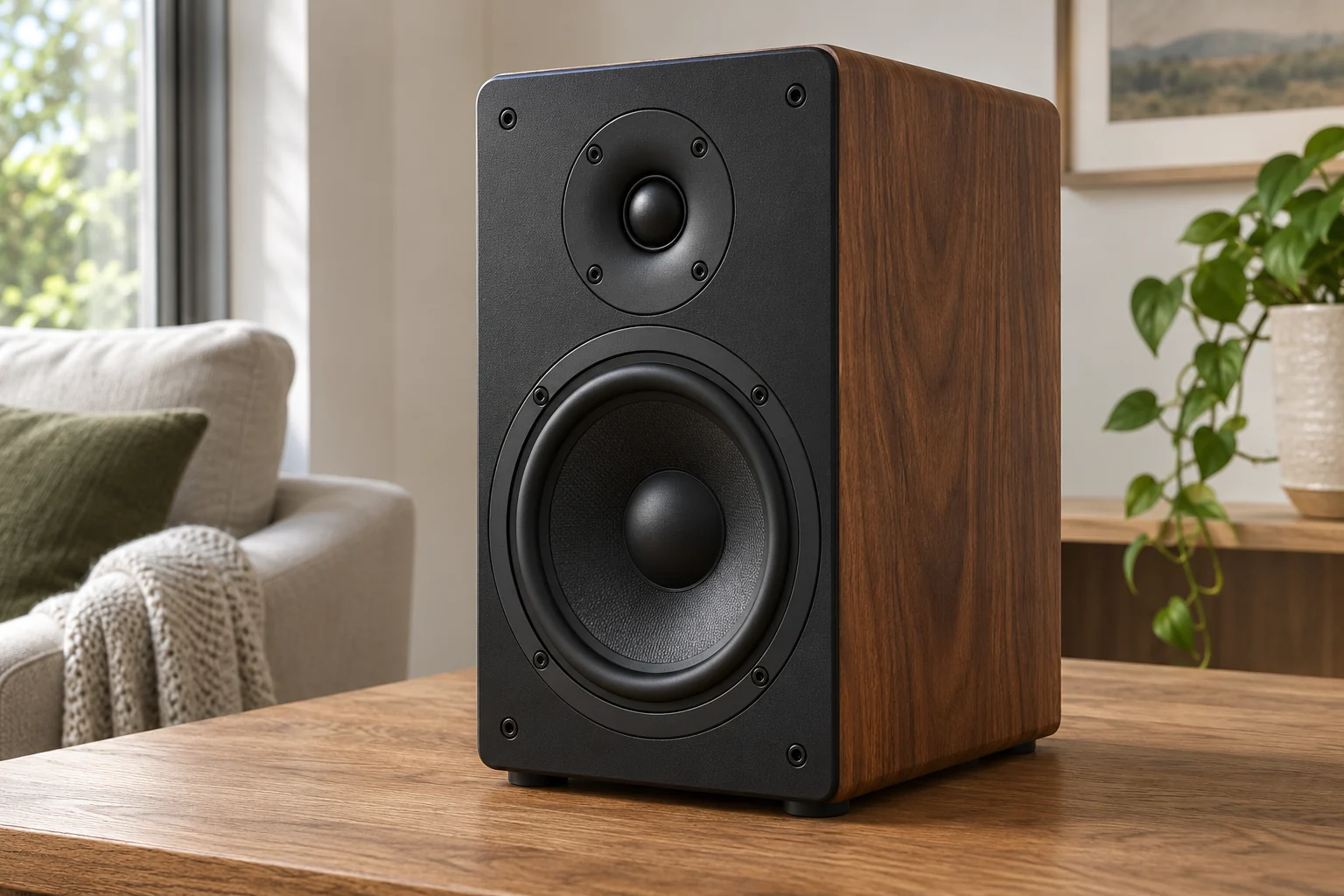
A loudspeaker does not release sound stored inside a magnet. It uses electrical energy to move a surface, creating a changing pressure pattern in the surrounding air.
How do loudspeakers turn electricity into sound? In a moving-coil driver, a changing current passes through a voice coil in a magnetic field. The resulting force moves the coil and its attached diaphragm. That motion creates compressions and rarefactions in the air, reproducing the timing and changing strength of the audio signal. [1]
The signal has to become physical motion
Recorded audio contains information about a sound, but information alone does not move the air in a room. A playback system needs energy and a mechanism that turns the electrical output into mechanical motion. A loudspeaker driver is that conversion stage, also called a transducer.
Bose describes the familiar electrodynamic arrangement as a voice coil operating in a magnetic field and driving a cone back and forth. Its digital-audio explanation also distinguishes the stored digital representation from the analogue signal needed by this physical output stage. Digital storage does not eliminate the need for a moving surface at the end of the chain. [5]
This article focuses on the moving-coil design. Other loudspeaker technologies exist, so a cone and permanent magnet are not a definition of every possible sound-producing device.
A voice coil sits in a magnetic gap
The fixed magnet assembly creates a magnetic field in a narrow gap. A lightweight coil is positioned within that field and connected to the moving diaphragm. When current passes through the wire, the field exerts a force on it. Reversing the current reverses the force under the same field arrangement.
UNSW describes a loudspeaker as a linear motor with a limited range of travel. Unlike a rotating motor, it drives the attached surface back and forth along an axis. The coil’s low moving mass helps it respond to changes in the signal. [2]
The magnet therefore does not have to move back and forth with each note. A useful distinction is between the fixed field-producing structure and the lightweight moving assembly on which the force acts.
The cone produces pressure variations
As the diaphragm moves outward and inward, it disturbs the nearby air. The resulting pressure variations propagate away from the surface as sound. Air motion near the cone and the travel of the pressure disturbance are related, but they are not the same thing.
UCSB’s demonstration describes the cone’s oscillation producing alternating compressions and rarefactions. This is why a diagram showing arrows flying outward should not be read as a stream of air molecules travelling all the way from the speaker to the listener. Sound transmits a disturbance through the medium. [1]
A pure tone is a simple repeating case. Music is a changing combination of components, so the moving assembly follows a more complex time-varying signal. It does not assign one physical patch of cone to each instrument in the recording.
What keeps the coil centred?
A speaker needs freedom of movement in the intended direction while keeping the coil away from the sides of its narrow magnetic gap. The suspension provides that control. Two familiar parts are the outer surround at the diaphragm’s edge and the inner suspension called the spider.
Eminence explains how the surround and spider guide the coil along the axis of the magnet structure. The diaphragm is therefore not simply hanging from its wires, and the magnet is not the only component determining its movement. [3]
That combination of flexible support and controlled geometry is characteristic of many engineered mechanisms. A part must move easily in one direction without becoming unconstrained in every direction. The suspension supplies a mechanical restoring response as well as alignment.
Pitch and excursion describe different properties
Pitch is related to the frequency of a repeating pressure variation. Excursion describes how far the moving assembly travels. A driver can make rapid movements over a small distance or slower movements over a larger distance; speed of repetition and displacement are distinct quantities.
For a simple illustrative tone at 100 hertz, the repeating pattern completes 100 cycles per second. That number does not specify how far the cone moves or how loud the result is. A complete description also needs the signal level and the response of the driver and its acoustic surroundings.
This helps explain why the phrase “the cone moves faster” can be ambiguous. It might mean a greater oscillation frequency, a greater instantaneous velocity or a different amplitude. Those are not interchangeable descriptions.
Why a cabinet may contain several drivers
One driver must balance moving mass, radiating area and the frequency range it is expected to reproduce. UNSW contrasts large low-frequency woofers with smaller, low-mass high-frequency drivers. Different designs address different portions of the audible range rather than being identical cones scaled for decoration. [2]
A multiway loudspeaker uses filtering to distribute frequency ranges. Klipsch describes a crossover as circuitry that divides an audio signal into bands, such as bass for a woofer and higher frequencies for a tweeter. This allows different drivers to work together as a system. [4]
The division is based on frequency, not meaning. A crossover does not recognise “the singer” and send that person to one driver while sending “the guitar” to another. One musical source can contain components spanning several bands.
Why watts do not directly tell you loudness
A power rating is not a sound-level reading at the listener. Klipsch’s specifications guide explicitly notes that a higher power rating does not necessarily mean a louder speaker; sensitivity and other factors also matter. [6]
The distinction follows the energy conversion chain. Electrical input, mechanical movement and acoustic output are different stages. A number describing one stage cannot, without additional information, fully describe another. Distance and the listening environment also affect the result a person experiences.
This is an explanation of what the quantities mean, rather than a buying rule. A useful comparison needs consistent measurement conditions, not just the largest printed number.
A speaker converts energy rather than creating it
The permanent magnet supplies a field, not an endless reservoir of power for the music. Electrical input drives the motion, and the moving diaphragm transfers some of that energy to the surrounding air. The signal controls how the output changes through time.
Thinking in those stages makes the whole process easier to follow: representation, electrical drive, force, motion and pressure variation. The familiar box becomes understandable as a sequence of physical conversions.
Frequently asked questions
Does the magnet vibrate to make the sound?
In the design discussed here, the magnet assembly is fixed while the coil and attached diaphragm move.
Does a crossover separate musical instruments?
No. It divides frequency ranges. A single instrument can contribute sound in more than one range.
Does more cone movement always mean a higher note?
No. Excursion is movement distance; note frequency is a rate of repetition.
Is a power rating the same as loudness?
No. Power handling and acoustic output describe different properties, and sensitivity also affects the result.
Keep exploring
Sources and further reading
- University of California, Santa Barbara — Loudspeaker physics demonstration
- UNSW Physics — Loudspeakers as linear motors
- Eminence — How speakers work: motor and suspension
- Klipsch — Crossover operation
- Bose — How a speaker works and the digital-to-analogue stage
- Klipsch — Speaker specifications and sensitivity
Reference review: November 11, 2026.
Keep exploring.
One remarkable idea at a time—nature, science, history and beyond.
Last updated November 12, 2026.

Barnakle Editorial Team
Barnakle Editorial Team is the collective byline used for Barnakle’s editorial articles. The contributor profile explains the team identity and links to the publication’s editorial policies.
More from the editorial team →