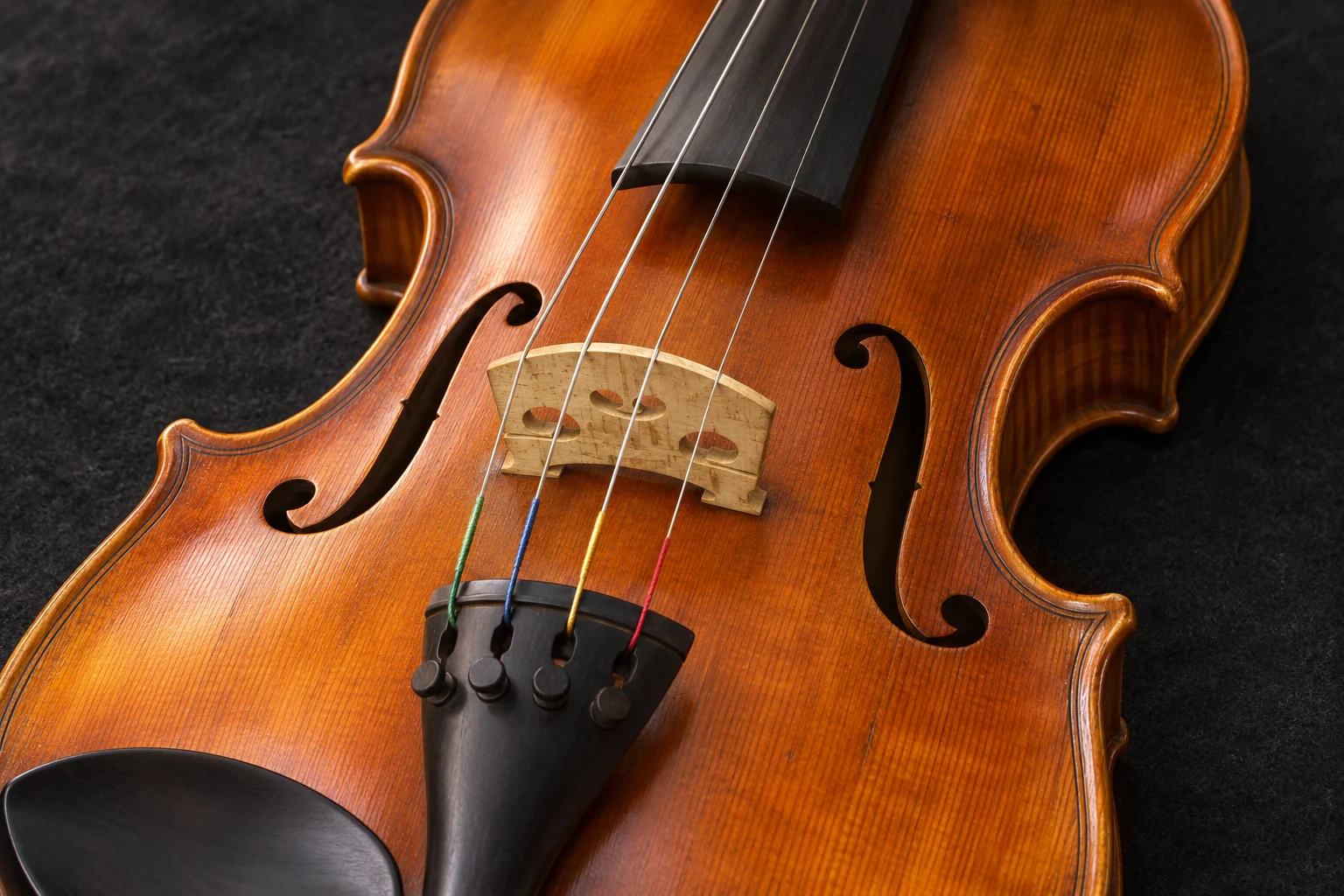
A violin’s two curved openings look decorative, but their geometry participates in the instrument’s acoustics. They connect the air cavity to the outside and help define a flexible region of the wooden top.
Why do violins have f-shaped holes? The openings influence air resonance and the motion of the top plate. Their elongated shape provides a substantial edge length without removing a large continuous patch of wood. Research on air-resonance radiation shows why perimeter and geometry matter, but the holes are only part of the violin’s complete sound-producing system. [3]
The strings need the body to move air
A vibrating string is thin and does not efficiently disturb a large amount of air by itself. The bridge transfers some of its vibrational energy into the instrument’s body. The wooden plates, sides and enclosed air then participate in producing the radiated sound.
UNSW’s introduction describes the bridge and body as the link between string vibration and sound in the air. It also explains that the f-holes affect the mechanical freedom of the top plate in the bridge region. Their role is not simply that of two outlets through which all the sound escapes. [1]
This distinction corrects an intuitive but incomplete image of the violin as a box holding sound. The instrument is a coupled vibrating structure, and its surfaces can radiate as well as its openings.
What happens to the air inside?
The enclosed air can compress and expand while air moves through the openings. Together these motions support an air resonance, related in broad principle to the resonance of air in a bottle. The geometry of the cavity and opening influences how the system responds.
Tavakoli Nia’s MIT thesis investigates how sound-hole design affects this lower-frequency radiation. Its analysis considers complex openings whose behaviour cannot be predicted adequately by looking only at the total empty area. The opening’s detailed geometry changes how air moves. [2]
A resonance does not supply energy from nowhere. The player supplies energy through the strings, and the instrument’s resonances influence how that input is transmitted and radiated. A strong response at a particular frequency is a property of the coupled system, not a hidden amplifier powered by the hole.
Why the edges matter
It might seem that two holes with the same area must have the same acoustic effect. Research on complex sound-hole shapes shows why that is insufficient. Flow close to the perimeter contributes strongly to the opening’s acoustic conductance, so the shape and edge length matter as well as area.
The 2015 violin study analysed this relationship across shapes associated with historical instruments. Elongated f-holes provide more acoustically useful perimeter relative to their void area than a simple circular opening in the studied comparisons. [3]
This does not mean edge length is the only design variable or that making an opening indefinitely longer would create an ideal instrument. The conclusion concerns a defined acoustic problem and a coupled physical structure with other constraints.
How researchers compare different shapes
A meaningful shape comparison has to specify what is held constant. If one opening is simply much larger, a measured difference cannot automatically be attributed to shape alone. Models and experiments can instead compare geometries under controlled assumptions.
The Berkeley research-group account describes experimental and numerical work comparing historical sound-hole forms at a fixed void area. In those comparisons, the f-hole arrangement provided greater air-resonance radiation efficiency than the simpler openings considered. [4]
The scope is important. A result for air-resonance efficiency is not a complete ranking of musical instruments, and it does not independently measure every quality that a player or listener values. Controlled comparisons clarify one mechanism at a time.
The wood and the air influence one another
The cavity is not a perfectly rigid bottle. A violin’s wooden structure moves, and that motion interacts with the air inside. UNSW’s account explains how the bridge, top, back and soundpost contribute to the assembled response. [1]
This interaction is why a simple hole-in-a-box analogy has limits. The same opening attached to a different body need not produce the same complete response. Air resonance and plate vibration belong to one instrument rather than two independent devices placed side by side.
It also helps explain why the f-holes’ location around the bridge matters. They are cut into the structure that transmits the string’s force, not into an acoustically irrelevant outer covering.
How did the shape develop historically?
MIT’s account of the 2015 work describes a long sequence from simpler openings in earlier bowed instruments toward the elongated f-shape. The researchers also examined changes in f-hole length across historical Cremonese instruments.
They proposed that small variations in making and copying, retained through the craft tradition, could contribute to the observed development. That is a hypothesis about how historical changes may have arisen, not proof that every maker selected a shape accidentally or followed one conscious acoustic calculation. [5]
It is useful to separate an opening’s physical function from the history of its adoption. A model can explain a performance consequence without establishing exactly what each historical maker intended.
Why makers and acousticians study it together
North Bennet Street School describes its violin makers’ participation in the research and the combination of instrument measurements with acoustics and fluid dynamics. The study considered features such as hole geometry and back-plate thickness rather than treating the f-shape as an isolated decorative signature. [6]
Craft knowledge and measurements address overlapping questions from different directions. A maker works with a complete instrument and accumulated experience; a controlled analysis isolates physical relationships. Bringing them together can reveal why a familiar construction detail matters.
Does the f-shape explain a great violin?
No single feature provides a complete answer. MIT’s research account explicitly acknowledges that instrument quality involves more than adjusting a few parameters. Acoustic power is one measurable property, while musical response and a listener’s judgement involve a broader experience. [5]
The useful takeaway is specific: the f-holes influence air motion and structural behaviour in ways that depend on geometry. That is a substantial role without requiring the much larger claim that their outline alone explains the whole instrument.
Frequently asked questions
Are the holes just decoration?
No. They influence the cavity’s connection to outside air and the flexibility of the top plate.
Does all the violin’s sound come out through them?
No. The vibrating wooden body also contributes to sound radiation.
Would a circle of the same area behave identically?
Not necessarily. Perimeter and detailed geometry affect acoustic conductance and resonance behaviour.
Does a longer f-hole always make a better violin?
No. A trend in one acoustic property is not a universal rule for the complete instrument or its musical quality.
Keep exploring
Sources and further reading
- UNSW Music Acoustics — Violin acoustics, bridge, plates and air resonance
- Tavakoli Nia (2010), MIT thesis — Acoustic function of sound-hole design; abstract
- Research paper (2015) — The evolution of air-resonance power efficiency in the violin and its ancestors
- Tavakoli Nia’s Berkeley research group — Acoustics of sound holes
- MIT News — Researchers explain violin acoustic-power findings
- North Bennet Street School — Violin makers’ participation in the study
Reference review: November 11, 2026.
Keep exploring.
One remarkable idea at a time—nature, science, history and beyond.
Last updated November 12, 2026.

Barnakle Editorial Team
Barnakle Editorial Team is the collective byline used for Barnakle’s editorial articles. The contributor profile explains the team identity and links to the publication’s editorial policies.
More from the editorial team →