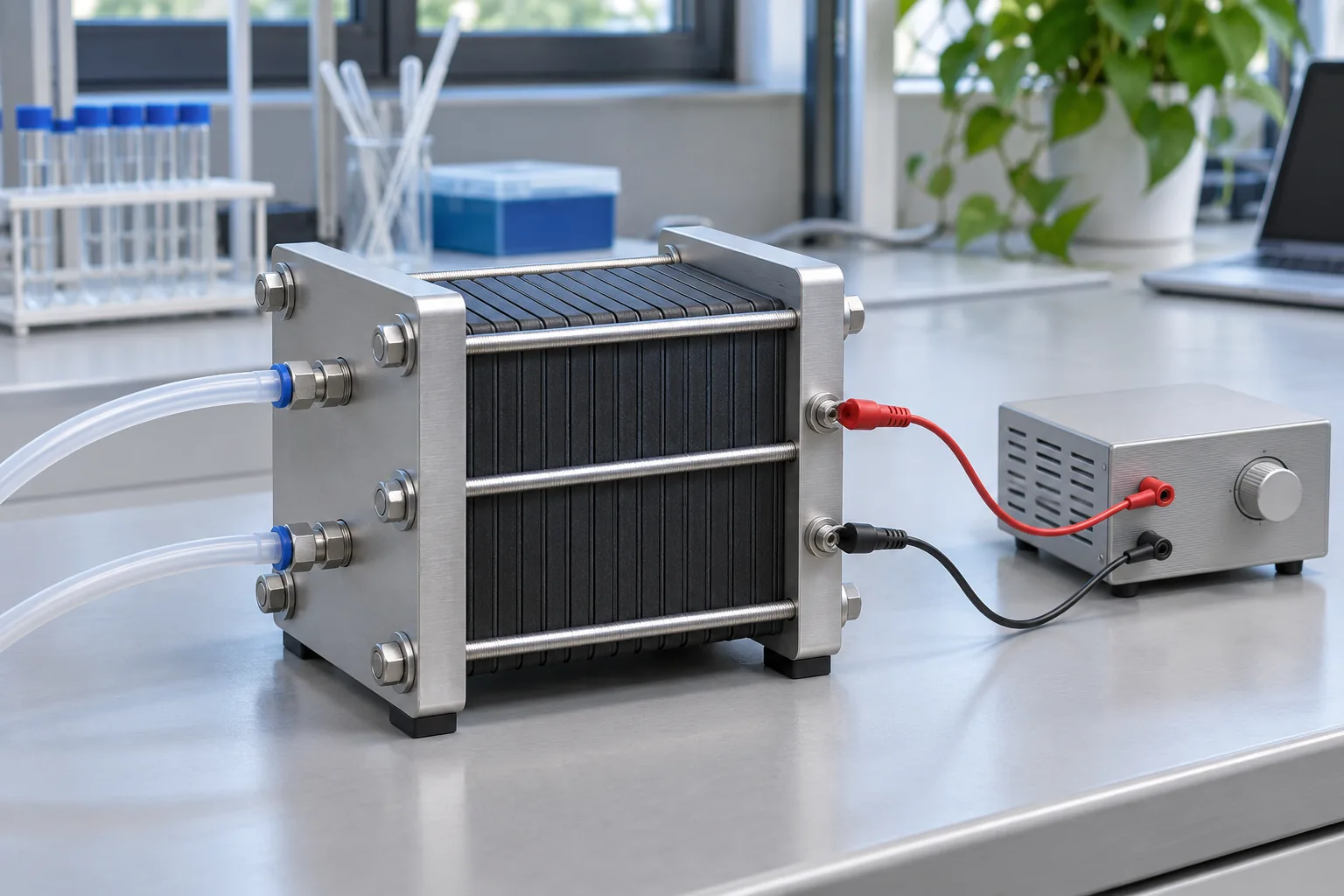
A hydrogen fuel cell converts chemical energy into electricity through electrochemical reactions. In a common design, hydrogen enters one side and oxygen from air enters the other. The cell separates the routes taken by charged particles, sending electrons through an external circuit where they can supply power. Water and heat are produced along the way. [1, 2]
It does not first burn hydrogen in an engine and then turn a generator. The central conversion takes place at electrodes on either side of an electrolyte. Understanding those separate paths makes the device much easier to follow than treating it as a mysterious box that turns gas into electricity.
Which kind of hydrogen fuel cell is this?
The explanation here follows a polymer electrolyte membrane, or PEM, fuel cell with a proton-conducting membrane. PEM is also commonly expanded as proton exchange membrane. This design is widely used in descriptions of fuel-cell vehicles, although other fuel-cell types use different electrolytes and different ion-transport mechanisms. [5, 7]
A single cell has an anode, a cathode and the electrolyte between them. The anode is the hydrogen side in this example; the cathode receives oxygen. Gas channels, catalyst layers and other materials help the reactions occur over useful areas. [2, 3]
Those names describe functions, not a requirement that every fuel cell look like the same classroom diagram. An operating system includes hardware that keeps reactants moving and manages the heat and water the process produces.
What happens to hydrogen at the anode?
Hydrogen arrives as H₂ molecules. A catalyst at the anode enables the hydrogen to participate in a reaction that yields protons and electrons. For the proton-conducting PEM example, the half-reaction can be written H₂ → 2H⁺ + 2e⁻. [2]
The membrane conducts protons but does not provide the electrons with the same passage. The electrons therefore take an external conducting route toward the cathode. A connected electrical load can receive energy as current flows through that route. [2, 3]
The catalyst helps the reaction proceed; it is not the fuel consumed to supply the cell’s ongoing energy. Hydrogen must continue to be supplied. Keeping the distinction between fuel and catalyst clear avoids the mistaken idea that a special coating creates power without an energy source.
Why does separating the paths matter?
The electrolyte allows ionic conduction inside the cell while the external circuit provides an electronic path. Both are parts of the overall electrochemical process. In the PEM design discussed here, protons travel through the membrane and electrons through the circuit before participating in reactions at the cathode. [2, 3]
“The membrane blocks electrons” is therefore useful shorthand, but a working cell needs more than a barrier. Electrodes, catalyst sites and a suitable electrolyte must work together, and an external circuit must provide the route through the load.
Opening that circuit does not make electrons circulate indefinitely somewhere else. Useful continuous electrical output depends on the connected system and its operating conditions. A fuel supply alone is not the same thing as a completed electrical circuit.
Where does the water come from?
At the cathode, oxygen, protons and electrons participate in the reaction that forms water. The overall reaction is 2H₂ + O₂ → 2H₂O, with some of the available chemical energy delivered electrically and some released as heat. [1, 2]
This means a conventional fuel cell consuming hydrogen is making water rather than extracting endless energy from water. Producing hydrogen from water beforehand requires an energy input in a separate process. Confusing those directions turns a real energy-conversion technology into an impossible free-energy claim. [6]
Water management also matters inside the cell. The membrane needs appropriate hydration, while excessive liquid water can obstruct the routes through which gases reach reaction sites. The gas-diffusion layers and associated materials help manage that balance. [3]
Why are fuel cells assembled into stacks?
One cell supplies a relatively small voltage. Combining cells in series adds their voltages, producing a more useful output for many applications. DOE describes stacks ranging across different sizes and designs rather than one universal arrangement. [3, 4]
As a purely hypothetical arithmetic example, ten cells each delivering 0.6 volts under the same operating conditions would provide 6 volts in series before other system effects. This is not a performance specification for the illustrated equipment, and voltage alone would not tell you its power output.
The stack also needs to receive gases, release products and maintain suitable temperatures. Plates provide flow channels and electrical connections while helping physically support the assembly. The neat stack seen from outside is therefore the packaging of many coordinated functions. [3]
Does a fuel-cell system have moving parts?
The central electrochemical reaction does not require a piston or a rotating generator, but a complete system can include pumps, an air compressor, cooling equipment and controls. Calling the whole installation motionless would obscure those supporting components. [4]
Fuel cells produce direct current. Depending on the application, power electronics adjust that output or convert it into alternating current. Some of the electricity is also used by the system’s own supporting equipment, so stack output and useful delivered output are different quantities. [4]
This is a familiar engineering distinction: the component carrying out the main conversion is only one part of a system that has to keep operating reliably.
Why do fuel-cell cars also use batteries?
A fuel-cell electric vehicle uses electricity to drive its motor. Its battery can store energy recovered during braking and support the vehicle’s power management. The presence of a battery does not mean the fuel cell is merely decorative; the components perform complementary jobs. [5]
It is helpful to distinguish where energy is stored from where it is converted. The tank stores hydrogen fuel. The fuel cell converts chemical energy into electrical energy. The battery stores electrical energy through reversible electrochemical processes, and the motor converts electrical energy into motion.
Does a hydrogen fuel cell have zero emissions?
For a cell supplied with hydrogen, water and heat describe the main reaction products at the point of operation. That statement does not establish the environmental impact of making and delivering the hydrogen. [1, 6]
Hydrogen can be produced through processes using fossil fuels, biomass, electricity or other inputs. Electrolysis splits water using electricity; other production routes involve different reactions and sources of energy. Those upstream choices matter when evaluating the full chain. [6]
Other fuel-cell families can also process hydrogen-rich fuels in different ways. Their operating temperatures, reactions and supporting equipment vary, so the detailed PEM explanation should not be copied onto every design. [7]
The central idea remains clear: a fuel cell obtains useful electrical work by coordinating chemical reactions with separate ionic and electronic pathways. Its value depends on the entire energy system, not simply the fact that water appears at the outlet.
Keep exploring
Follow the electricity into a motor, or compare this conversion process with solar power:
Sources and further reading
Fuel-cell descriptions checked November 16, 2026 against U.S. Department of Energy technical explanations. The detailed reaction path here concerns a proton-conducting PEM cell.
- U.S. Department of Energy — Fuel Cells
- U.S. Department of Energy — Fuel Cell Animation, text version
- U.S. Department of Energy — Parts of a Fuel Cell
- U.S. Department of Energy — Fuel Cell Systems
- Alternative Fuels Data Center — Fuel Cell Electric Vehicles
- U.S. Department of Energy — Hydrogen Production Processes
- U.S. Department of Energy — Types of Fuel Cells
Keep exploring.
One remarkable idea at a time—nature, science, history and beyond.
Last updated November 17, 2026.

Barnakle Editorial Team
Barnakle Editorial Team is the collective byline used for Barnakle’s editorial articles. The contributor profile explains the team identity and links to the publication’s editorial policies.
More from the editorial team →