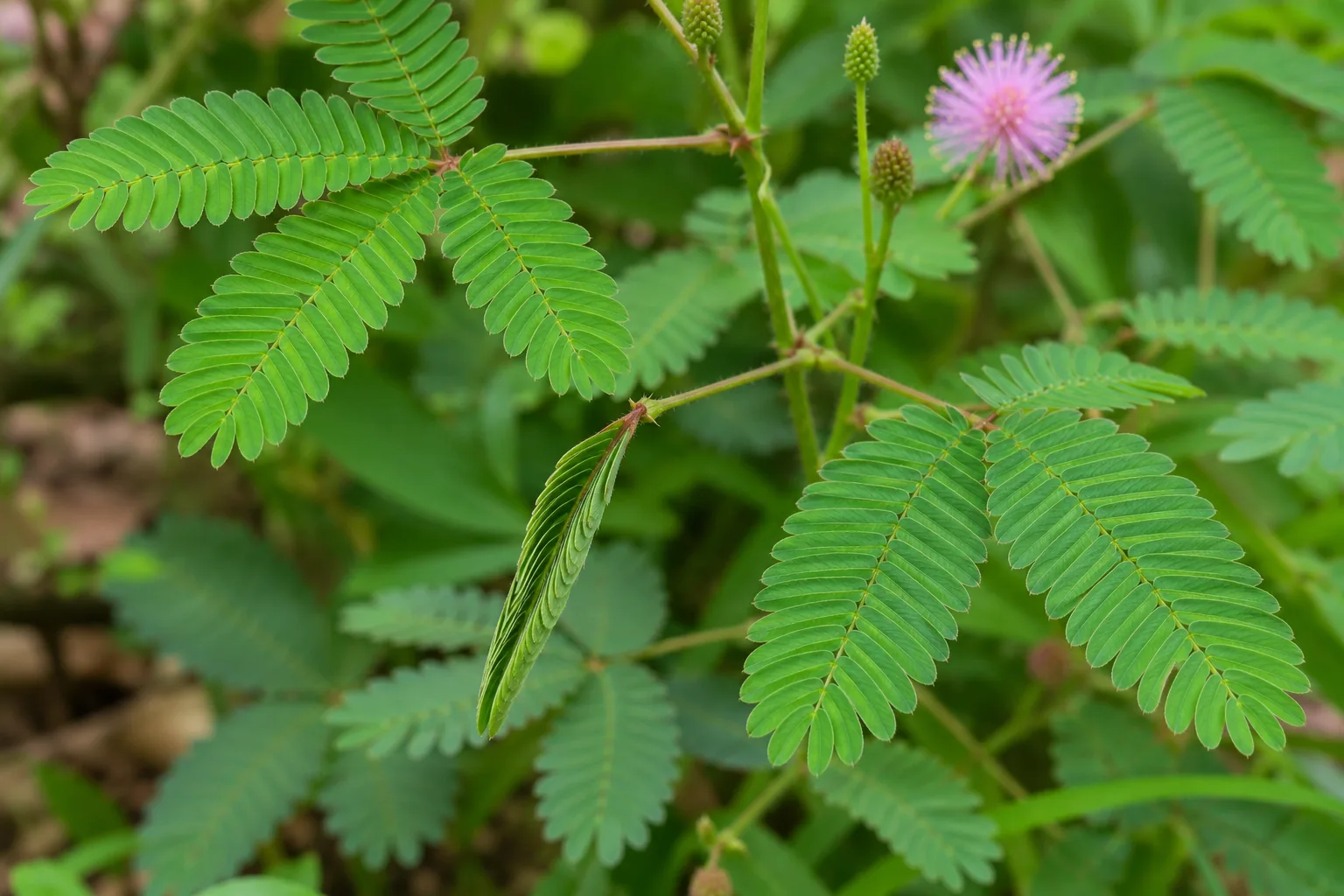
Mimosa pudica folds its leaflets after a suitable touch because the disturbance activates a signaling system that changes pressure in specialized motor organs. Electrical activity and calcium signals help link the stimulus to rapid movement. The plant does this without animal muscles or neurons. [1]
The familiar “sensitive plant” can therefore look startlingly responsive while relying on plant physiology. Its leaves do not suddenly grow into a new position. Living tissues redistribute water, change their mechanical balance and move parts of an existing leaf. The fast closing response and the slower return are different phases of that process. [2, 4]
Where does a Mimosa leaf bend?
A Mimosa leaf is divided into many small leaflets arranged along branching axes. Swollen motor organs called pulvini occur at several levels: at the main leaf base, at the bases of the leaf's subdivisions and at the small leaflet joints. This organization allows movements at different scales. [2]
The small joint associated with a leaflet is also called a pulvinule. A touch response can involve paired leaflets folding together, while movement at the larger leaf base can lower the whole leaf stalk. These are related actions, but they need not always occur together or with identical timing. [2, 3]
Thinking of each joint as a simple hinge is useful only up to a point. A pulvinus is living tissue whose cells and structural organization help generate the bend. It is not a metal pivot pulled by a hidden string. Its changing shape is part of the movement itself. [4]
How does the plant detect contact?
Mechanical contact deforms plant tissue. Mechanosensitive ion channels provide one route by which such deformation can become a cellular signal. These membrane proteins can respond to mechanical forces by changing how ions pass across a cell membrane. That connects a physical disturbance with electrical behavior. [3]
A 2021 study identified the pulvinule as an important site of mechanosensation in Mimosa leaflets and recorded a stretch-activated channel permeable to chloride. Blocking mechanosensitive channels partially reduced touch-triggered closure. This supports a role for those channels without making one channel a complete explanation of every stage of movement. [3]
The leaflet's arrangement also matters. A force applied away from its base can be transmitted mechanically to the joint. The touch is not interpreted by a central brain; local anatomy helps deliver the disturbance to responsive tissue. [3]
What carries the signal through the leaf?
Experiments using calcium-sensitive fluorescent indicators have tracked changes inside stimulated Mimosa tissues. A 2022 study found that propagating calcium changes and electrical signals were closely coupled in time and space, linking stimulation with movement at the leaflet motor organs. [1]
Touch and injury did not produce identical signal patterns. In that study, non-wounding touch and wounding generated different combinations of electrical activity and calcium responses. It would therefore be misleading to imagine every light touch issuing the same command to the entire plant. The kind and location of disturbance matter. [1]
The important distinction is between detecting a local event and coordinating a response beyond that point. Electrical signaling gives the plant a way to connect these stages. It does not turn plant vascular tissue into an animal nervous system. [2]
How can water pressure move a leaf so quickly?
Plant cells contain water under pressure against their walls. This turgor pressure contributes to tissue shape. In Mimosa motor organs, movements of dissolved ions alter the conditions that govern water movement, allowing motor cells to lose or redistribute water and change their pressure. [2]
When opposite regions of a pulvinus change differently, the organ bends. Work on the main pulvinus has described a decrease in volume on one side with an increase on the other during downward leaf movement, followed by a reversal during recovery. The mechanism couples hydraulic change with elastic tissue behavior. [4]
This is faster than building a new leaf or adding enough new cells to bend a stalk through growth. The relevant structures already exist. Movement follows a change in their state, rather as changing pressure can reshape a flexible container, though a living pulvinus has far more organized and actively regulated tissues. [4]
Why doesn't the joint swell equally in every direction?
Pressure alone does not specify a useful direction of motion. The structure receiving that pressure matters. Research on Mimosa pulvini has examined anatomy at multiple scales and tested how the tissues deform under changes in their water balance. [5]
The findings point to structural anisotropy: mechanical behavior differs with direction. Cell walls, tissues and the larger organ are organized so that cell-level changes can produce a coordinated bend. The plant's architecture helps turn hydraulic change into a useful movement instead of an undirected bulge. [5]
For an analogy, two flexible objects can respond differently to the same internal pressure if their reinforcements run in different directions. That comparison explains why identifying water as the moving component is only part of the answer. A complete account also needs the constraints that guide deformation.
Why do the leaves open again more slowly?
After closing, the joint must restore the internal conditions associated with its open position. Ion and water distributions cannot simply be treated as a switch that instantly resets. Recovery includes transport through living tissues and a return of pressure and shape. [6]
A 2026 modeling study specifically examined this slower recovery using coupled descriptions of vascular tissue, membrane transport and ionic-water dynamics. A model can test whether proposed interactions reproduce observed behavior; it does not mean every molecular step has been directly measured or resolved. [6]
The different time courses are therefore part of the biology, not evidence that the leaf has finished growing and must grow back. Rapid motion and recovery use the same existing organ in changing physiological states. [4, 6]
Does folding help defend the plant?
There is experimental evidence for a defensive benefit. The 2022 study compared moving leaves with leaves whose movements were inhibited, including genetically altered plants, and found that rapid movements helped defend against the insect herbivores tested. That is stronger evidence than appearance alone. [1]
It remains a result about a particular plant response and experimental settings. Folding should not be described as guaranteed protection from every grazer, or as proof that the plant feels fear. Mimosa is remarkable enough on its own terms: mechanical sensing, cellular signals, water pressure and directional tissue mechanics combine to move a leaf in plain sight.
Keep exploring
Plant movement takes several forms. Compare Mimosa’s living motor organs with a flytrap’s snap and the moisture-driven movement of pine-cone scales.
Sources and further reading
Mimosa physiology checked November 16, 2026. References distinguish an experimental defense study, a signaling review, tissue-mechanics research and an explicitly labelled recovery-model abstract.
- Hagihara et al., Nature Communications (2022) — Calcium-mediated rapid movements defend against herbivorous insects in Mimosa pudica
- Hagihara and Toyota, Plants (2020) — Mechanical Signaling in the Sensitive Plant Mimosa pudica L. (review)
- Tran et al., Plant Physiology (2021) — Mechanosensitive ion channels contribute to mechanically evoked rapid leaflet movement
- Volkov et al., Plant Signaling & Behavior (2010) — Mechanical and electrical anisotropy in Mimosa pudica pulvini (abstract)
- Sleboda et al., Current Biology (2023) — Multiscale structural anisotropy steers plant organ actuation (abstract)
- Annals of Botany (2026) — A multiscale-multiphysics model for the slow recovery of Mimosa pudica (abstract)
Keep exploring.
One remarkable idea at a time—nature, science, history and beyond.
Last updated November 16, 2026.

Barnakle Editorial Team
Barnakle Editorial Team is the collective byline used for Barnakle’s editorial articles. The contributor profile explains the team identity and links to the publication’s editorial policies.
More from the editorial team →