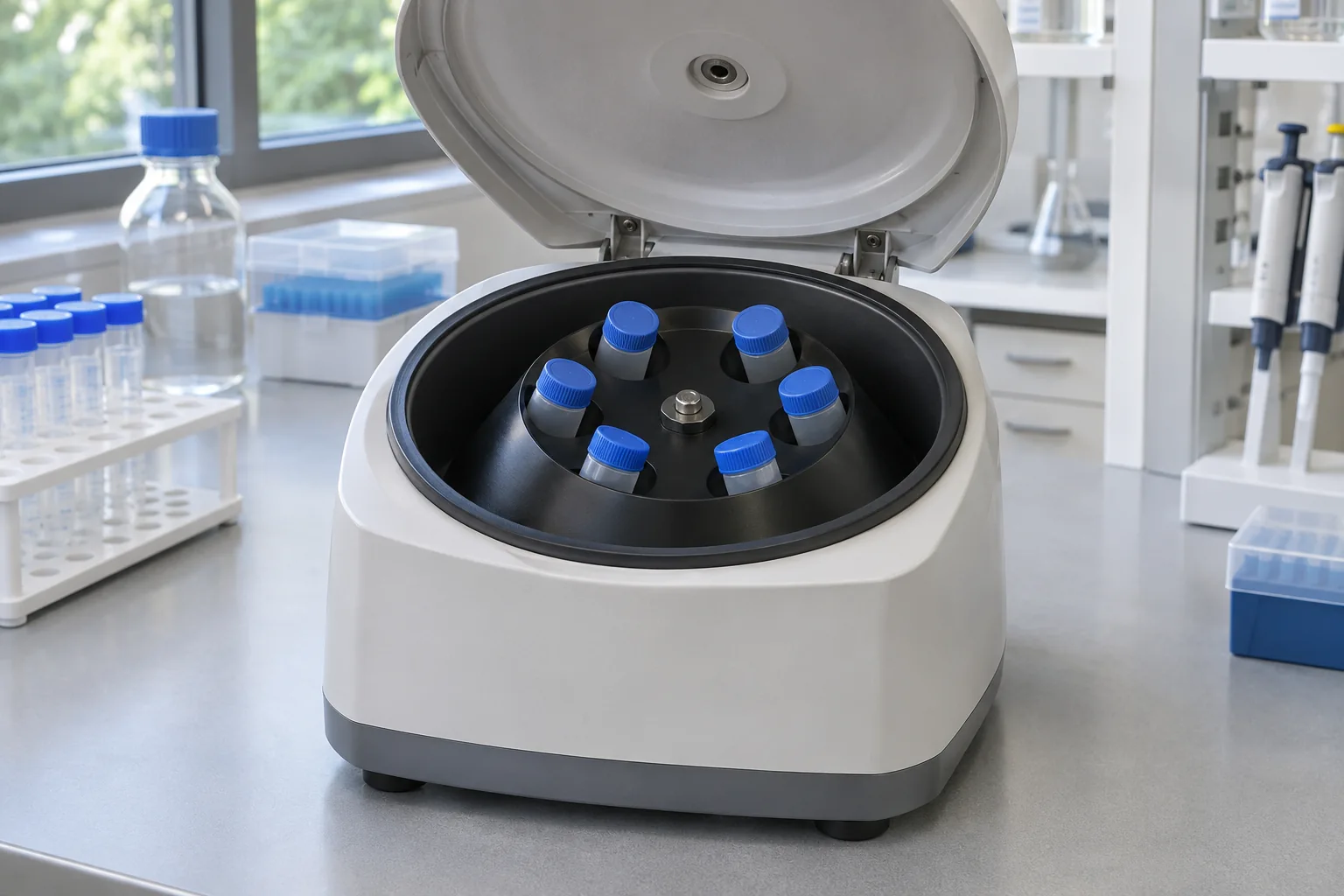
A centrifuge separates materials by rotating a sample so that suspended particles can move through a liquid much faster than they would under gravity alone. The process is accelerated sedimentation. Which particles move, how quickly they move and where they collect depend on the particles, the surrounding liquid and the rotating system. [1, 2]
“It throws the heavy stuff to the bottom” is an incomplete explanation. Size, density difference, shape and fluid resistance matter. Some components collect as a pellet, some remain in the liquid, and others can form separate bands within a specially arranged density gradient. [1, 5]
Why does spinning help a mixture separate?
A particle moving in a circle continually changes direction, even if its speed stays constant. That change requires centripetal acceleration toward the rotation axis. In a centrifuge, the rotating tube and liquid provide the forces that keep material following a curved path. [2]
Viewed from the rotating sample, an effective outward centrifugal effect is useful for describing sedimentation. Material denser than the surrounding medium tends to move outward relative to that medium. Rotation does not switch off gravity; it provides a much larger acceleration relevant to the separation. [2]
This does not mean each particle simply flies outward through empty space. It is moving through a fluid. Buoyancy and drag oppose or modify its motion, so the rate at which it migrates cannot be inferred from rotation alone. [1]
Is density the only thing that matters?
No. A simple sedimentation model for small spheres relates their speed to particle size, the density difference between particle and liquid, the acceleration and the liquid's viscosity. Larger particles can sediment faster than smaller ones under comparable conditions, and a more viscous liquid slows movement. [1]
The density comparison is with the surrounding medium, not just with another particle. When a particle has the same density as the medium at its location, there is no density-driven sedimentation in that simple model. A denser medium can therefore change a separation even when the particles themselves have not changed. [1]
For a conceptual example, imagine equal-sized objects with different compositions in the same fluid. Their behavior can differ because equal size does not imply equal density. Now imagine similar materials in different sizes: their rates can differ even without a difference in density. [4]
Why are RPM and g-force different?
Revolutions per minute, or RPM, describes how often a rotor turns. Relative centrifugal force, commonly written RCF or × g, expresses the acceleration relative to standard gravitational acceleration. The two quantities are connected, but they are not interchangeable. Rotor radius is part of that connection. [3]
At a fixed angular speed, acceleration increases with distance from the axis. Two rotors running at the same RPM can therefore expose samples to different RCF values. Eppendorf uses this distinction to explain why a rotation rate cannot by itself describe the physical effect on a sample. [3]
The relationship is also nonlinear with speed. Holding radius constant, doubling the rotation rate produces four times the centripetal acceleration. That is a mathematical comparison, not an instruction to increase a machine's setting: a real instrument and sample system have specific operating limits. [2]
Why can one rotor have several RCF values?
A sample occupies space, rather than a single point. Its inner and outer regions are at different distances from the rotation axis. Rotor documentation can consequently give minimum, average and maximum radii, with corresponding acceleration values. A quoted g-force needs a clear geometric reference. [6]
Thermo Fisher's TH-641 manual is one example of a manufacturer documenting that distinction. Its rotor specifications separate radius locations instead of treating the entire tube as though it lay at one distance. The principle follows from circular motion, while the actual dimensions belong to that particular rotor. [6]
This helps explain why a number on a display is only part of a separation's description. Where the sample sits, how far particles must travel and which radius a specification uses all belong to the physical arrangement. Two setups can share one headline number without being identical.
What are the pellet and supernatant?
In a common pelleting separation, faster-sedimenting material collects against the outward part of its container. That collected material is the pellet. The liquid remaining above it after the run is the supernatant. Either fraction may be the part a researcher wants to retain, depending on the purpose. [3]
The position of a pellet reflects rotor geometry. A fixed-angle rotor holds tubes at a set angle; a swinging-bucket design allows the sample holders to swing outward during rotation. Those arrangements produce different sedimentation paths, so “bottom” is a practical container description rather than a universal downward direction during spinning. [3, 6]
How does differential centrifugation work?
Different particles in a mixture may sediment at different rates. Differential centrifugation takes advantage of those differences through successive separations. A fraction that collects in one stage can be separated from material that remains suspended and is collected at another stage. [4]
This approach can divide a complicated mixture into useful groups, but a pellet is not automatically a pure substance. Particles with overlapping sedimentation behavior can collect together, and material can remain associated with other components. The physical separation is useful without being a guarantee of perfect chemical identification. [4]
Why do some samples form bands instead of pellets?
A density gradient contains layers or a continuous range of liquid densities. In an isopycnic separation, particles migrate toward locations where the medium matches their buoyant density. Different components can therefore occupy distinct bands instead of all continuing toward an outer wall. [5]
Rate-zonal separation uses a gradient differently: components separate because they migrate at different rates over a controlled interval. It should not be described as the same endpoint process as reaching a matching-density layer. Both use a rotating field, but the basis for interpreting the resulting bands differs. [5]
That distinction matters whenever an attractive photograph shows colored stripes in a tube. The stripes alone do not reveal whether the sample was separated by rate, by equilibrium density or by some other preparation. Understanding the method is necessary before assigning meaning to its appearance.
What does a centrifuge actually accomplish?
It creates conditions in which components with different sedimentation behavior can become physically separated or concentrated. That can make a mixture easier to study, but separation itself does not prove what a fraction contains, establish purity or supply a medical diagnosis. The result belongs to a wider measurement or research process. [4, 5]
The central idea is more precise than sorting by weight: spinning changes the acceleration, while particle properties, buoyancy, drag and travel distance govern the response. A centrifuge is powerful because those factors can be controlled and used together, not because one speed divides every mixture in the same way.
Keep exploring
Sorting and buoyancy depend on their setting. Compare sedimentation in a liquid with particle segregation in nuts and the stability of a floating iceberg.
Sources and further reading
Centrifuge principles checked November 16, 2026, using equipment manufacturers and OpenStax. Numerical comparisons are explanatory, not settings for a laboratory procedure or a diagnostic interpretation.
- Merck Millipore — Centrifugation Basics
- OpenStax, College Physics 2e — Centripetal Acceleration
- Eppendorf — Basics in Centrifugation
- Beckman Coulter Life Sciences — Particle Separation
- Beckman Coulter Life Sciences — Density Gradient Centrifugation
- Thermo Fisher Scientific — TH-641 Swinging Bucket Rotor instruction manual (PDF; rotor geometry and RCF definitions)
Keep exploring.
One remarkable idea at a time—nature, science, history and beyond.
Last updated November 16, 2026.

Barnakle Editorial Team
Barnakle Editorial Team is the collective byline used for Barnakle’s editorial articles. The contributor profile explains the team identity and links to the publication’s editorial policies.
More from the editorial team →