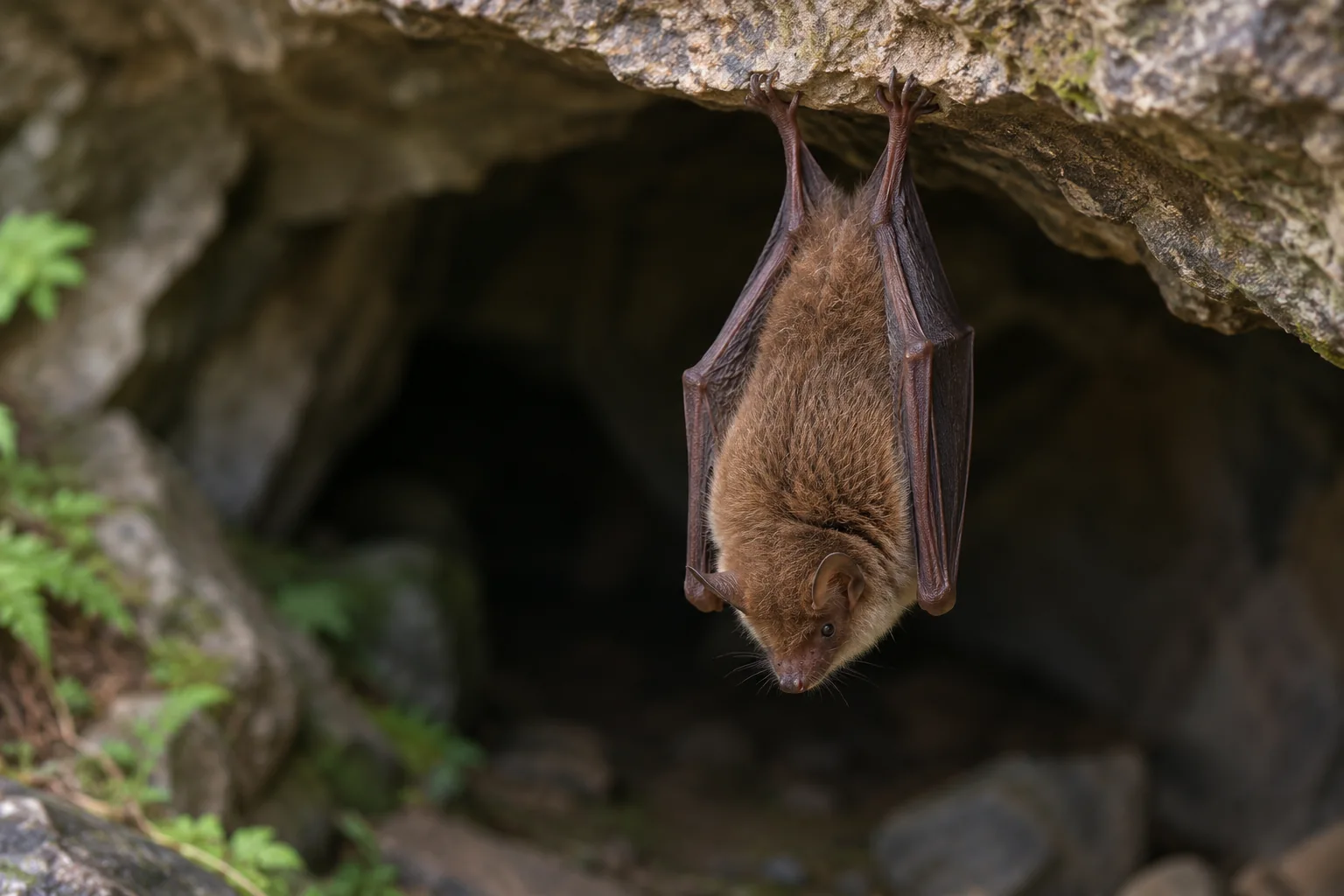
Many bats hang upside down because it is a useful way to rest in an elevated roost and begin another flight. Their hind feet provide a secure grip, while releasing that grip lets gravity help them become airborne. Inverted roosting brings together the mechanics of resting, landing and taking off. [1, 2]
It is a widespread bat posture, but it is not universal. Some specialized bats roost head-up on smooth leaves. Explaining the familiar hanging bat therefore requires both the general advantages of suspension and the anatomical differences that allow exceptions. [6]
Why is hanging a useful starting position for flight?
A bat resting below a branch or ceiling already has space underneath it. Releasing its hold allows it to drop into that space and begin flying. It does not have to perform the same upward launch a person might imagine from watching a bird leave a flat perch. [1]
The advantage is a convenient route into flight, rather than evidence that gravity can power the whole journey. Once airborne, the bat still needs to control its motion and produce the forces required for flight. Letting go solves the initial separation from the roost; it does not replace the work of the wings.
An elevated roost can also be difficult for some predators to reach. Bat Conservation International identifies this as another benefit of hanging in inaccessible locations. The value depends on the surroundings: a branch, crevice or cave surface offers a different setting from an exposed patch of ground. [1]
How can a bat keep gripping while it rests?
Human hands tire when they maintain a hard grip. A bat's foot is organized differently for its roosting task. Tendons connect the gripping muscles with the toes, and specialized structures associated with those tendons can help maintain the curled position after the initial muscle contraction. [2]
Bat Conservation International describes a ratchet-like arrangement involving ribs inside a tendon sheath. Once the foot is engaged, this mechanism helps hold the tendon in place, reducing the need for continuous gripping effort. The claws provide purchase on an appropriate surface while the supporting anatomy maintains the hold. [2]
This is a mechanical explanation, not a claim that a resting bat uses no energy. Its body remains alive and must maintain essential functions. The distinction is between the cost of maintaining a particular grip and the animal's total metabolism.
Are bats hanging by their wings?
In the usual head-down resting posture, the hind feet are the main attachment points. Folded wings lie close to the body rather than acting like two hands permanently clamped to the ceiling. Wings and feet have different roles, even though both can be involved during some landing movements. [1, 4]
A useful way to read a photograph is to locate the actual contact points before drawing conclusions from the silhouette. A wing draped around the body can conceal the legs, and different roost surfaces can make the gripping arrangement hard to see. The outline alone does not explain how the load is supported.
How does a flying bat turn upside down to land?
Landing involves more than flying straight at a ceiling and catching it. In a 2015 study, researchers tracked wing and body movements and used dynamical models to investigate how bats rotate into an inverted posture. The work showed an important role for the inertia of the wings. [3]
Bat wings contain substantial bones and muscles, rather than behaving as almost massless surfaces. By changing their configuration asymmetrically, the studied bats could redistribute moving mass and rotate the body. The analysis supported wing inertia as the dominant contributor to the observed reorientation during landing and falling maneuvers. [3]
That finding does not mean aerodynamics is irrelevant to bat flight. It identifies a particular contribution during a particular maneuver. The same wings that interact with air can also help change body orientation through the way their mass moves relative to the trunk. [3]
Do all bats land in the same way?
No. A Brown-led study reported in 2009 compared landing behavior in three species and found different approaches. Some used a four-point contact involving feet and wrists, while others used a two-point landing on the hind feet. Their impact forces differed too. [4]
The researchers connected those differences with the kinds of surfaces the bats used for roosting, while cautioning against drawing sweeping conclusions from a small selection of species. A landing suited to flexible vegetation need not have the same mechanics as one suited to a rigid cave ceiling. [4]
This adds an important qualification to a familiar description. “Bats land upside down” states an outcome for many species. It does not specify a single universal sequence of wingbeats, body rotations and contact points that every bat repeats.
Does every bat sleep in a cave?
The resting place is called a roost, and caves are only one kind. Bats use tree hollows, buildings, underground spaces and other sheltered locations. Their requirements can also change with season and life stage, so a suitable roost at one time may not serve the same purpose later. [5]
The Bat Conservation Trust distinguishes summer maternity roosts from winter hibernation roosts and describes movements between different sites. A roost should therefore be understood as part of an animal's changing habitat needs, rather than a permanent bedroom with one interchangeable ceiling. [5]
The surface and available space also influence the practical value of hanging. An attachment point, room for folded wings and a route out are physical features of a living site. The broad posture makes sense in relation to that setting.
Which bats roost head-up?
Spix's disk-winged bat, Thyroptera tricolor, provides a striking exception. It uses specialized disks at the thumbs and feet to attach to smooth surfaces inside furled leaves. Those attachments allow a head-up posture that differs from the familiar image of claws hooked onto rough stone or bark. [6]
Bat Conservation International describes small groups using emerging Heliconia leaves and moving as new suitable leaves become available. The attachment system and roost choice work together: a smooth, temporary leaf surface presents a different gripping problem from a long-lasting rock crevice. [6]
The exception makes the general answer clearer. Hanging head-down is not an arbitrary rule imposed on every bat. It is one effective arrangement among bodies, attachment mechanisms and habitats shaped by evolution.
What does an upside-down bat reveal about adaptation?
The posture looks unusual because humans compare it with their own resting positions. For many bats, however, specialized gripping feet make suspension practical, elevated sites offer useful shelter, and the space below provides a route into flight. Landing research reveals additional coordination between wing motion and body rotation.
Rather than treating the animal as a tiny person doing a difficult gym exercise, follow the physical tasks separately: arrive at the surface, establish a hold, rest, release and fly again. The bat's anatomy connects those tasks into an ordinary part of its life.
Keep exploring
Roosting is one part of a bat’s life in the air. Read how bats navigate crowded skies and use returning sounds to locate their surroundings.
Sources and further reading
Bat roosting and landing sources checked November 17, 2026. Experimental findings are identified by study; the illustration does not claim to show a photographed or identified species.
- Bat Conservation International — Why Do Bats Hang Upside Down? (2023)
- Bat Conservation International — Where the Upside is Down (2025)
- Bergou et al., PLOS Biology (2015) — Falling with Style: Bats Perform Complex Aerial Rotations by Adjusting Wing Inertia
- Brown University — Brown-Led Team Offers First Look at How Bats Land (2009)
- Bat Conservation Trust — What is a roost?
- Bat Conservation International — Species Spotlight: Spix’s Disk-winged Bat
Keep exploring.
One remarkable idea at a time—nature, science, history and beyond.
Last updated November 24, 2026.

Barnakle Editorial Team
Barnakle Editorial Team is the collective byline used for Barnakle’s editorial articles. The contributor profile explains the team identity and links to the publication’s editorial policies.
More from the editorial team →