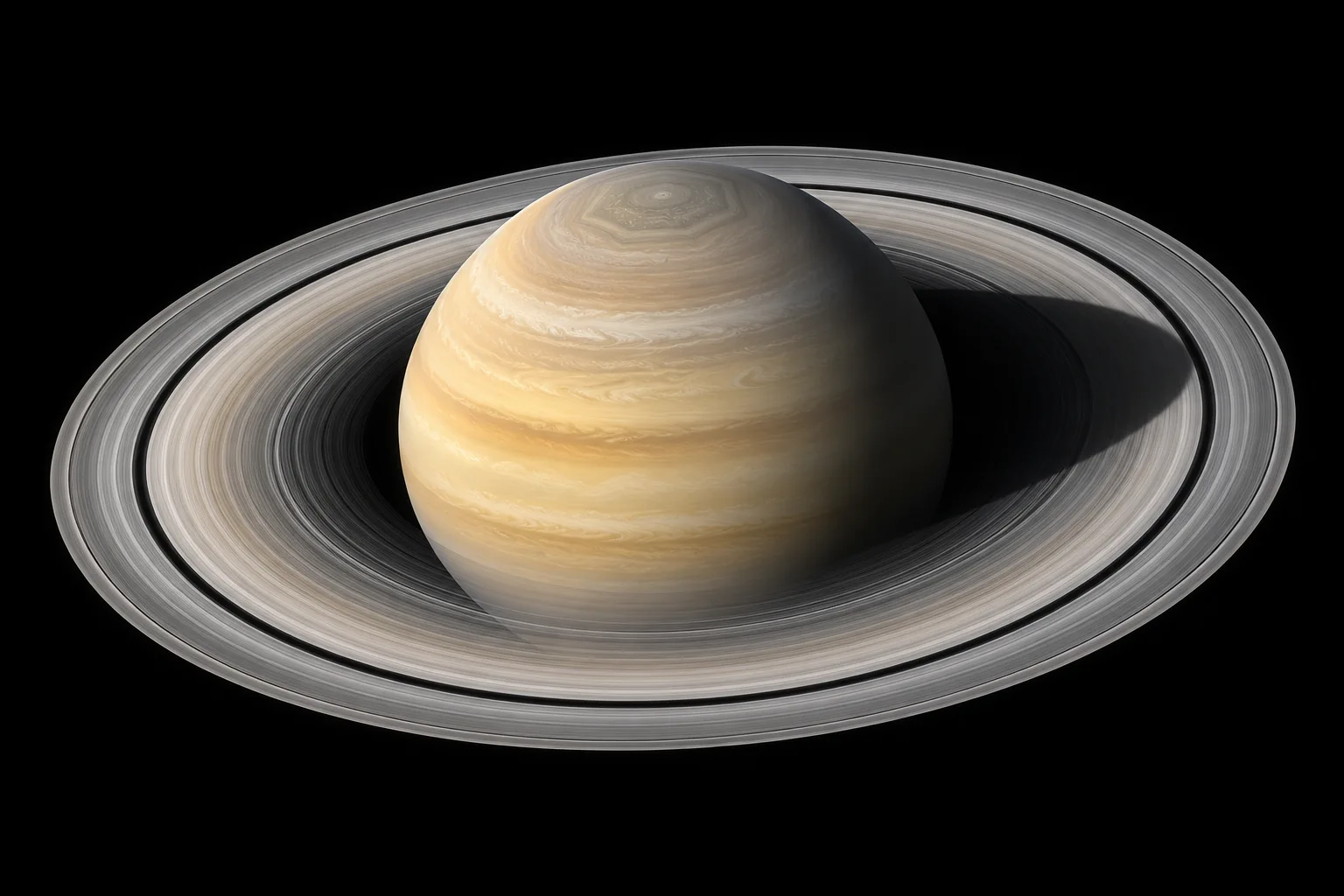
Saturn’s rings are made mostly of water ice, mixed with smaller amounts of other material, including dust and rocky debris. They consist of enormous numbers of separate particles circling the planet. The smooth bands in a distant view are the combined appearance of those particles, rather than the surface of one solid object. [1]
That distinction changes the entire picture. An icy fragment in a ring has its own orbit around Saturn. The ring is a shared region occupied by many objects, not a rigid hoop attached to the planet. NASA describes particles spanning a great range of sizes, from tiny grains to much larger chunks. There is no single standard-sized piece from which all the rings are built. [1]
Mostly ice, but how do scientists know?
A bright appearance alone would be insufficient to identify a material. Scientists examine how ring material interacts with different wavelengths of light. Water ice absorbs some wavelengths more strongly than others, leaving recognizable features in a spectrum. These features offer evidence about composition beyond what an ordinary colour photograph can show. [6]
Observations reported in 2024 used the James Webb Space Telescope to study Saturn’s A ring and several small moons. The A-ring spectrum was dominated by highly crystalline water ice. The study also examined infrared signatures that help constrain other constituents. Its results strengthen the ice-dominated picture without implying that every ring particle is perfectly clean or chemically identical. A measurement of one ring region should also retain that geographical scope. [6]
A broad system with remarkably little thickness
The familiar bright main rings are enormously wide compared with their typical vertical thickness. NASA gives a characteristic thickness of about 10 metres for the main rings, while noting a ring system that extends hundreds of thousands of kilometres. These are scale descriptions, not a claim that the entire system has one perfectly uniform height. [2]
The major rings have letter names assigned in discovery order. Moving outward therefore does not produce a simple alphabetical sequence. The D, C and B rings lie inward of the A ring, with the Cassini Division between B and A. Fainter rings lie farther out. A photograph that seems to show two or three broad stripes is compressing a much richer arrangement of bands and structures into a small view. [2]
Why can the rings look solid and still be translucent?
At great distance, individual particles and the spaces between them blend together. Cassini images nevertheless show that parts of the rings transmit light: the planet and ring shadows can sometimes be seen through ring regions. Different viewing and lighting arrangements reveal different aspects of this structure. A dense-looking band in one image need not resemble an opaque sheet from every direction. [4]
The distinction was understood before spacecraft reached Saturn. NASA’s account notes James Clerk Maxwell’s nineteenth-century work showing that the rings must consist of many small bodies, followed much later by spectroscopic evidence for their icy composition. Structure and material were separate questions, answered through different kinds of evidence. A beautiful image can introduce both questions, but cannot by itself settle either one. [4]
Moons help sculpt the gaps
The Cassini Division is associated with repeated gravitational interactions involving Mimas, a moon outside the main rings. In the relevant orbital relationship, ring particles make approximately two circuits for each orbit of Mimas. Repeated nudges can accumulate rather than simply cancel, influencing the outer edge of the B ring and the distribution of material nearby. This is an example of orbital resonance. [5]
It is more useful to imagine gravity reorganizing a moving population than a tool cutting a groove into a solid surface. The dark division separates visibly different ring regions, while the dynamics continue to operate on orbiting particles. Its broad appearance and its detailed internal structure belong to the same gravitational system. [5]
A different example is Pan, the small moon orbiting within the Encke Gap in the A ring. NASA’s Cassini description places the moon inside that gap. Such images give a concrete sense of how closely rings and moons are interwoven: some moons orbit alongside the broad rings, while others occupy openings within them. [9]
Some ring material is still being supplied
The bright main rings are not the whole story. Cassini established that icy material ejected by Enceladus supplies much of the diffuse E ring. That finding links an active moon to material distributed around Saturn, and it should not be stretched into an explanation for the origin of every ring. [3]
Cassini also observed exchanges between other moons and ring material, and disturbances produced by embedded moonlets. The system has movement and interaction on many scales. A ring may look almost motionless in a single picture because the picture freezes a moment, while the particles and their gravitational neighbours keep moving. [3]
Does clean ice tell us how old the rings are?
Ring age remains a harder question than ring composition. NASA’s 2023 discussion described evidence for comparatively young rings, including calculations involving the accumulation of non-icy material delivered by micrometeoroids. The underlying idea is that a pollution rate can help estimate an exposure time. Such an estimate depends on assumptions about what arrives and what remains. [7]
A 2025 study proposed that resistance to pollution during impacts could help explain why ring particles appear clean, weakening a simple equation between cleanliness and formation age. That interpretation illustrates why the age should not be presented as one permanently settled number. The strong conclusion is about the material: Saturn’s spectacular main rings are predominantly icy. Reconstructing when and how that icy system formed remains an active scientific problem. [8]
Keep exploring
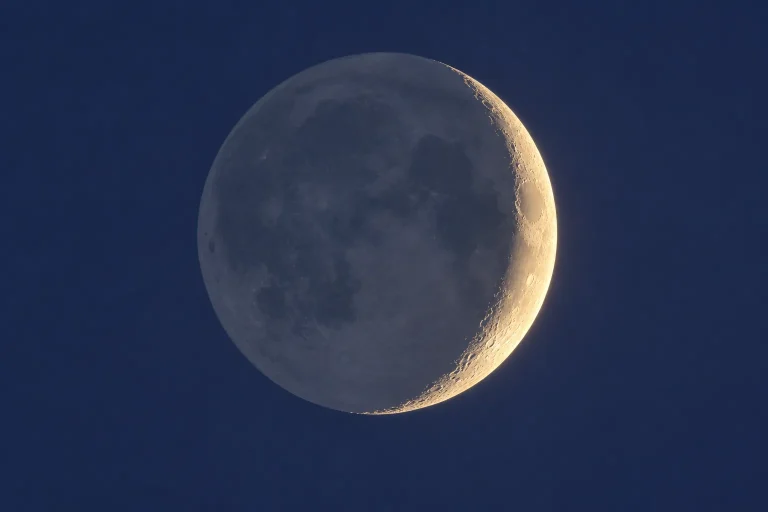
Explore two other ways orbital geometry shapes familiar sights: the Moon’s phases and the face it keeps turned toward Earth.
Sources and further reading
Checked November 17, 2026. NASA mission explanations and the 2024 JWST study support the composition and structure sections. Ring-age interpretations remain debated; the 2025 pollution-resistance paper is represented by its indexed abstract. The illustration is not a spacecraft observation.
- NASA Cassini — Frequently asked questions: ring particles and individual orbits
- NASA — Saturn facts: ring structure and naming
- NASA Cassini — Rings: observations, Enceladus and moon interactions
- NASA Cassini — Translucent Rings
- NASA Cassini — The Great Divide
- Hedman and colleagues — Water-Ice Dominated Spectra of Saturn’s Rings and Small Moons From JWST (2024)
- NASA Ames — May/June 2023 Astrogram: studies of Saturn’s ring age
- Nature Geoscience — Pollution resistance of Saturn’s ring particles during micrometeoroid impact (2025; abstract)
- NASA Cassini — Veil of Ice: Pan and the Encke Gap
Keep exploring.
One remarkable idea at a time—nature, science, history and beyond.
Last updated November 20, 2026.

Barnakle Editorial Team
Barnakle Editorial Team is the collective byline used for Barnakle’s editorial articles. The contributor profile explains the team identity and links to the publication’s editorial policies.
More from the editorial team →