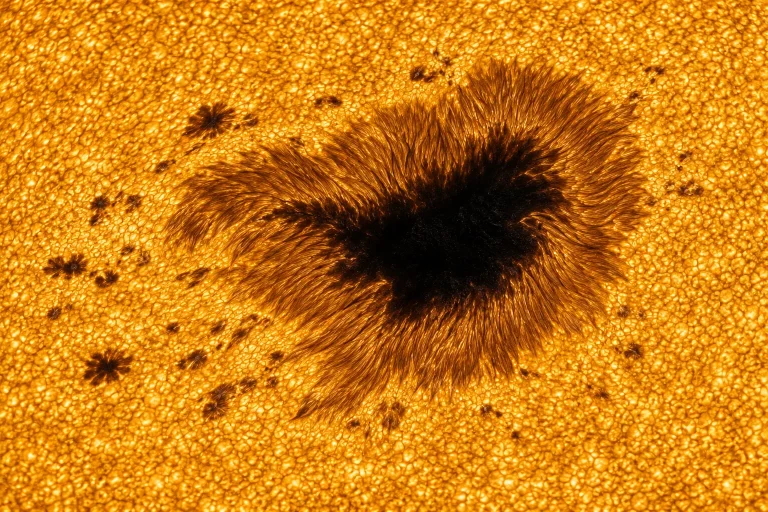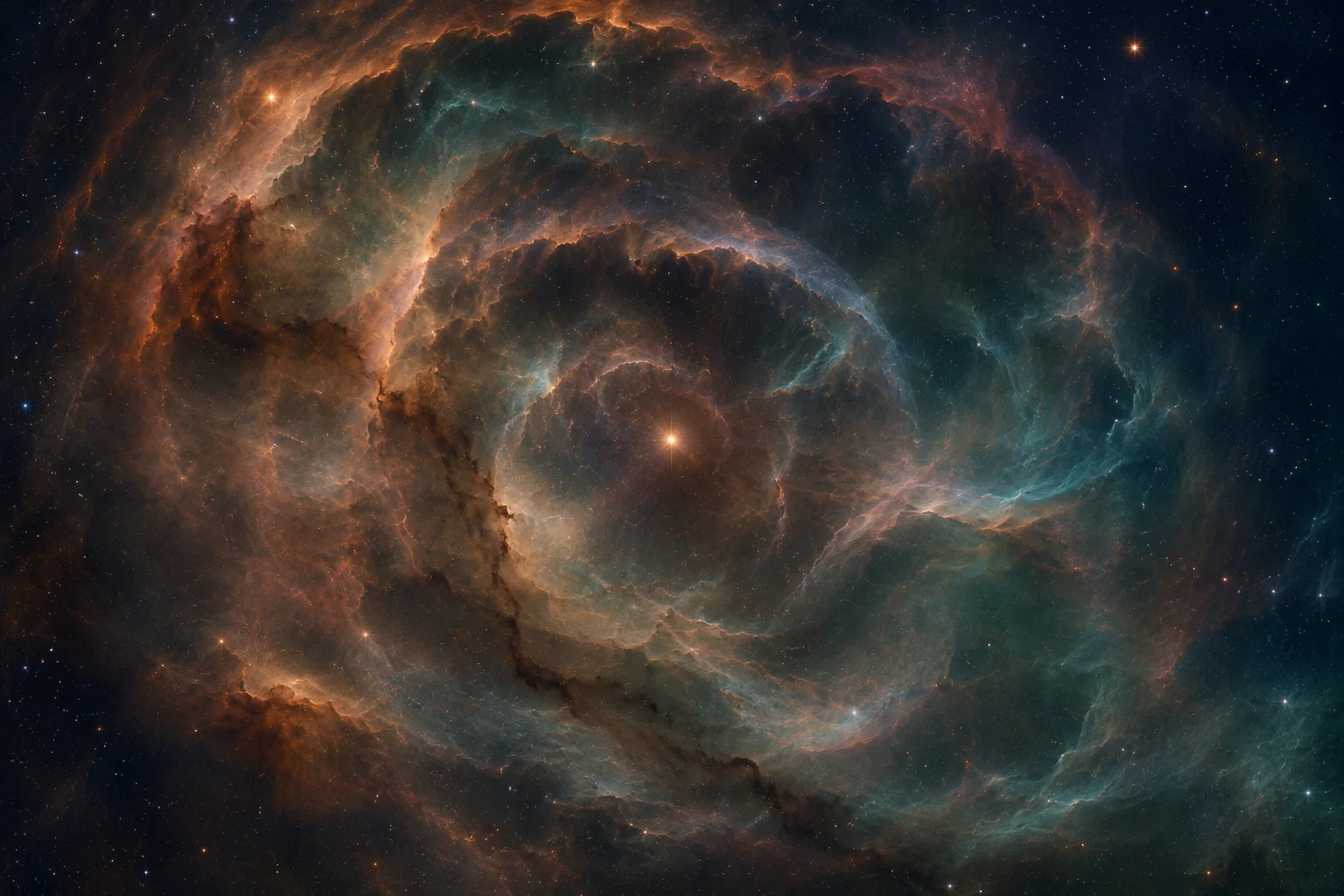
In a sequence of Hubble images taken in 2002, a star appears to blow an enormous, colourful bubble. Across seven months the illuminated region around V838 Monocerotis grew from about four light-years across to about seven. Treat those edges as pieces of flying debris and the arithmetic makes little sense. The apparent increase in diameter was three light-years in substantially less than a year. What moved across Hubble’s pictures was a pattern of illumination in dust that was already there.[1, 2]
Astronomers call it a light echo. Light from a bright stellar outburst can travel straight to a telescope, or it can head away in another direction, strike a dust grain and scatter towards the same telescope. The second route is longer. The observer can therefore receive light from the same outburst again, later and apparently from another direction in the sky. There is no need for the star to flare a second time.[1, 2]
Which clock measures the delay?
Put a star on the left of a piece of paper and a telescope on the right. Draw a straight line between them. Now put a dot for a dust grain well above the line. Draw one segment from the star to the dot and another from the dot to the telescope. Add those two lengths and subtract the straight line. The difference is the extra distance light must cover to arrive by way of the grain. Dividing it by the speed of light gives the echo delay.[2, 3]
For example, if one route adds a light-year to the direct path, light arrives a year later along that route. This does not mean the dust grain must sit one light-year from the star. A grain can be much farther away and add relatively little distance if it lies close to the direct line of sight in front of the star. It is the entire journey, including the leg from the dust to the observer, that sets the clock.
Now keep the star and telescope fixed and look for every point on the page that adds exactly the same extra distance. You can make the shape with a loop of string and two pins, one at each fixed point. Keeping the string taut while you draw traces an ellipse, along which the sum of the distances to the pins is constant. In space the corresponding surface is an ellipsoid. Near a star very far from the observer, astronomers often approximate the relevant part of that surface by a paraboloid.[3]
Why a ring can seem to outrun its own light
A photograph taken on one date selects dust that lies on the appropriate equal-delay surface for that date. A later photograph selects a different surface. If a thin sheet of dust cuts across those surfaces, the set of grains sending echo light towards us can trace a widening ring. If the dust is clumpy, only a few bright arcs may be visible. A dark gap might mean there is little dust at the right position. It need not mark a hole torn in an expanding cloud.[1, 2, 3]
Imagine numbering three grains along a distant dust sheet. Light from the outburst travels independently to grain one, grain two and grain three. None has to wait for the previous grain to pass the message along the sheet. An observer comparing successive pictures can see the illuminated patch jump from one region to the next faster than any object could travel between them. What the pictures time is a changing set of paths from the star, through grains, to the telescope.[1, 3]
That difference is especially striking in V838 Monocerotis. The date stamped on a Hubble frame tells you when scattered light reached the instrument. It does not give one common time at which every visible dust grain scattered its light. Some grains are nearer to us and some farther away. A picture makes them look like neighbours on a flat page, hiding a depth that matters to every path in the image.[1, 2]
What could a ring tell us about distance?
Echo geometry is useful precisely because light travels at a known speed. To turn an apparent ring size into a distance to the star, however, astronomers need some way to constrain where the scattering dust lies. Light scattered through about a right angle can show particularly strong linear polarization, meaning its electric field favours a particular orientation. Observations through polarizing filters therefore supply information that a plain image of brightness alone does not.[3]
For dust roughly in the plane of the sky containing the star, the extra path length to a distant observer is close to the distance from star to dust. An elapsed time can then supply a physical scale. Compare that scale with the angular size measured in the sky and one can estimate the star’s distance, much as a known-width object looks smaller when it is farther away. In practice astronomers modelled the duration and changing brightness of the outburst, the scattering angles and the distribution of polarization.[3]
A team applying this method to V838 Monocerotis obtained about 6.1 kiloparsecs, or roughly twenty thousand light-years, with an uncertainty of about ten percent. The result agreed with an independent estimate using stars in an associated cluster. The agreement mattered because each method can go wrong in a different way. In the echo method, uncertainty about the scattering angle that produces maximum polarization was particularly important.[3]
Receiving a sixteenth-century supernova again
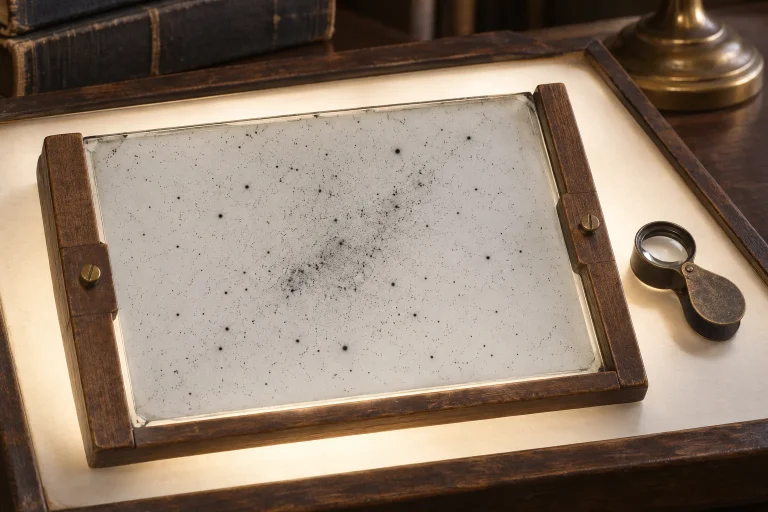
A light echo can preserve information that nobody was equipped to measure the first time around. In 1572 observers including Tycho Brahe followed a brilliant new star in Cassiopeia. Their descriptions preserve changes in its appearance. They could not record a modern spectrum, a measurement of how much light reached them at each wavelength. Centuries later, light that had taken a longer route offered another opportunity.[4, 5]
In 2008 astronomers obtained a spectrum from an echo of that explosion. Comparing its features with spectra of modern supernovae, they identified the event as a normal Type Ia supernova. The light they analysed came from the historical outburst, scattered by dust. A bright knot in the expanding remnant would have supplied a different sort of evidence, radiation being produced by material in its later state. The echo carried a sample of what the explosion itself had looked like around its peak.[4, 5]
Think back to those apparently racing arcs in the Hubble sequence. In one instance the delay helped measure the distance to a star. In another it gave modern instruments access to a sixteenth-century sky. For astronomers, dust is often something that blocks the view. Occasionally it sends just enough light the long way round to give an observer a second look.
Keep exploring
Polarization helps astronomers interpret scattered light. A neutron star offers a different kind of evidence left behind by some stellar explosions.
Sources and further reading
- NASA and the Hubble team — Light echo from V838 Monocerotis
- NASA — Seeing light echoes
- Sparks and colleagues — A geometric distance from polarimetric imaging of a light echo
- Krause and colleagues — The light-echo spectrum of Tycho’s 1572 supernova
- National Astronomical Observatory of Japan — Subaru observations of Tycho’s supernova echo
Keep exploring.
One remarkable idea at a time—nature, science, history and beyond.
Last updated November 20, 2026.

Barnakle Editorial Team
Barnakle Editorial Team is the collective byline used for Barnakle’s editorial articles. The contributor profile explains the team identity and links to the publication’s editorial policies.
More from the editorial team →