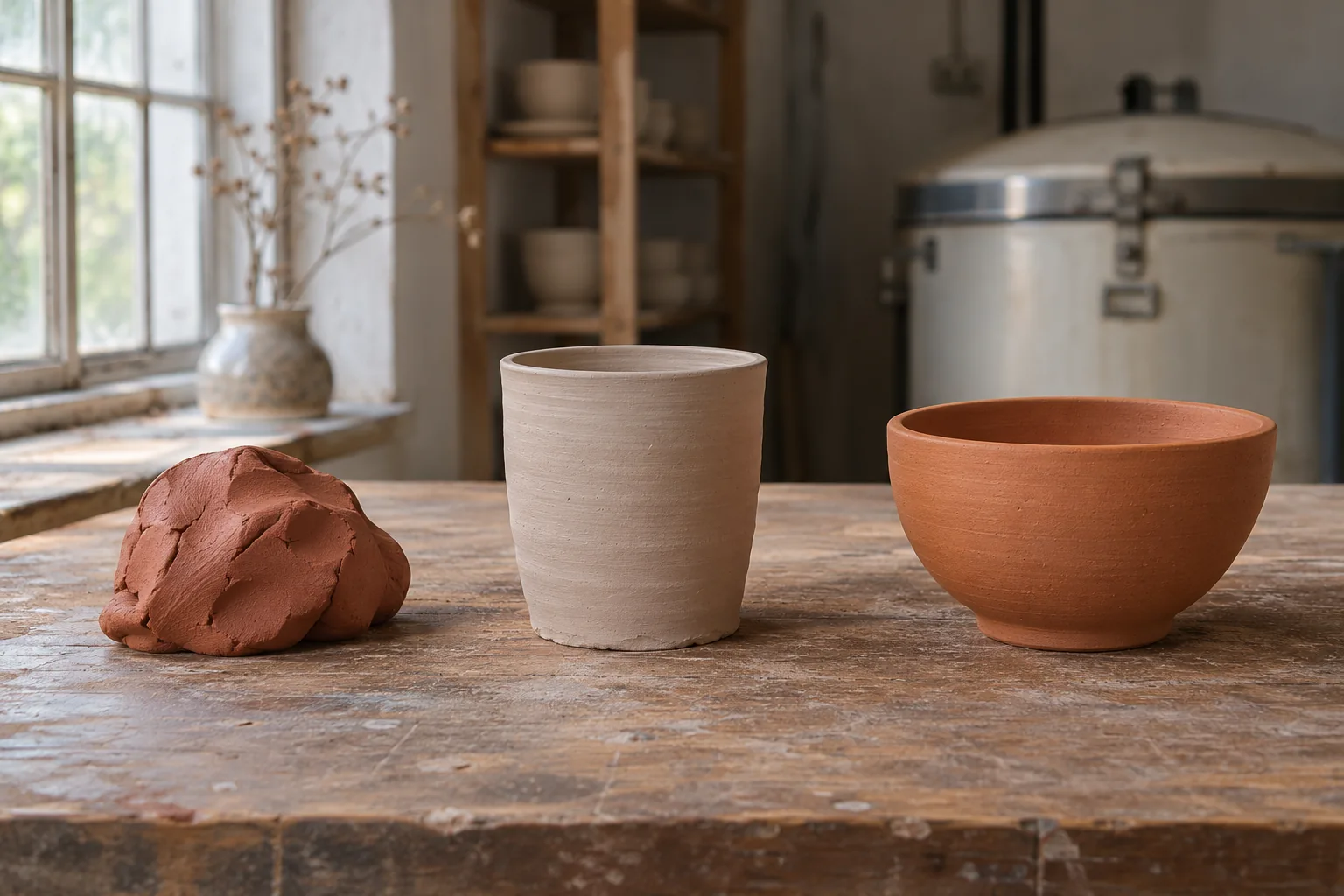
Firing turns clay into ceramic through a combination of chemical changes and the bonding of particles at high temperature. Water leaves in different stages, the original clay minerals change, and the body develops a stronger connected structure. Depending on its ingredients and firing conditions, part of the material may also form glass. [2, 3]
That is why leaving a pot to dry and firing it in a kiln produce different results. Dry clay has become rigid mainly because moisture has left it. A properly fired ceramic has undergone changes that adding water will not simply reverse. The transformation involves the material’s structure, rather than just how wet its surface feels. [2, 3]
Start with the minerals inside the mud
Clay contains very small mineral particles, often with sheet-like crystal structures. It forms through weathering processes that alter other minerals over long periods. “Clay” therefore describes a family of materials rather than one chemically uniform ingredient. Kaolin and bentonite, for example, contain different principal clay minerals and do not respond identically to water. [1]
The University of Waikato’s Science Learning Hub describes the flat, layered structure of kaolinite and contrasts it with the more water-accessible arrangement of smectite minerals. Such differences help explain why two earthy-looking materials can behave differently. A potter’s clay body also has a recipe: the properties of the finished object depend on what minerals and other components enter the kiln together. [1]
Drying removes moisture without completing the transformation
Water between particles helps make a clay body workable. As that moisture leaves, particles move closer together and the shaped object becomes rigid. Uneven shrinkage can distort a form or cause cracks. Drying is therefore an important structural stage even though it does not create the final fired ceramic. [2]
Further heating brings the loss of chemically bound water associated with the clay minerals. This is different from evaporating a film of liquid off a surface. The Western Australian Museum’s account places major loss of this bound water in the several-hundred-degree range during firing. It is one reason the finished material cannot be understood as a lump of mud that has merely been made exceptionally dry. [2]
Sintering builds bonds between particles
As firing proceeds, particles begin to join into a coherent solid. The term sintering describes the development of bonds between particles under heat. The material can become denser and stronger as its internal structure changes. Aalto University’s ceramic handbook describes both the strengthening and the shrinkage that accompany the process. [3]
Heating also brings a risk of deformation. The body can soften, warp, slump or ultimately melt if pushed beyond suitable conditions. A successful firing develops the intended structure while preserving the object’s form. [3]
Vitrification adds a glassy phase
Sintering and vitrification are closely connected in many clay bodies, but the words emphasize different features. Sintering concerns the joining of particles; vitrification concerns the development of glassy material. A fired body can contain a combination of crystals, glass and pores rather than becoming a completely uniform block of glass. [3, 5]
The distinction helps explain the range of ceramic products. Earthenware is generally more porous, while suitably fired stoneware is more densely vitrified. Porcelain uses a different composition to achieve its characteristic properties. These names describe material families, not interchangeable outcomes that any random clay will produce if the kiln is simply turned higher. Composition, additives and the firing process work together. [5]
Why there is no single temperature for all pottery
Temperature matters because it determines which changes can occur and how far they proceed. The Science Learning Hub gives roughly 1,100–1,300°C as a broad range for traditional clay-based ceramics, while describing much higher firing temperatures for some advanced ceramics. These examples communicate the scale of the heating involved; they are not universal operating instructions. [4]
The same resource explains sintering in terms of very fine particles joining at high temperature. It is the resulting microstructure that provides the useful solid, not the temperature number alone. A firing process must suit the actual material. Comparing ceramics therefore means considering what was heated and what structure developed, alongside how hot the furnace became. [4]
Glaze is a separate part of the object
A glaze is a glassy layer fused to the ceramic body. It can provide decoration and help make a porous surface less permeable. It is distinct from the clay fabric underneath, even though the two become joined during firing. A shiny surface therefore does not mean the entire thickness of a pot has turned to glass. [6]
Glazes contain silica and other ingredients, including fluxes that help it melt under suitable conditions. The glaze and the body also need compatible expansion and contraction behaviour. If they respond differently enough during temperature changes, the surface can crack. This is a relationship between two materials, not just an issue of whether a coating looks smooth when the object leaves the kiln. [6]
Why fired objects differ in colour and absorbency
The Canadian Conservation Institute explains that impurities and firing conditions influence the colour of ceramic bodies. Iron compounds, for example, contribute to familiar red, grey and buff appearances. Colour alone is therefore a poor test of what exact material or firing history a vessel has. A brown pot and a pale one can differ for several reasons. [6]
Porosity is another separate property. Science Learning Hub’s comparison of earthenware, stoneware and porcelain shows why “fired” does not automatically mean equally dense or impermeable. Some bodies retain connected spaces through which water can enter; others develop a much denser structure. Glazing the surface and changing the body’s internal porosity address related but different features. [5]
The lasting achievement of firing is that a workable mineral mixture becomes a new structural material. Reading a ceramic object means looking beyond the finished outline: its body, its pores, any glaze and the relationship between those components explain why it behaves as it does. Two bowls with similar shapes can embody quite different material histories. [1, 5]
Keep exploring
Continue exploring how solid structure affects behaviour, from thermal shock in a ceramic mug to the open pores inside aerogel.
- Why Can a Ceramic Mug Crack from Sudden Temperature Change?
- What Is Aerogel, and Why Is It So Light?
Sources and further reading
Checked November 17, 2026 against university teaching resources and museum conservation guidance. Temperature ranges are broad material examples, not a firing schedule. Sintering, vitrification and surface glazing are distinguished; no universal waterproof or food-safe result is implied.
- Science Learning Hub, University of Waikato — What is clay?
- Western Australian Museum — Ceramics: composition, firing and categories
- Aalto University Ceramic Handbook — From Clay to Ceramics and Ceramic Firing
- Science Learning Hub, University of Waikato — Temperature: the highs and lows
- Science Learning Hub, University of Waikato — What are ceramics?
- Canadian Conservation Institute — Care of Ceramics and Glass, Notes 5/1
Keep exploring.
One remarkable idea at a time—nature, science, history and beyond.
Last updated November 20, 2026.

Barnakle Editorial Team
Barnakle Editorial Team is the collective byline used for Barnakle’s editorial articles. The contributor profile explains the team identity and links to the publication’s editorial policies.
More from the editorial team →