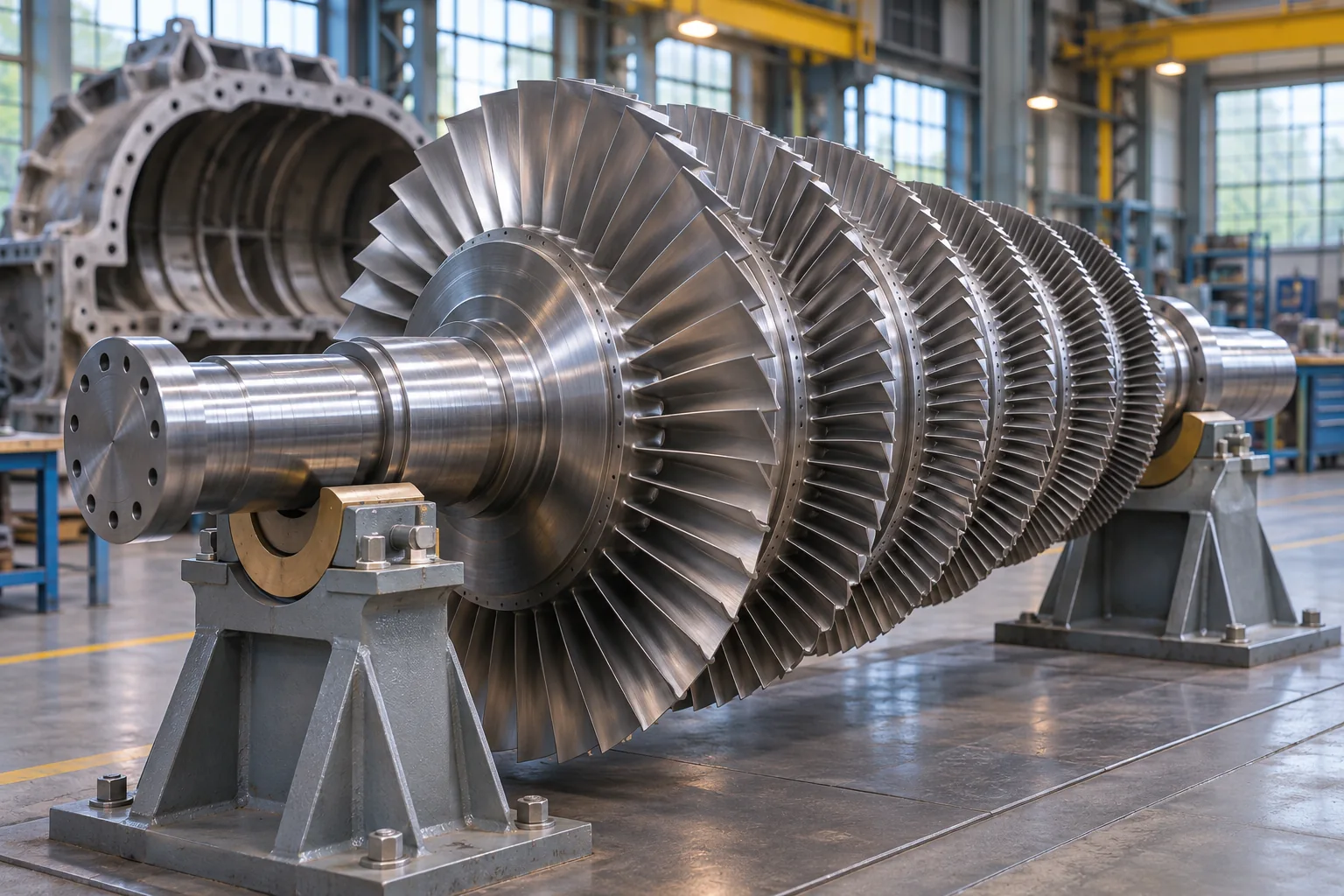
A steam turbine turns heat into mechanical power by allowing pressurized steam to expand through carefully shaped passages and rows of blades. The moving steam exerts forces on the rotor, turning a shaft. When that shaft drives an electrical generator, the generator converts the mechanical power into electricity. The turbine and the generator perform different steps in the energy conversion. [1, 2]
The steam is an energy-carrying working fluid. It receives heat elsewhere in the plant, passes through the turbine, and leaves with less energy available to deliver as shaft work. A spinning rotor is the visible result of that transfer. To understand the whole power station, however, the flow must be followed beyond the blades and back toward its heat source. [2]
Expansion gives the steam a useful direction
High pressure alone does not explain the machine. The steam must flow through a pressure drop in a path designed to convert its energy into useful motion. Fixed nozzles or guide passages can accelerate and direct the flow; moving blade rows then change its momentum and receive a force in return. Arranged around the rotor, these forces create a turning effect on the shaft. [3]
Impulse and reaction designs divide the pressure drop differently between stationary and moving passages. They are engineering approaches to managing expansion and transferring energy, rather than different fuels. A large machine can spread the process across many stages. The repeated blade rows reveal that staged steam path. [3]
Why the generator is another machine
The turbine’s output is rotation and torque. Electrical generation depends on the interaction of magnetic fields and conductors inside the generator. In a common arrangement described by the U.S. Energy Information Administration, the rotating magnetic field interacts with stationary coils, producing an electrical output. The shaft provides the mechanical connection between the steam-driven machine and the electrical one. [1]
That distinction is useful when comparing power sources. Water flowing through a hydro turbine, wind acting on a wind turbine and steam passing through a steam turbine can all provide mechanical power for a generator. Their energy supplies and turbine designs differ. Electricity is not a substance squeezed directly out of steam; it is the result of a sequence of energy transfers through connected equipment. [1]
The water-and-steam loop
A simplified condensing steam plant can be understood as a cycle of pumping, heating, expanding and cooling. A pump raises the pressure of liquid water. The heat source adds energy, producing steam. The steam expands through the turbine and delivers shaft work. A condenser then removes heat so the working fluid can return to a liquid state and be pumped around again. [4]
This is the basic pattern represented by the Rankine cycle. Actual plants add components and refinements, but the cycle makes clear why a turbine cannot be considered in isolation. The pump requires work, the heat source must keep supplying energy, and the condenser must transfer heat away. Reusing the water does not mean reusing all its energy without further input. [4]
Why a condenser matters
In a condensing arrangement, cooling the exhaust steam helps maintain a low pressure downstream of the turbine. The useful expansion depends on conditions at both ends of the steam path. The condenser is therefore part of the power-conversion system, even though it does not supply the heat that started the process. [4]
Other steam-turbine installations deliberately deliver exhaust or extracted steam for useful heating. The EPA’s technical account distinguishes these combined-heat-and-power applications from power-only condensing systems. Steam can serve an industrial process or district heating after doing some turbine work. The appropriate configuration depends on which forms of energy the site needs. There is no single exhaust arrangement that describes every steam turbine. [3]
The heat can come from different sources
A steam turbine does not identify its own fuel. In a nuclear power plant, fission supplies the heat used to make steam. The Department of Energy describes different routes in common light-water reactor designs: a pressurized-water reactor transfers heat to a separate steam circuit, while a boiling-water reactor produces the turbine steam in the reactor vessel. [6]
Those differences matter to the plant’s layout, but the electricity-producing sequence still includes thermal energy, turbine rotation and a generator. Calling a station “nuclear” describes its heat source and associated reactor system; the turbine remains a machine for extracting power from steam. A diagram of the steam side can therefore contain familiar components even when the equipment supplying the heat is very different. [6]
A second use for gas-turbine exhaust heat
A combined-cycle gas power station links two different turbine systems. The gas turbine works with hot combustion gases. Its exhaust still contains useful heat, so a heat-recovery steam generator transfers some of that energy into a steam cycle. The steam turbine then produces additional mechanical power rather than letting all that exhaust heat escape unused. [5]
This is why a gas turbine and a steam turbine can appear in the same station without being the same type of machine. “Combined cycle” describes the relationship between the energy systems. It also shows why the efficiency of one turbine component is not automatically the efficiency of the entire plant, with its heat recovery, cooling and auxiliary equipment. [2, 5]
Can sunlight supply the heat too?
Concentrating solar-thermal systems use mirrors to focus sunlight onto a receiver and heat a fluid. The collected thermal energy can drive a power cycle, including turbine-based arrangements. This is a different route from photovoltaic panels, which generate electricity without first using a large heat-driven turbine. Solar-thermal systems also come in different configurations, so not every installation uses the same engine or turbine layout. [7]
The comparison makes the turbine’s role easier to recognize. Its job is the conversion of flowing steam’s energy into shaft power. The choice of heat source, the design of the water cycle, the destination of rejected heat and the generator all determine how that component fits into a working station. Following those connections reveals far more than watching the rotor turn. [2, 7]
Keep exploring
Follow the conversion between electricity and motion in electric motors, then compare steam-driven rotation with a wind turbine.
Sources and further reading
Checked November 17, 2026 using government technical resources and a turbine manufacturer’s explanation. The simple condensing cycle is distinguished from combined heat and power. The DOE handbook is used for thermodynamic principles, not present-day industry statistics or universal efficiency figures.
- U.S. Energy Information Administration — How electricity is generated
- GE Vernova — How combined-cycle steam turbines work
- U.S. Environmental Protection Agency — Catalog of CHP Technologies, Section 4: Steam Turbines (2014)
- U.S. Department of Energy — Fundamentals Handbook: Thermodynamics, Heat Transfer and Fluid Flow, Volume 1 (1992), Rankine-cycle sections
- U.S. Department of Energy — How gas turbine power plants work
- U.S. Department of Energy — Nuclear 101: How does a nuclear reactor work?
- U.S. Department of Energy — Concentrating solar-thermal power basics
Keep exploring.
One remarkable idea at a time—nature, science, history and beyond.
Last updated November 20, 2026.

Barnakle Editorial Team
Barnakle Editorial Team is the collective byline used for Barnakle’s editorial articles. The contributor profile explains the team identity and links to the publication’s editorial policies.
More from the editorial team →