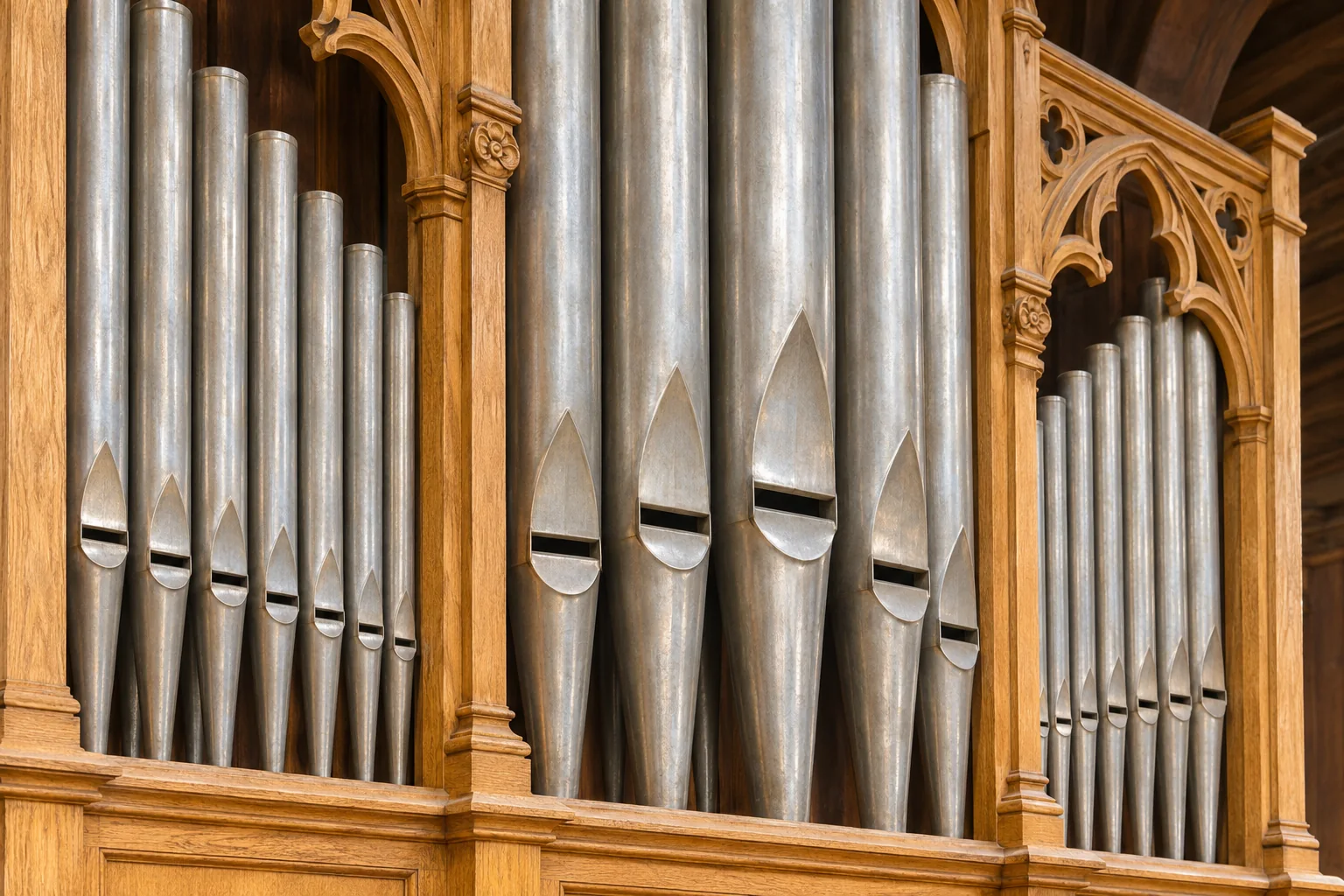
Press a key on a pipe organ and the key admits air to a pipe, or sometimes to several pipes at once. Which pipes speak depends on another choice the organist has already made with the stops. A blower supplies the wind, valves direct it and the pipes turn a steady flow into a rapid vibration. That division of labour explains one of the instrument’s most striking tricks. An organist can keep playing the same melody with the same touch and change the entire sound by drawing a different stop. [1, 2]
Follow one note from the keyboard
Start with the wind supply. A modern pipe organ usually has an electric blower. A reservoir or regulating system helps supply wind at the pressure the pipes need as different numbers of them come into use. Air travels to the windchest beneath a group of pipes. At that stage the instrument has a supply of energy, but it has yet to choose which note to sound. An organ with the blower running can still be silent. [1, 2]
Imagine a traditional mechanical organ with a slider chest. Pressing a key moves a linkage that opens a valve called a pallet. Wind can now enter a passage for that note. The stop control has a different job. Moving it brings holes in a slider into or out of alignment with the feet of a row of pipes. Where both the note passage and the selected stop admit wind, a pipe sounds. Other designs use electrical or pneumatic controls to perform selections that a tracker linkage and slider make mechanically. [1, 2]
Think of a simple organ with two independent rows of pipes available at the same pitch. Select the first row and press middle C. Its C pipe speaks. Select both rows and repeat the note, and two C pipes can sound together. Press a three-note chord with both rows selected and there can be six speaking pipes. This example assumes one pipe per note in each row. Some real stops draw on multiple rows, and instruments with shared pipework can assign one pipe more than one duty. [1]
How a steady stream becomes a musical note
In a flue pipe, air enters through the foot and passes through a narrow opening that forms a thin jet. The jet crosses the pipe mouth near a sharp lip. Small changes in the jet interact with pressure variations in the air column inside the pipe. When the interaction reinforces itself, the jet oscillates and repeatedly supplies energy to a resonant vibration. The sound can continue for as long as the wind is supplied. [3, 4]
There are two very different motions here. Air flows into the foot from the windchest, while the air involved in a sound wave oscillates back and forth locally. You hear periodic pressure changes. There is no need for one parcel of air to travel from the foot to the far end and back hundreds of times each second. Researchers studying flue pipes measure pressure and the motion of the jet separately because the starting transient and the sustained tone reveal different parts of their interaction. [3]
A reed pipe starts the vibration another way. Wind makes a flexible tongue beat against an opening in a shallot. The resonator above it influences the sound that emerges, while the vibrating length of the tongue is important for tuning. Two pipes with different tone-producing mechanisms can sound the same named note and still be easy to tell apart. Their overtones and the way the sound begins give them different musical characters. [1, 4]
Why the tallest pipes often make the lowest sounds
The pitch of a simple open flue pipe is linked to the effective length of its vibrating air column. For its lowest ordinary resonance, the wavelength is roughly twice that length. A longer column supports a longer wavelength and hence a lower frequency. Double the effective length in an idealized comparison and the frequency falls by half, an octave. Actual pipe mouths, widths and open ends affect the tuning, so measuring a metal tube with a tape will give only an approximation. [3, 4]
Closing the far end changes the allowed pattern of air motion. A simple stopped pipe can sound a fundamental about an octave below that of an open pipe of similar effective length. This is one reason an organ builder can produce a surprisingly low note without having room for a towering open tube. It also helps explain the foot numbers on stop labels. An eight-foot stop normally gives the written pitch, while a four-foot stop sounds an octave higher for the same key. The label describes a pitch relationship across the stop. Every pipe in an eight-foot rank is a different length for its own note. [1, 4]
How the player changes colour and volume
A rank is a family of pipes intended to have a related tone across a range of notes. Drawing different stops can add another family at the same pitch or one that reinforces a different octave. By combining them, a player can give a line of music a clear edge, a more rounded sound or a much fuller texture. Removing one stop while holding the same keys can change the blend even when the melody and harmony stay exactly where they were. [1]
A pianist can alter a note dramatically by changing the speed of the hammer strike. On a conventional pipe organ, pressing a key harder is generally a poor way to make a sustained pipe tone grow louder. One continuous control available on many instruments is the swell pedal. It opens or closes shutters around an enclosed group of pipes, changing how readily their sound reaches the room. A row of pipes outside that enclosure can continue at much the same level while the enclosed division recedes. [1, 2]
Listen to a held chord as an organist introduces another stop. If the brightness changes suddenly, an additional set of pipes may have joined. If the sound of an enclosed division grows gradually, the shutters may be opening. When the player releases the keys, the supply to those notes closes, although the building can keep ringing briefly. What reaches your ear at the end is partly the instrument’s valves and air columns, and partly the room that has been sounding along with them.
Keep exploring
Hear how a piano sets strings in motion and how a tuning fork sustains a clear pitch. Each instrument starts and maintains its vibration differently.
Sources and further reading
The organ resources describe wind supply, stops and key action. Acoustical research examines how a pipe’s jet and resonances interact as a note begins.
- Brigham Young University — Organ types and components
- Oklahoma Historical Society — How does a pipe organ work?
- Sensors — Sounding mechanism of a flue organ pipe, a multi-sensor measurement approach
- Angster and colleagues, Acoustics Today — Acoustics of organ pipes and future trends in the research
Keep exploring.
One remarkable idea at a time—nature, science, history and beyond.
Last updated November 18, 2026.

Barnakle Editorial Team
Barnakle Editorial Team is the collective byline used for Barnakle’s editorial articles. The contributor profile explains the team identity and links to the publication’s editorial policies.
More from the editorial team →