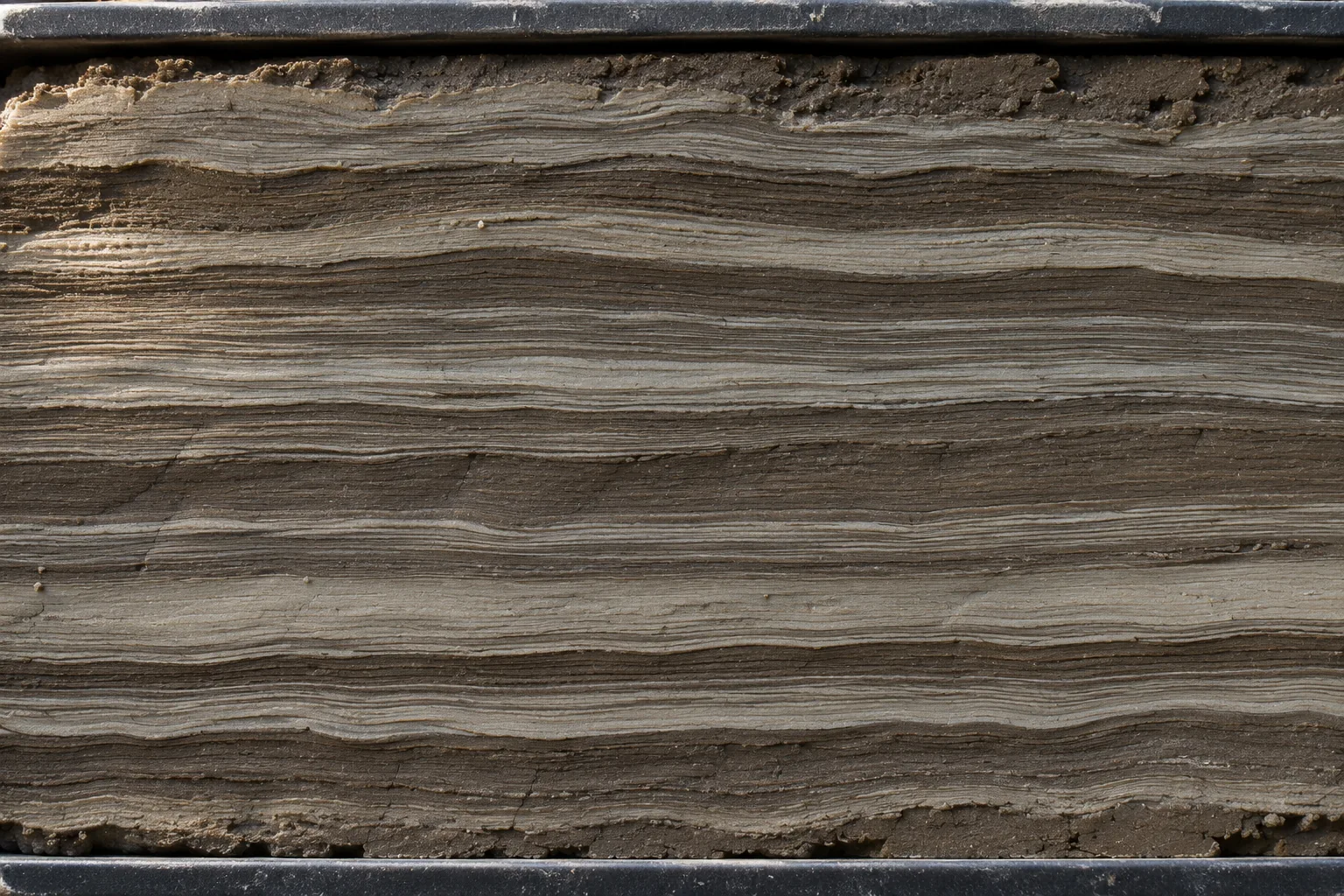
A pale band and a dark band in old lake mud can belong to the same year. In a lake fed by a glacier, summer meltwater can deliver sand and silt while very fine clay remains suspended. When the meltwater supply dwindles, the clay has a chance to settle in quieter water. If the sequence is preserved, the coarser deposit and its fine cap make an annual unit called a varve. The calendar lies in the return of a seasonal cycle. Counting every visible stripe as a separate year can give quite the wrong answer. [1, 2]
What arrives with the summer meltwater
A glacier grinds rock as it moves. Streams draining the ice can carry a mixture of particles to a lake. Where a stream enters standing water, the speed and direction of the flow change. Under suitable conditions, sediment-laden water also follows the slope along the lake bed. Sand, silt and clay have different settling behaviour. Material accumulating at one point on the bottom therefore reflects its distance from the inlet as well as the amount of sediment the stream supplied. [1]
One warm season can leave more than one visible stripe. Imagine a week of strong melting, followed by cooler weather and then another burst of runoff. Two pulses of silt may land on the same part of the lake bed, separated by a finer band. A summer flood can contribute an unusually conspicuous layer. The question for someone examining a core is where one whole depositional year ended and the next began. Every change in the weather need not start a new annual count. [1, 2]
As runoff decreases in winter, material fine enough to have stayed aloft during the more turbulent season can settle slowly. The resulting clay layer may have a smooth texture and a sharp contact where the next season’s coarser material arrives. In a good exposure you can trace that contact sideways across the face of the mud. The recurring change in grain size gives a better basis for recognizing boundaries than an assumption that every dark line must represent a winter. [1]
Why some lakes keep the record
Depositing layers is only half the job. Bottom currents can scour them away. Burrowing animals can mix what arrived in one season with what came later. A slump can bring older sediment down a slope and leave an extra deposit on top of a younger sequence. Relatively quiet bottom water and limited disturbance give thin layers a better chance of surviving. A thick mass of apparently uniform mud may contain centuries of sediment even where none of its individual years can be distinguished by eye. [1, 3]
Varve is a term for annual sedimentation, so the ingredients need not come from a glacier. In other lakes, seasonal growth of microscopic organisms or changes in water chemistry can produce contrasting material. Different processes can dominate at different times in a lake’s history. An annual pattern established for one part of a core is a starting hypothesis when the texture changes farther down. Researchers still need evidence that the new pattern represents the same unit of time. [3]
How to count what is actually there
Suppose you find 100 alternating pale and dark bands in a complete stretch of idealized glacial mud. If the stretch begins at the start of a summer deposit, ends after a winter cap and contains exactly one band of each kind per year, it represents 50 years. Now add a silt pulse within one summer. Your total number of visible stripes changes, but the number of complete years stays the same. Marking winter boundaries and counting the material between successive boundaries gives a more informative record than writing down a total stripe count. [1, 2]
The top and bottom of a section also deserve attention. A core can stop in the middle of a summer deposit, and its uppermost material may have been removed by erosion. An incomplete unit at the edge has a different status from a complete unit sandwiched between two clear boundaries. Two observers can agree on every visible mark and still report different durations if one counts partial years as whole ones. Stating what was counted makes their records easier to compare.
How two cores can extend one calendar
Now imagine two cores collected from different parts of the same former lake. The site nearer a stream may accumulate more sediment per year, so a particular year need not have the same thickness in both cores. What researchers can compare is the sequence of changes. Several thin years followed by an unusually thick one and then a gradual decline can make a recognizable pattern in both places. A match spanning many changes is generally more persuasive than lining up one spectacular stripe. [2]
This approach allows a record from one exposure to overlap another that continues farther back in time. It can also reveal a missing or duplicated count. If the early part of a proposed match fits closely and the later part fits only after shifting a year, researchers can re-examine the boundary near the shift. A fold, a faint winter deposit or an unusually complex summer may explain the discrepancy. The comparisons need to respect both the sediment itself and the regional setting that made the matching pattern possible. [2, 4]
A 5,659-year sequence in North America
In a 2012 study, researchers combined new cores, earlier exposures and radiocarbon ages in the northeastern United States. Their North American Varve Chronology assembled a continuous sequence of 5,659 years during the retreat of the last ice sheet. The number refers to a correlated series. It does not mean someone found exactly that many tidy pairs in one exposed bank. Independent dating helped place the relative annual sequence on a calendar, and overlaps between locations helped put the pieces in order. [4]
A varve can tell you that two events were a certain number of years apart without telling you their calendar dates all by itself. Think of a diary with a page for each day but no printed year on the cover. Its page order and the distance between entries are valuable before its opening date is known. Once an independent date ties part of the diary to a calendar, the entries have a second use. A lake can preserve the order of seasons under its bed, and a network of such records can recover the history of a retreating glacier. [2, 4]
Keep exploring
Compare the seasonal evidence in lake mud with the annual growth of a tree and the atmospheric record trapped in glacial ice.
Sources and further reading
- Tufts University, North American Varve Chronology Project — What are glacial varves?
- Tufts University — What is varve chronology?
- US Geological Survey — Lacustrine varve formation through time
- Ridge and colleagues — The New North American Varve Chronology
Keep exploring.
One remarkable idea at a time—nature, science, history and beyond.
Last updated November 19, 2026.

Barnakle Editorial Team
Barnakle Editorial Team is the collective byline used for Barnakle’s editorial articles. The contributor profile explains the team identity and links to the publication’s editorial policies.
More from the editorial team →