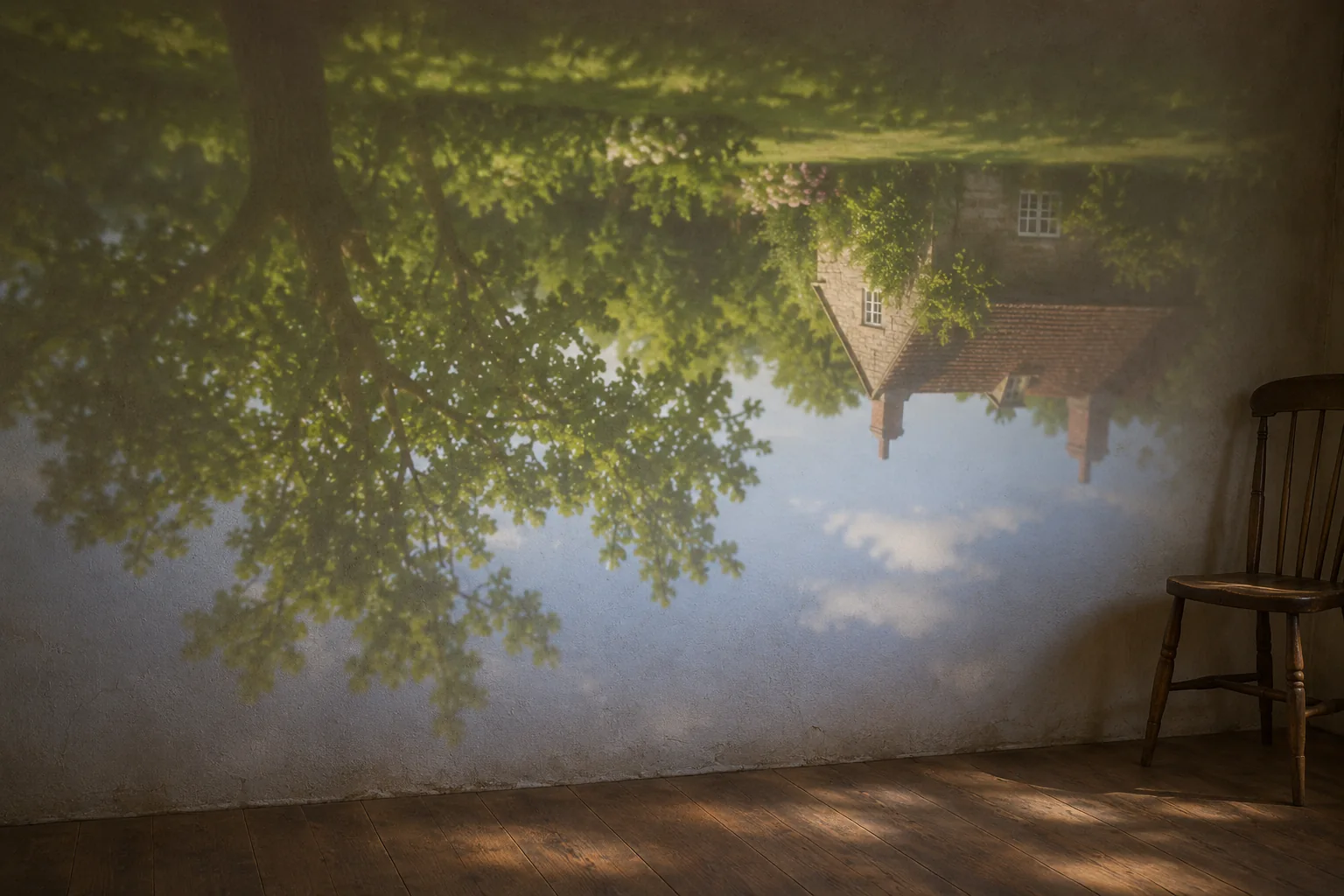
The chimney points at the floor. The blue sky runs along the skirting board. A branch dips in the breeze outside and its image lifts on the wall. A camera obscura can turn an ordinary room into a live view of the street using daylight and a small opening. To see why the picture is upside down, follow just two paths through that opening, one from the top of the chimney and one from its base.[1]
Light from the top travels slightly downward to reach the hole. Once inside, it continues on that downward path until it strikes the far wall. Light from the base approaches the opening at a higher angle and lands higher on the wall. The paths cross at the opening. Repeat that reasoning for each point across the building and the entire view appears inverted. No mirror or lens is required for the effect.[1, 2]
Why a whole window gives the room light but a tiny hole gives it a picture
Each little patch of a sunlit wall outside sends light in many directions. Through an open window, a point on the opposite indoor wall can receive light from the roof, the pavement and much of the sky at once. Their contributions overlap. The surface brightens, but you cannot pick out the chimney in the general wash of daylight.
Now cover the window except for one small opening. A line drawn from a particular spot on the indoor wall through the hole points to a particular part of the outdoor scene. Light from a great many other directions is blocked. The spot takes on the brightness and colour of a small piece of the view. The spot beside it samples the neighbouring piece. Together all the spots form the image the eye recognizes.[1, 3]
A pinhole has a finite width, so each spot samples a little patch rather than one mathematical point. Imagine opening a second hole a short distance from the first. Each opening makes its own complete view, shifted slightly on the wall. A bright window frame across the street would acquire a double edge. Make enough neighbouring holes and the overlapping views begin to explain why a large open window washes out the picture.
Predicting where the treetop will land
Draw a horizontal line through the opening. Treat it as the level shared by an imaginary observer at the hole and a mark on the far wall. Suppose a branch outdoors stands one metre above that level and is five metres from the opening. The ray from the branch drops one metre on its five-metre journey to the hole. On the other side it will drop another twenty centimetres for every metre of horizontal travel.[4]
Put a vertical white screen one metre behind the opening and the branch appears twenty centimetres below the mark. Move the screen two metres behind the hole and the image of the branch lands forty centimetres below the mark. These are similar triangles. With the outdoor scene in the same place, doubling the distance from the opening to the screen doubles every projected dimension. The screen must be wide enough to catch the enlarged picture.[4]
The same drawing works from left to right when all directions are marked in one fixed room coordinate system. A ray arriving from one side goes on to the other side of the centre line. For comparisons between a picture and the real street, mark the directions on the drawing first. A person who turns around to face a wall has also changed which side they call left. That extra turn is an easy way to confuse a mirror reflection with a projection.
The trade between brightness and detail
Make a large hole smaller and the chimney usually gains a clearer outline. Less light reaches the screen, though, and at some point the picture becomes hard to see. There is also a physical limit to the improvement. Light behaves as a wave. A sufficiently small opening spreads the light from one distant point into a broader diffraction pattern. A pinhole can therefore be too large for good definition or too small for it.[3]
Changing the screen distance produces another visible trade. At twice the distance the same outline becomes twice as wide and twice as tall. A postcard-sized feature now covers roughly four postcard areas. The light collected through the opening for that feature has to spread over all that extra space. Even when the larger image is easier to recognize, it can be noticeably dimmer. The darkness of a camera obscura gives that faint picture a chance to stand out.
Why some camera obscuras have a lens or a mirror
A lens lets a wider bundle of light from one object point enter and bends the rays toward a corresponding image point. A screen placed at the right distance can receive a brighter, sharply defined image. A mirror can fold the light path so the observer looks down at a drawing surface. The pinhole room, the lens and the mirror each solve a different part of the problem.[2]
The National Science and Media Museum describes portable reflex models used as sketching aids. An inclined mirror directed the image onto translucent paper, where an artist could trace an outline. A moving branch still moved on the paper. The artist had to decide which instant to capture and which details to keep. The device supplied a view in perspective, while the permanent record came from the hand holding the pencil.[2]
A simple way to read the projection
A bright building with a dark roof and a distinctive tree is an easier subject than a uniformly lit patch of grass. Look first for the boundary between roof and sky, then for one moving feature. A branch waving across the bright background can reveal the projection before the eye can distinguish colours in the dim room. The George Eastman Museum’s room demonstration uses this same ordinary daylight geometry.[1]
Once the view is recognizable, imagine moving only the screen toward the opening. The tree shrinks and the light gathers onto a smaller area. Move the screen back and the tree grows again. Through both changes, the chimney continues to point toward the floor. Its upside-down position was decided the moment the light from the chimney took a downward path through the hole.
Keep exploring
Explore how a modern camera finds focus and what changes when a mirror redirects an image.
Sources and further reading
- George Eastman Museum — How to Turn a Room into a Camera Obscura
- National Science and Media Museum — Introduction to the Camera Obscura
- Pinhole Visions — Pinhole imaging
- Pinhole Camera — Image size and geometry
Keep exploring.
One remarkable idea at a time—nature, science, history and beyond.
Last updated November 19, 2026.

Barnakle Editorial Team
Barnakle Editorial Team is the collective byline used for Barnakle’s editorial articles. The contributor profile explains the team identity and links to the publication’s editorial policies.
More from the editorial team →