A flat mirror reverses the direction perpendicular to its surface—not one chosen horizontal direction
The short answer
Stand before a mirror and raise your right hand. The raised hand stays on your right side of the reflected scene. We call it the reflected person’s left hand only after imagining that person as someone turned around to face us. That imagined rotation creates the familiar left-right comparison.
A mirror redirects incoming light
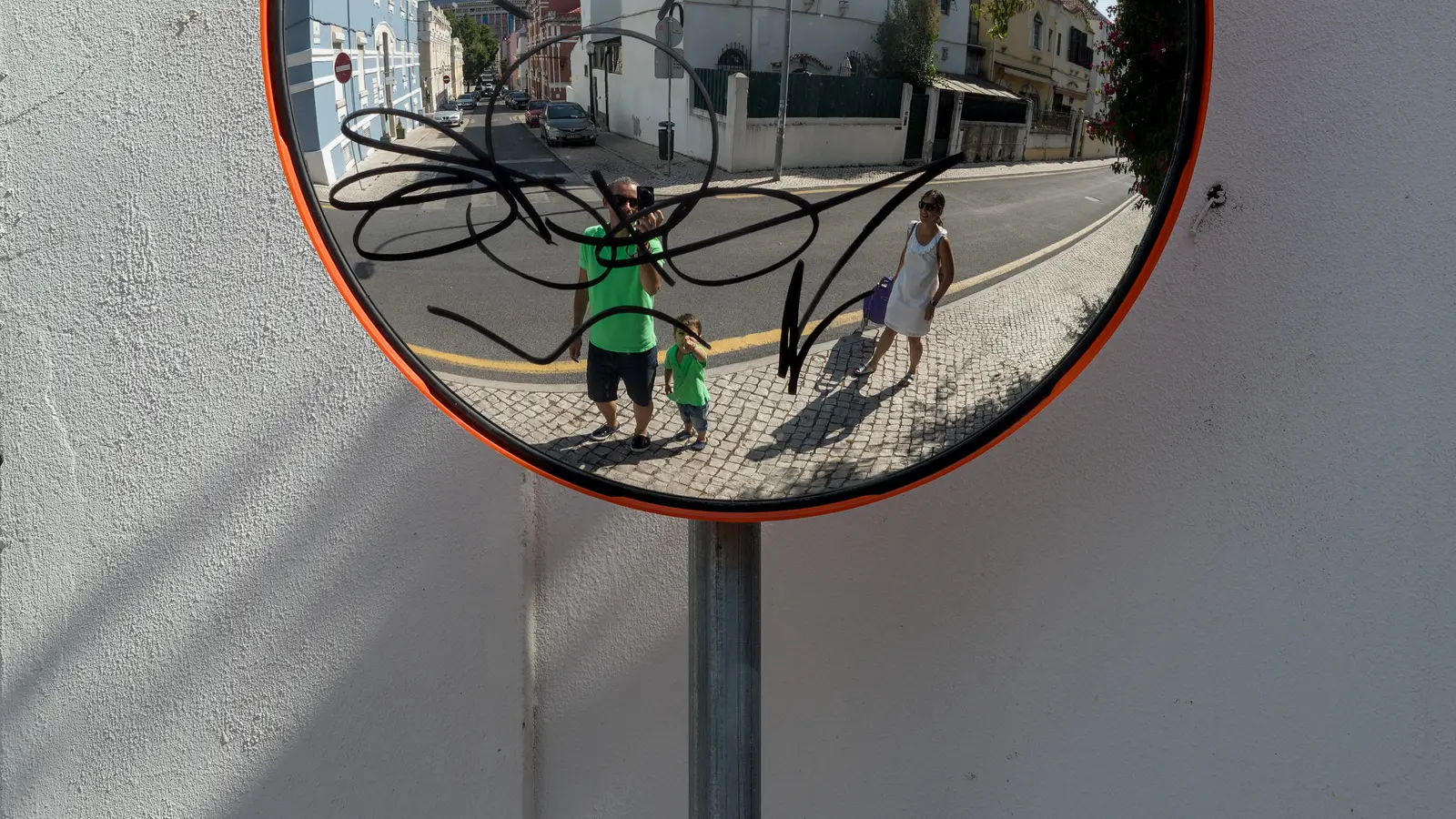
At each point on a smooth reflective surface, the outgoing ray leaves at the same angle to the surface normal as the incoming ray. Your eyes extend those returning rays backward and locate a virtual image behind the mirror.
The reversed axis is front to back
Coordinates parallel to a flat mirror stay aligned, while distance perpendicular to it changes sign. A point one metre in front appears one metre behind; the mirror has not selected the room’s left-right axis.
Mental rotation creates the familiar puzzle
To compare a reflection with yourself, people often imagine turning a duplicate body around a vertical axis. That rotation swaps left and right but preserves up and down, making the mirror seem responsible for the swap.
Writing exposes the geometry
Writing can look backward when we compare a mirror image with the front of a page or shirt turned around to face us. The reflection reverses the direction perpendicular to the mirror, while that comparison adds a rotation. Looking through a transparent written sheet from behind offers a way to separate the viewing direction from the mirror itself.
Up and down are not privileged
A mirror would appear to reverse top and bottom if you compared the image with a person imagined to somersault into the reflected position. The apparent choice depends on the rotation used for comparison.
Virtual images are not projected on a screen
Reflected rays diverge as though they came from behind the mirror, but they do not actually converge there. A camera can photograph the returning rays, yet a screen behind the mirror does not capture the virtual image.
Multiple mirrors transform orientation again
Two reflections can restore handedness or rotate a view depending on the angle between surfaces. Periscopes, kaleidoscopes and corner reflectors use carefully arranged repeated reflections.
Curved mirrors also change scale
Concave and convex surfaces redirect neighbouring rays differently, creating magnified, reduced, upright or inverted images. Those effects add focusing geometry to ordinary reflection.
Human perception supplies object identity
The visual system recognizes the reflected figure as you and maps body parts automatically. That useful recognition encourages the everyday language of a left-right swap even when the optical mapping is front-back.
Common misconceptions
A mirror does not know which direction is left, and it does not rotate the scene. It returns light according to surface geometry. The silvered or metallic layer also does not store a photograph; the image changes immediately as rays, observer and objects move.
How scientists know
Optical experiments trace laser rays, measure incident and reflected angles and reconstruct virtual-image positions. Coordinate transformations describe reflection mathematically, while perception studies test how people mentally rotate bodies, letters and objects when judging handedness.
Why is text backward in a mirror?
The reflected pattern has opposite handedness through the front-back transformation.
Why is my right hand on the other side?
You are comparing the image with a person imagined as facing you after a half-turn.
Does a mirror reverse up and down?
No axis parallel to the mirror is physically reversed; the comparison rotation determines the apparent swap.
Can a mirror image be projected?
A flat mirror forms a virtual image, so rays do not converge behind it onto a screen.
Why do two mirrors look different?
A second reflection can restore handedness or rotate orientation depending on mirror angle.
Key takeaways
- Flat mirrors reverse the direction perpendicular to their surface.
- Left-right reversal comes largely from mental comparison by rotation.
- The virtual image lies as far behind the mirror as the object is in front.
- Repeated or curved reflections create additional transformations.
Continue exploring
- How optical illusions work
- Why light bends in water
Sources and further reading
Keep exploring.
One remarkable idea at a time—nature, science, history and beyond.
Last updated October 29, 2026.

Barnakle Editorial Team
Barnakle Editorial Team is the collective byline used for Barnakle’s editorial articles. The contributor profile explains the team identity and links to the publication’s editorial policies.
More from the editorial team →