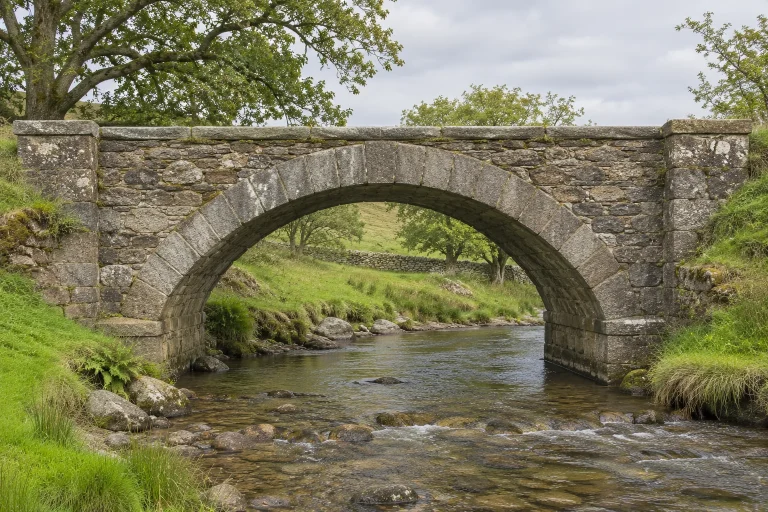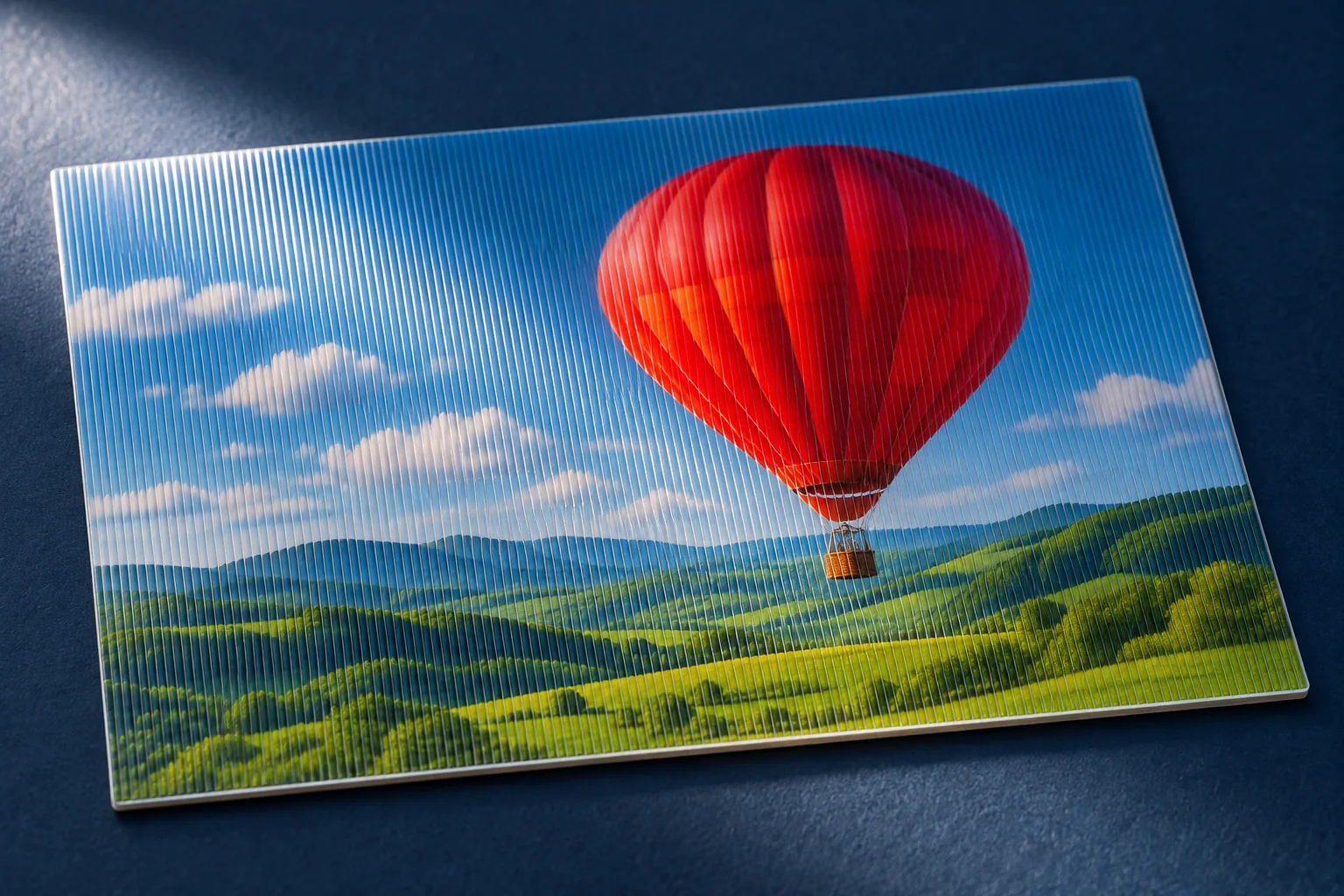
Hold a ridged postcard at arm’s length and a balloon sits on the ground. Tilt it a few degrees and the balloon is in the air. Stop halfway and you may catch a faint second balloon in the same sky. Run a fingertip over the front and you can feel the part that chooses which picture reaches you.
A lenticular print holds two or more pictures at once. Each has been cut into narrow strips in the artwork, and the strips have been interleaved beneath a sheet of tiny parallel lenses. From one angle the lenses show a set of strips belonging to the first picture. Shift the angle and another set comes into view. The card performs the same little trick in daylight, without a battery or a sequence of moving parts.[1, 2, 5]
Where does a whole extra picture fit?
Imagine two pictures of the same balloon field, made from exactly the same viewpoint. In the first, the balloon stands just above the grass. In the second, it has risen above a tree. Slice each picture into a hundred narrow vertical columns. Keep the columns in order. Beside the first column from the grounded balloon put the first column from the airborne balloon. Do the same for the second pair, then the third, all the way across the print.
That gives you two hundred columns occupying the width of the original picture. A magnifying glass held over the printing alone would reveal pieces of both scenes. The tree might line up reasonably well because it did not move. The edge of the balloon would break into stripes because neighbouring strips come alternately from different moments. Printing the file accurately gets both pictures onto the page. It takes a lens sheet to make either one readable on its own.[1, 2]
Each ridge on the clear sheet is a long lens with a curved face. Behind one ridge lies a small repeating group of image strips. Rays from different strips leave the curved face in different directions. From a suitable position your eye receives light predominantly from the corresponding strip under each ridge. Across the width of the sheet, those selected strips rebuild one coherent view. Your eye sees the red balloon against the sky because a great many little lenses are making the same selection at once.[1, 2]
Which way should you tilt the card?
Pick a ridge and trace it lengthwise. Its profile curves across that line, while along the line it stays nearly the same. This is why a card with vertical ridges can change when you move your head left or right. Slide your head straight up while keeping roughly the same horizontal angle and much less happens. Turn the card a quarter turn and the direction of the effect turns with it. The picture has a preferred direction you can discover with your eyes closed just by feeling the grooves.[2, 3]
Now keep the card still and close one eye. Move slowly across the image. A simple flip still works because one eye can sample different views in succession. If you can get both pictures while looking with only one eye, you have learned something quite specific. The change does not require binocular vision. Exactly the same system of little lenses can deliver depth, but for that effect the pictures must be chosen and arranged differently.[3, 4]
A second moment and a second viewpoint give different results
Take two photographs of a toy balloon from one fixed position while someone lifts it. Those pictures contain a change in time. Send them to different viewing angles and tilting the finished card can make the balloon jump. Take a second pair while the toy stays still and the camera moves sideways a little. Now the balloon shifts against the distant wall, just as your thumb seems to jump against the room when you close one eye and then the other. Those pictures contain a change in viewpoint.
A stereoscopic print makes different views of the same subject available to a viewer’s horizontally separated eyes. The brain can use the disparity between them as a cue to depth. One object then appears in front of another although all the ink lies in a single plane. A sequence of frames from different moments can give the impression of movement instead. The ridged cover by itself cannot tell you which effect a designer intended. The information is in the images underneath.[3, 4]
Why a second balloon sometimes shows through
A lens sheet and its printing have to agree on how often a group of strips repeats. The spacing of the lenses is its pitch, often described by the number of lenses in an inch. Suppose a sheet has 50 lenses to the inch. Each lens then occupies about half a millimetre of width. In a simplified two-view print, only half of that width is available to each view beneath each ridge. Four views would have to share the same space in still thinner strips.[1]
Here is why a small mismatch can be so conspicuous. If the printing repeats at a slightly different interval from the lenses, the first group could be lined up perfectly and a later group could be appreciably off. Like two rulers with slightly different divisions, agreement at one end does not guarantee agreement at the other. A viewer might see one scene cleanly on the left and a ghost of its partner towards the right. A slight skew between the strips and the ridges can also let unwanted parts of a neighbouring view show through.[1, 2]
Exhibit designers have another consideration. Someone passing a panel in a gallery sees it at a different range from someone turning a postcard in their hands. The Smithsonian’s exhibit team treats viewing distance as an early design decision. The distance influences both the choice of lens material and the preparation of the artwork. For a wall display, the designer gets to choreograph the change by considering where a visitor will stand or walk. With a postcard, the viewer supplies the movement of the scene with a turn of the wrist.[3]
If you have one of these cards, hold it still and let someone look over your shoulder. Move their viewpoint a little to the side. The two of you may be looking directly at the same patch of ink yet disagree about where the balloon is. Both accounts can be accurate. The ridges on the front of the card have sent a different picture to each of you.
Keep exploring
An inkjet printer puts the colour in place. A camera’s focusing system offers another way to see what changes when a lens and an image plane line up.
Sources and further reading
- Kodak — How does lenticular printing work?
- FESPA — An introduction to lenticular printing and lens sheets
- Smithsonian Exhibits — Designing and mounting a changing graphic
- National Museums Scotland — Photographic techniques and stereoscopic vision
- Stereoscopy.com — Image preparation and lenticular effects
Keep exploring.
One remarkable idea at a time—nature, science, history and beyond.
Last updated November 19, 2026.

Barnakle Editorial Team
Barnakle Editorial Team is the collective byline used for Barnakle’s editorial articles. The contributor profile explains the team identity and links to the publication’s editorial policies.
More from the editorial team →