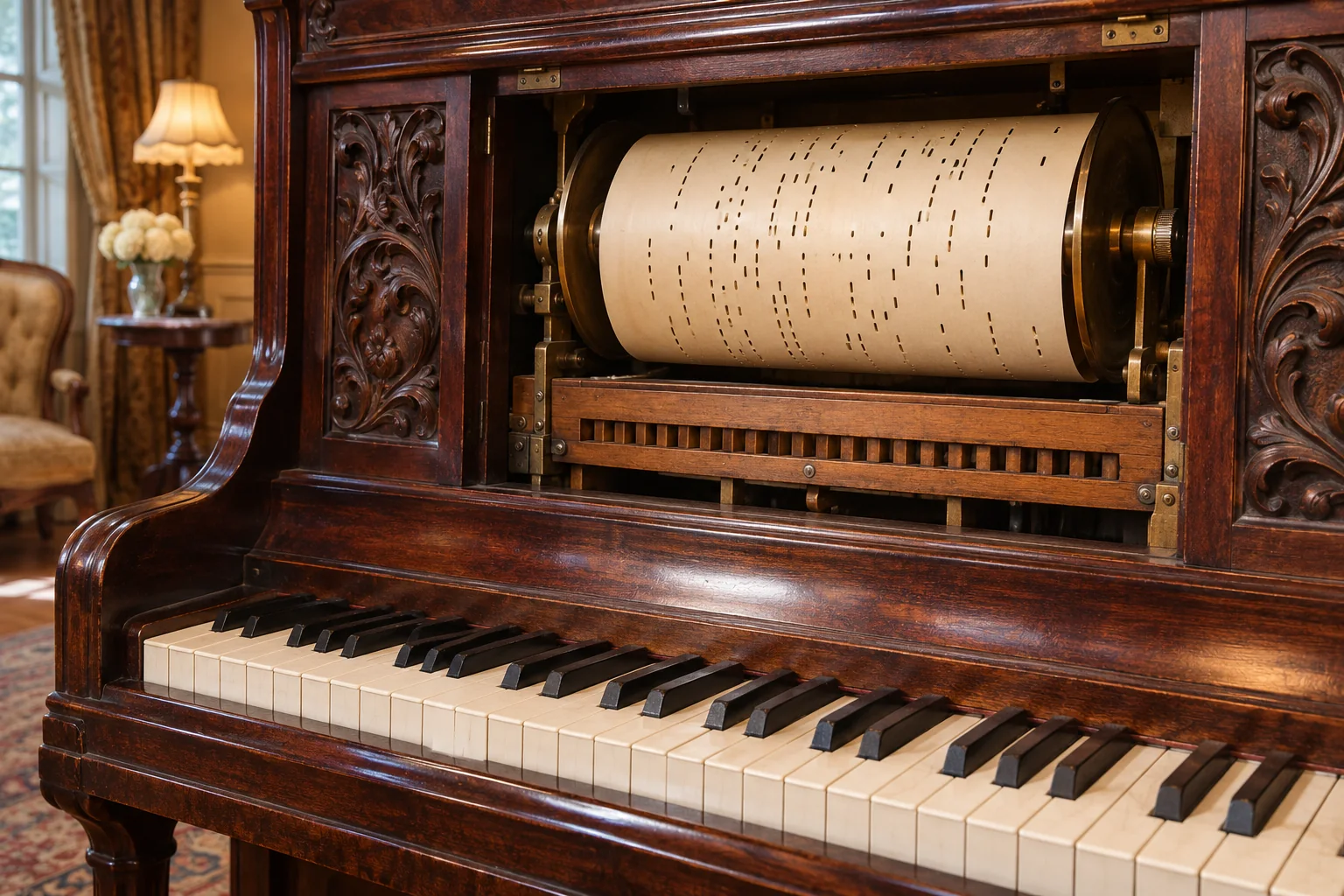
Watch a player piano with its roll compartment open. Just before a chord sounds, several little openings in the paper reach a brass bar together. Paper covers them again and the phrase moves on. If you could stop the roll at that moment, you could point to the chord with a pencil. There is no picture of a hand on the paper and no groove holding the sound of a piano. There are just holes, arranged in two directions.[1, 2]
Across the roll, the position of a hole selects a note. Along the roll, its position determines when that note begins. As the paper travels over the tracker bar, its perforations uncover small ports connected to the piano’s pneumatic mechanism. A change in air pressure operates a valve, a small bellows moves, and the piano action sends a felt hammer towards a string. The sound that fills the room is being made there, on that instrument.[1, 2]
How to read a tune without hearing it
Imagine unrolling a metre of paper on a table. Choose one track and follow it with your finger along the length of the sheet. An opening here and another farther along indicate two separate attacks on the same note. Now draw an imaginary line across the width, perpendicular to the direction of travel. Openings that begin along that line can trigger several notes together. A staircase of holes stepping across neighbouring tracks will sound different from a row beginning all at once, even if both use the same handful of pitches.
The paper also distinguishes a sustained note from a short one. An uninterrupted opening keeps a port exposed for as long as the opening takes to pass it. The same function can be achieved with a succession of closely spaced perforations that the mechanism reads as a sustained command. The paper needs bridges of its own material to stay strong. One should be cautious about counting every punched mark in a long row as a fresh blow of the hammer.[1, 3]
The speed of travel turns those distances into time. For an easy example, suppose two note beginnings lie two centimetres apart along a roll travelling at four centimetres per second. The second begins half a second after the first. Double the paper speed and the interval becomes a quarter of a second. No hole has moved sideways into a new pitch. This is why changing playback tempo on a player piano can make a tune hurry along while the tuning of the strings stays the same.
The hole admits air. What lifts the hammer?
A hole in a sheet of paper seems a flimsy way to set a substantial mechanism moving. The paper can be so light because it acts as a control. In a foot-pumped player, the treadles work bellows that maintain pressure below that of the surrounding air. With sound paper covering the tracker bar, a note channel remains in its resting state. Uncover its port and room air enters a small passage. The pressure change at a flexible pouch shifts a valve.[1, 2]
That valve lets the pressure difference act on a larger folding pneumatic connected to the piano action. As the pneumatic collapses, its linkage moves and the hammer strikes. When the port is covered again, the control returns to rest and the mechanism is ready for the next note. The hammer still has to rebound after striking the string, as in an ordinary piano. Holding the note command open allows the note to ring with its damper lifted where the piano has a damper. It does not leave the hammer pressing against the string.[1, 2]
There is a useful comparison inside the machine itself. The tracker hole can be quite small because the air passing through it only has to change the state of a valve. The larger pneumatic supplies the motion needed at the action. Trace the paper to the key and you are following an instruction. Trace the foot pedals to the bellows and the moving linkage and you are following the supply of energy. Both paths have to work for the note to sound.
Who plays the expression in the music?
Sit someone at a conventional foot-pumped player and there is still a musician’s job to do. How strongly they pump affects the available suction and how firmly notes sound. A tempo control changes how quickly the roll passes. Someone familiar with the phrase can linger before a cadence or give the next entrance more weight. The roll settles the question of which notes come next. It need not settle every question about how the music goes.[1, 2]
A reproducing piano preserves more of those decisions in the roll. Systems such as Duo-Art, Ampico and Welte added control information for musical expression. Dedicated perforations could call for changes in dynamics or pedalling. The systems used different codes, which matters when someone finds an old roll and wants to hear what it contains. A mechanism that can locate the melody notes still needs the appropriate way of interpreting the extra instructions.[1, 3]
How did a performance get onto paper?
A roll could be prepared by laying out the notes from a score. Another approach began with a pianist at a recording instrument. In 1912 Melville Clark developed the QRS marking piano. It recorded the timing of played notes for preparation of a master roll. Timing is a revealing part of a performance. Two pianists can read the same chord from the same score, yet one may strike its notes together while the other lets them overlap in a quick ripple. A record of the keys preserves evidence of that difference.[4]
Paper also creates an unusual challenge for an archive. The evidence is visible, but passing a brittle roll through a player can damage the object that preserves it. Stanford Libraries developed a dedicated scanner to capture historic rolls. A scan preserves where the perforations actually lie. Software and knowledge of the roll format are then needed to turn that arrangement back into musical events. A recording made from one particular playback adds still another layer, including the tuning, the instrument’s acoustics and the sound of the room.[5]
At the next chord, watch the brass bar instead of the keys. The shape about to cross the bar already exists several turns deep on the spool. What the paper carries through time is a set of decisions about playing. The instant those decisions become sound is the instant the hammer meets the string.
Keep exploring
Follow a hammer into an acoustic piano, then see how another machine reads holes to select threads on a loom.
Sources and further reading
- Player Piano Group — Pneumatic action and reproducing systems
- Deutsches Museum Digital — The pianola and the role of its player
- Pianola.com — How a player piano works
- American Society of Mechanical Engineers — The QRS marking piano
- Stanford Libraries — Digitizing historic piano rolls
Keep exploring.
One remarkable idea at a time—nature, science, history and beyond.
Last updated November 19, 2026.

Barnakle Editorial Team
Barnakle Editorial Team is the collective byline used for Barnakle’s editorial articles. The contributor profile explains the team identity and links to the publication’s editorial policies.
More from the editorial team →