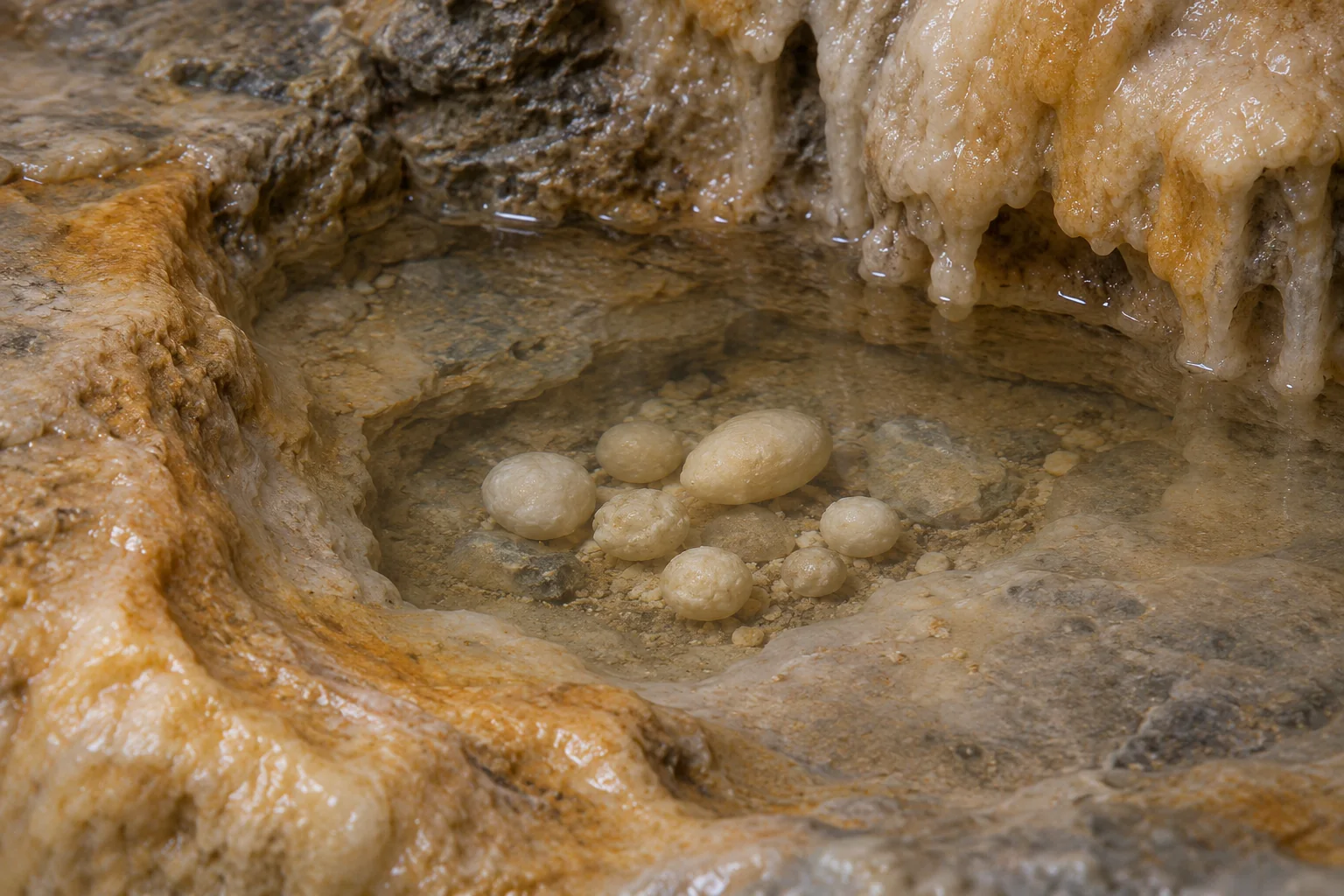
In a shallow limestone cave pool, a cluster of pale stones can look uncannily like a clutch of eggs. Some are smooth and almost spherical. Others nestle so closely that their sides have flattened against one another. Each began as something much smaller on which mineral could collect. Occasionally the object hidden in the middle turns out to be a piece of human history.[1, 2, 5]
A cave pearl grows when water deposits calcium carbonate around a loose grain or fragment. A drip supplies fresh mineral-bearing water. Repeated deposition builds a coating that can surround the original object on all sides. Cave pearls belong to the same broad family of mineral deposits as stalactites and stalagmites, but the distinction is easy to picture. A stalagmite grows upwards from its base. A pearl can grow around a centre that remains separate from the floor.[1, 2]
How a drip brings stone into a cave
The water arriving at the ceiling may have travelled through soil and limestone overhead. Water containing dissolved carbon dioxide can dissolve a little of the rock along its route and carry calcium and bicarbonate in solution. At the cave, conditions change. Carbon dioxide can escape from the incoming water into the air. When the water becomes sufficiently supersaturated with respect to calcite, some of that dissolved load can return to the solid state as calcium carbonate.[1, 2]
It helps to distinguish the water you can see from the mineral you cannot. A perfectly clear drop can deliver ions in solution. It does not have to look milky, carry sand or chip pieces off the ceiling. Nor does a pearl require the whole pool to evaporate. Water can enter, exchange gas with the air, deposit a small amount of mineral and leave. A succession of such visits can accomplish what would be hard to see happening in a single afternoon.[1, 2]
The first solid at the centre might be a grain of sand, a fragment of an older cave deposit or another small piece of debris. Once calcite coats it, the next deposit can grow on that coating. The original fragment can become a surprisingly small part of the final object. Cut across such a pearl in a laboratory and a dark, angular centre may lie inside a much rounder succession of pale layers.[2, 4]
Does the stone have to spin?
It is tempting to imagine each pearl turning continuously like a bead on a tiny polishing wheel. Drops certainly disturb a pool, and agitation can help a growing object avoid becoming cemented to the floor. But building a round coating and grinding down a rough stone are different processes. One adds material to an object. The other removes it. Growth around the surface can account for a rounded cave pearl without requiring it to spin continuously beneath a drip.[2]
Picture an irregular chip with a long dimension of four millimetres and a short dimension of two. Now give it a roughly uniform coating two millimetres thick on every exposed side. Its overall dimensions along those directions become about eight and six millimetres. The difference is still two millimetres, yet the shape is visibly less elongated. The example is deliberately simple. It shows how an original irregularity can become less obvious as a pearl gains mineral, even before considering where the water actually flows.
Neighbouring pearls complicate that tidy example. A surface in contact with another pearl does not experience exactly the same water circulation as one facing the open pool. If deposits eventually join, the objects can become fixed together or cemented to their nest. A pearl can also have a surprisingly angular outline. The name reflects a family resemblance, not a test of perfect roundness.[2, 3]
A layer is a change in growth, but how much time did it take?
In an underground mine, researchers followed two adjacent pearl-forming sites over a period stretching from 2006 to 2014. One group grew beneath an active drip. Others occupied small pools behind mineral rims. Even pearls only millimetres apart could have different numbers and sequences of layers. The shared location and overlapping histories made that difference particularly revealing. Two pearls in a single pool did not necessarily make the same record.[3]
Think of trying to count years by assigning a birthday to every stripe in a cross-section. If two neighbouring pearls experienced the same seasons but preserved different stacks of stripes, something more local must have influenced their records. Water flow near each growing surface and the escape of carbon dioxide are possible contributors. Within the mine pools some pearls nearer the top also grew faster than neighbours farther down. Just a few millimetres of position could matter.[3]
A separate study examined 27 pearls from a splash pool in Lebanon’s Kanaan Cave. Microscopy and chemistry gave evidence that some crystals grew across earlier internal features. A pearl’s interior can therefore record two histories at once, the original deposition and later reorganisation of its calcite. A pale layer visible today may retain some evidence of its first growth even when part of its crystal texture has changed. Reading such an object calls for more than counting rings around a centre.[4]
A pottery fragment at the heart of a pearl
An unusual collection from the Joweizeh spring tunnel in the Jerusalem Hills offered archaeologists another clock. Among fifty pearls, researchers identified examples formed around fragments of pottery and ancient plaster. Two contained pieces of lamps assigned to the Hellenistic period. Charcoal preserved in plaster nuclei also supplied material for radiocarbon dating. A fragment sealed in calcite could reveal something about the use and repair of the tunnel as well as the water that later ran through it.[5]
The reasoning works in a particular direction. A coating that grew around a piece of a broken lamp must be younger than the fragment. Dating the lamp does not give the precise year when the first calcite crystal settled on it. It supplies a limit, and it identifies a human object that was already present before the mineral concealed it. From the outside, a pearl with a story like that could resemble one that began around an ordinary grain of sand.[5]
That is a good reason to look twice at a shallow cave pool. The apparent eggs may be accumulating stone. The rounded outsides give very little away about their beginnings. And the ripple spreading from the next drop marks the arrival of another small instalment of the same material that built the cave’s hanging decorations.
Keep exploring
Compare a pearl with a cave formation fixed to the floor, then see how a living oyster makes its namesake.
Sources and further reading
- National Park Service — How cave mineral formations grow
- National Speleological Society — Cave pearls
- Sedimentology — Growth and recrystallization in two adjacent mine pearl sites
- Fadi H. Nader — Cave pearls from Kanaan Cave, Lebanon
- Archaeometry — Archaeological artefacts at the centres of cave pearls
Keep exploring.
One remarkable idea at a time—nature, science, history and beyond.
Last updated November 19, 2026.

Barnakle Editorial Team
Barnakle Editorial Team is the collective byline used for Barnakle’s editorial articles. The contributor profile explains the team identity and links to the publication’s editorial policies.
More from the editorial team →