The Apollo 12 lunar module produced one of its most useful measurements after the astronauts had finished with it. Its spent ascent stage struck the Moon about 76 kilometres from an instrument they had left on the surface. The impact was brief. At the seismometer, the signal took about seven minutes to reach its greatest amplitude and about 55 minutes in all to fade into the background. A quick collision had left a remarkably long trace.[1]
That trace explains the familiar description of the Moon “ringing.” A seismometer measures ground motion. Energy from a quake or impact can take many paths through broken lunar rock before it reaches the instrument, and some of that energy takes a long time to die away. Scientists can use the lingering motion to investigate the material it travelled through. The astronomical detective work begins with distinguishing the length of the event from the length of the recording it produced.[1, 2]
What the astronauts left behind
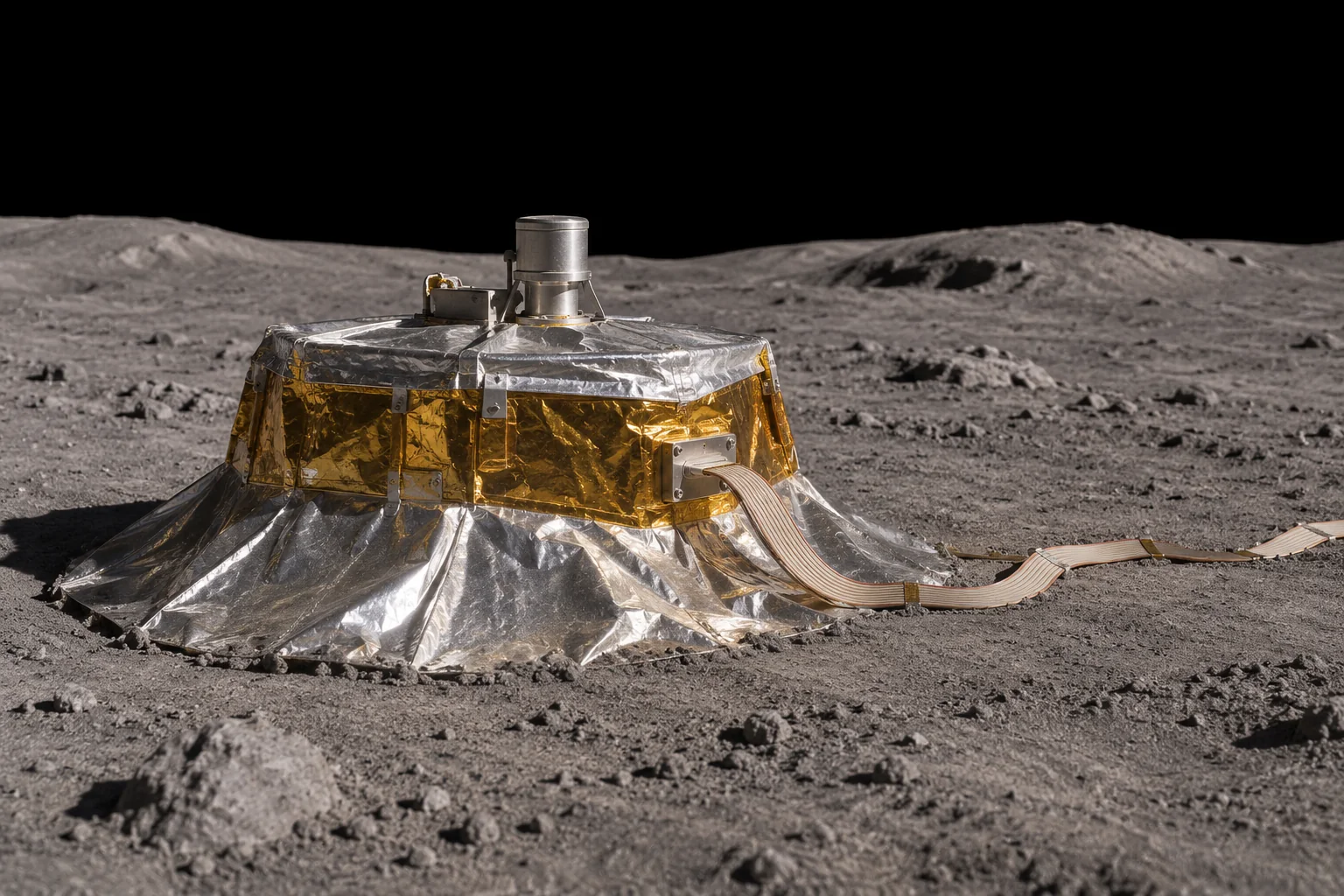
A seismometer can detect ground motion far too small for someone standing beside it to feel. Its case moves with the ground. A sensitive mechanism measures motion relative to a suspended mass, providing a signal that can be sent back to Earth. Several directions of measurement give more information than a single up-and-down trace. In the Apollo 12 impact experiment, the ascent-stage signal appeared on all three long-period components. The strongest motion was still measured on the scale of nanometres.[1]
An impact with a known origin has a special advantage. If you find an unfamiliar bump on a recorder, you might have to determine its time, place and cause all at once. With the spent spacecraft, mission records constrained where and when the blow landed. Researchers could ask a narrower question. Given this particular impact and this distance, what did the ground do at the station? The answer gave them a real example against which to compare events that arrived without advance notice.[1, 3]
Try representing that observation with two marks on a page. The first, a vertical tick, is the impact time. The second, a low hill rising gradually and trailing off to one side, shows how strong the signal was at the instrument as the minutes passed. Confusing the width of the hill with the duration of the collision would lead you seriously astray. The material between the two locations is an active part of the measurement.[1, 2]
What can set the lunar ground moving?
Apollo recorded naturally occurring events with several origins. A meteoroid delivers a blow at the surface. Surface material can expand and contract with the shift between the long lunar night and the heat of daylight. Deep moonquakes recur in source regions hundreds of kilometres below the surface. Their timing is connected to tidal stresses as Earth’s gravity deforms the Moon. Those are tides in solid material. A body does not need an ocean to experience differences in gravitational pull across it.[3, 4]
Shallow moonquakes form another group. As the Moon’s interior cools, contraction can stress its brittle outer layers. Where crust moves along a thrust fault, one block can ride up over another and leave a low cliff called a scarp. Those surface features give scientists something to compare with estimated locations of past shaking. A map of scarps and a set of old instrument traces come from quite different observations, so a geographical match is worth investigating.[4, 5]
One study returned to the records of 28 shallow moonquakes detected by the Apollo network. After refining source estimates, the team found eight events within about 30 kilometres of a young fault scarp. They considered those positions alongside the expected stresses and signs of disturbance near the scarps. The argument depends on the combination. A cliff alone cannot tell you the date it moved, and an estimated quake location carries an uncertainty that a dot on a small map can conceal.[5]
Why a sharp impact has such a long tail
Billions of years of impacts have fractured the material near the lunar surface. When a seismic wave encounters a change in physical properties, some energy can be redirected. Repeat that across a region full of contrasts and a station receives contributions by many routes. One packet of energy can take a relatively direct path. Another may be scattered repeatedly before arriving. The late part of a record is called the coda.[2, 3]
Imagine sending runners from one gate to another through a town with a dense network of lanes. If everyone leaves together but takes a different route, arrivals can continue well after the first runner reaches the gate. A count at the second gate need not peak at the instant of the first arrival. Seismic waves behave differently from runners in plenty of respects, but the example captures why a single starting time can produce a broad spread of arrivals.
Two processes are easy to mix up here. Scattering redirects energy that can still reach a detector. Attenuation through internal losses converts some mechanical energy into other forms, leaving less to arrive by any route. Analyses of Apollo signals have considered both effects, along with the possibility of near-surface layers concentrating energy. A long coda is evidence about the paths and losses in lunar material. It is a poor basis for guessing the shape of the Moon’s interior from the sound of a household bell.[2]
What scientists can recover from a noisy record
A long tail is both an opportunity and a nuisance. It contains information about the crust, but early scattered arrivals can obscure a later wave an investigator wants to identify. Repeating deep events offer a way to look for family resemblances. A signal that appears several times with a similar shape at the same station is easier to distinguish from a chance fluctuation. Agreement across several stations adds information about where an event occurred.[2, 3]
It matters where those instruments were put. A network of Apollo stations on the near side could record waves travelling over great distances, but its geometry did not offer the same view of every location. A small difference in a proposed source position can change the arrival times more clearly in one direction than in another. That is why a location inferred from sparse old records deserves an uncertainty region, even if modern imagery of a nearby fault is sharp enough to pick out individual boulders.[3, 5]
Apollo 12’s ascent stage makes a particularly good starting point for understanding the whole experiment. We know what hit the Moon, roughly where it hit and when the shaking reached its maximum at a station some distance away. The clock ran for nearly an hour on an event whose cause was over almost as soon as it began. Most of the story written on that seismogram belongs to the Moon itself.
Keep exploring
Compare lunar records with the waves that reveal Earth’s interior and the processes that generate earthquakes here.
Sources and further reading
- NASA — Apollo 12 Preliminary Science Report, passive seismic experiment
- Journal of Geophysical Research — Investigation of scattering in lunar seismic coda
- NASA Planetary Data System — Lunar seismology background
- NASA Science — Moonquakes
- Watters and colleagues — Shallow seismic activity and young thrust faults on the Moon
Keep exploring.
One remarkable idea at a time—nature, science, history and beyond.
Last updated November 19, 2026.

Barnakle Editorial Team
Barnakle Editorial Team is the collective byline used for Barnakle’s editorial articles. The contributor profile explains the team identity and links to the publication’s editorial policies.
More from the editorial team →