

Protecting a qubit without copying or peeking at it
What to know
- A logical qubit is encoded across a group of physical qubits.
- Syndrome measurements expose error patterns without reading the protected answer.
- Quantum codes must handle both bit-like and phase-like errors.
- Useful fault-tolerant machines require error rates below code-dependent thresholds.
A classical computer can protect information by copying bits. If one copy is damaged, another may reveal what the original should have been. Quantum information cannot be safeguarded so simply. An unknown quantum state cannot be perfectly copied, and measuring a qubit in the wrong way can destroy the relationships that give a quantum algorithm its power. Quantum error correction is the set of ideas that works around those limits.
Why quantum information is so fragile
A physical qubit can be built from a superconducting circuit, trapped ion, photon or another controllable quantum system. None is perfectly isolated. Stray electromagnetic fields, material defects, imperfect control pulses and interactions with the environment can alter its state. Researchers describe several broad error processes, including relaxation, dephasing and imperfect gates or measurements.
Classical language often divides mistakes into bit flips, where 0 becomes 1, and lost data. Quantum states have amplitudes and relative phases, so a useful code must detect both bit-like and phase-like errors, plus combinations of them. Continuous physical disturbances become discrete error events when interpreted through a code’s measurement structure. That is one of the central conceptual achievements of quantum error correction.
One logical qubit, many physical qubits
A quantum error-correcting code encodes a logical qubit across an entangled state of several physical qubits. The protected information is no longer located in any single component. If a limited number of physical errors occur, the collective state still contains enough structure to identify their effect and recover the logical information.
This redundancy is not ordinary copying. The no-cloning theorem remains intact because the individual physical qubits do not each hold an independent readable copy of the unknown state. Instead, carefully designed correlations spread the information across the system.
A small teaching example is the three-qubit repetition code, which can detect a single bit flip. It does not by itself protect against arbitrary quantum errors, but it shows the pattern: compare relationships among qubits rather than reading the protected logical value. More complete codes combine checks sensitive to different kinds of error.
Syndromes reveal the error, not the answer
The key measurements are called syndrome measurements. Ancillary qubits interact with data qubits through a circuit and are then measured. Their results reveal whether certain expected parity relationships have changed. A syndrome can indicate that an error probably occurred in a region of the code without revealing whether the logical qubit represents one computational outcome or another.
Because hardware is noisy, one round is not enough. Measurements themselves can be wrong, so experiments repeat syndrome extraction over time. The evidence becomes a three-dimensional pattern across the code’s layout and successive cycles. A classical decoder analyses that pattern and estimates the most likely chain of errors.
Correction does not always require physically flipping a qubit immediately. Software can update a record called a Pauli frame and reinterpret later measurements accordingly. What matters is preserving the logical computation, not making every physical component look pristine at each moment.
Why surface codes receive so much attention
Surface codes arrange physical qubits on a two-dimensional layout with local checks. That locality suits several hardware platforms because each qubit needs to interact mainly with nearby neighbours. Logical information is associated with global features of the encoded state, while local measurements reveal disturbances.
The code distance describes, roughly, how many physical errors are required to produce an undetected logical error. Increasing distance uses more physical qubits but can reduce the logical error rate—provided the underlying operations are good enough. Below a threshold error rate, adding code size should improve protection. Above it, extra noisy components may make the result worse.
This is why demonstrations compare logical error rates at different code distances. Evidence that a larger code suppresses errors more effectively than a smaller one is an important step. It indicates that the experiment has entered the regime where scaling the code can help, at least for the measured operations and noise conditions.
Fault tolerance is more than stored memory
Protecting an idle logical qubit is not the final goal. A useful fault-tolerant computer must initialize logical states, perform gates, measure results and move or combine information without allowing one physical fault to spread into an uncorrectable pattern. Every part of the computation needs procedures designed around the code.
Some logical operations are easier than others. Powerful universal computations may require specially prepared resource states, often called magic states, and a costly process of distillation. The overhead can be large: one reliable logical qubit may need many physical qubits, and a useful algorithm may need many logical qubits operating through vast numbers of correction cycles.
What recent experiments actually show
Research groups have demonstrated repeated syndrome measurements, logical qubits whose performance improves as a code is enlarged, and early fault-tolerant operations in several platforms. These are meaningful milestones because they test the central scaling promise rather than simply adding more unprotected qubits.
They do not mean that arbitrary commercial problems can now be solved better than on classical computers. Results may concern a specific logical memory experiment, error model or circuit depth. Hardware can also contain correlated errors, leakage outside the intended qubit states and rare events that do not match a decoder’s assumptions. Those details determine whether laboratory progress extends to large computations.
The decoder is part of the machine
Quantum error correction depends on classical computing. A decoder must process syndrome data fast enough to guide the experiment, often under tight latency limits. Simple noise assumptions allow efficient matching algorithms; more complex correlations may benefit from tailored statistical methods or machine learning. Accuracy, speed and hardware integration all matter.
The decoder does not receive a label announcing the true error. It infers a likely explanation from incomplete, noisy evidence. Different error chains can produce the same syndrome, and a successful decoder only needs to choose a correction in the right equivalence class. This makes decoding a problem in probability and topology as well as electronics.
Why researchers cannot eliminate every error
Error correction is not error prevention. Physical noise continues, and the code continually detects and manages it. A logical error occurs when a pattern of faults is large or unfortunate enough to mimic an undetectable operation on the encoded information. Researchers therefore report logical error probabilities rather than claiming perfect qubits.
Better materials, fabrication, calibration and control reduce the burden placed on the code. Better codes and decoders reduce the logical consequences of the noise that remains. Progress requires all of these layers. It is misleading to treat hardware quality and error correction as competing strategies; practical systems need both.
From fragile qubits to reliable computation
The deepest trick in quantum error correction is learning about damage without learning the protected answer. Redundant entanglement creates relationships that can be tested safely. Syndrome measurements turn those relationships into evidence. A decoder converts evidence into a correction, and fault-tolerant protocols stop single faults from spreading catastrophically.
That architecture is demanding, but it changes the question. Researchers no longer need each physical qubit to remain perfect for an entire useful calculation. They need errors to be sufficiently local and infrequent that encoded information improves as protection grows. Demonstrating that trend—and extending it from memories to full computations—is the road from today’s experimental processors toward reliable quantum machines.
Common questions
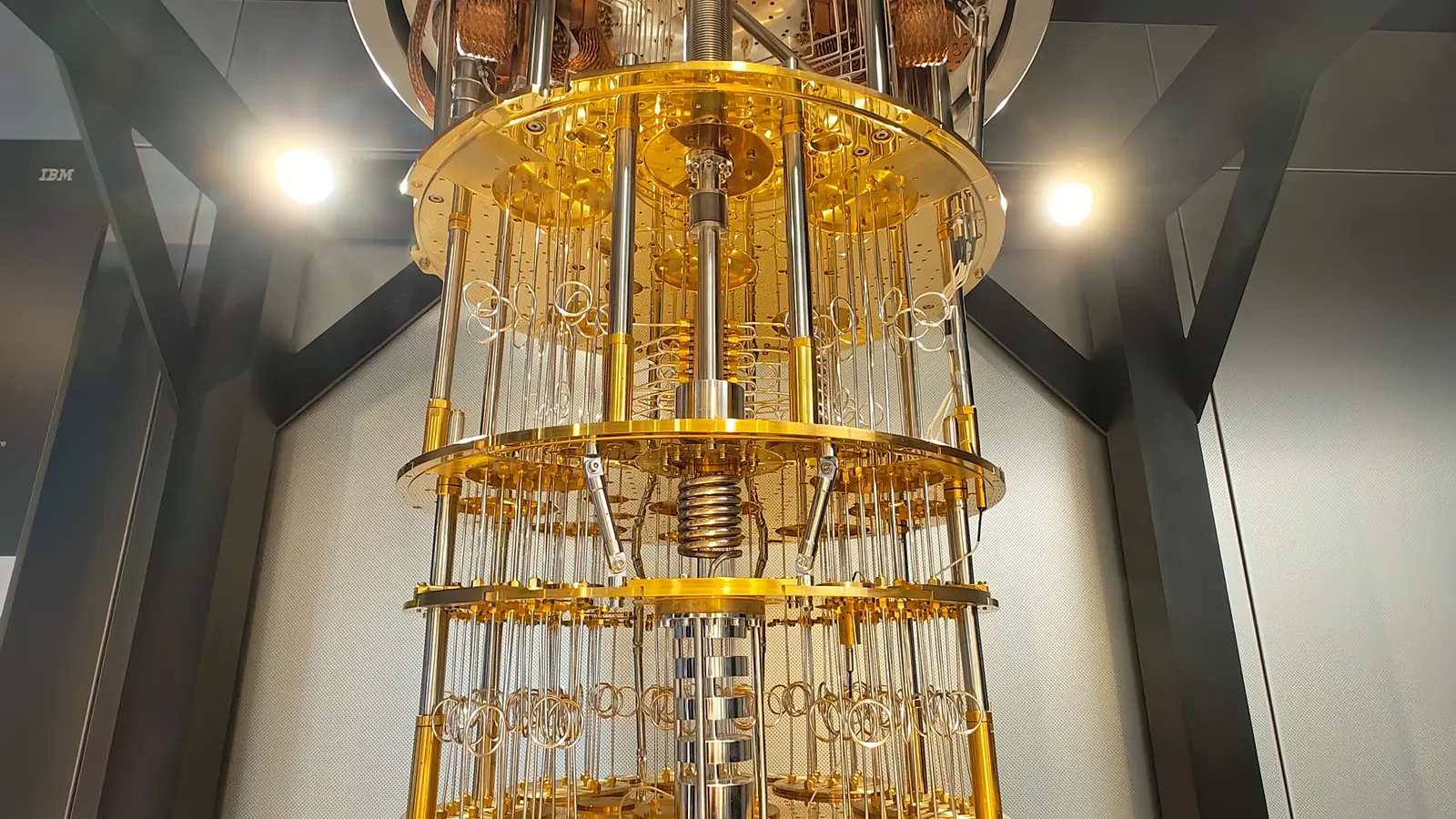
Why not cool the processor more? Extreme cooling reduces thermal disturbance in superconducting hardware, but it does not remove imperfect controls, material defects, radiation events or every environmental interaction. Better physical qubits reduce the correction burden; they do not eliminate the need for logical protection.
How many physical qubits make one logical qubit? There is no fixed number. It depends on the code, required distance, physical error rate, connectivity and target reliability. A demonstration may use tens or hundreds, while demanding algorithms could require substantially more resources per logical qubit.
Can the syndrome reveal the quantum answer? A properly designed stabilizer measurement reveals whether a protected relationship has changed, not the encoded logical value itself. That separation is what permits repeated error checks during a computation.
How to read a quantum-error headline
First ask what was protected: a stored logical state, a gate, a small algorithm or only one component of a protocol. Then compare the logical error rate with the best individual physical qubit under an equivalent task. Check how many correction cycles were run and whether performance improved at larger code distance. Finally, note which errors were excluded, post-selected or handled by offline analysis.
A strong result can still have narrow scope. Scientific progress often arrives as a sequence of controlled demonstrations rather than one dramatic switch from impossible to complete. The most informative question is whether each new experiment removes a known obstacle while preserving the scaling behaviour needed for the next stage.
Sources and further reading
- Google Quantum AI, quantum error-correction milestone
- Google Quantum AI, suppressing quantum errors by scaling a surface code
- Fowler et al., Surface codes
- John Preskill, Quantum Computing in the NISQ era and beyond
- IBM Quantum Learning, quantum error correction
How Barnakle selects and verifies sources · Corrections and updates
Keep exploring.
One remarkable idea at a time—nature, science, history and beyond.
Last reviewed September 16, 2026.

Barnakle Editorial Team
A member of the Barnakle editorial team, exploring remarkable ideas with clarity, curiosity and care.
More from this author →