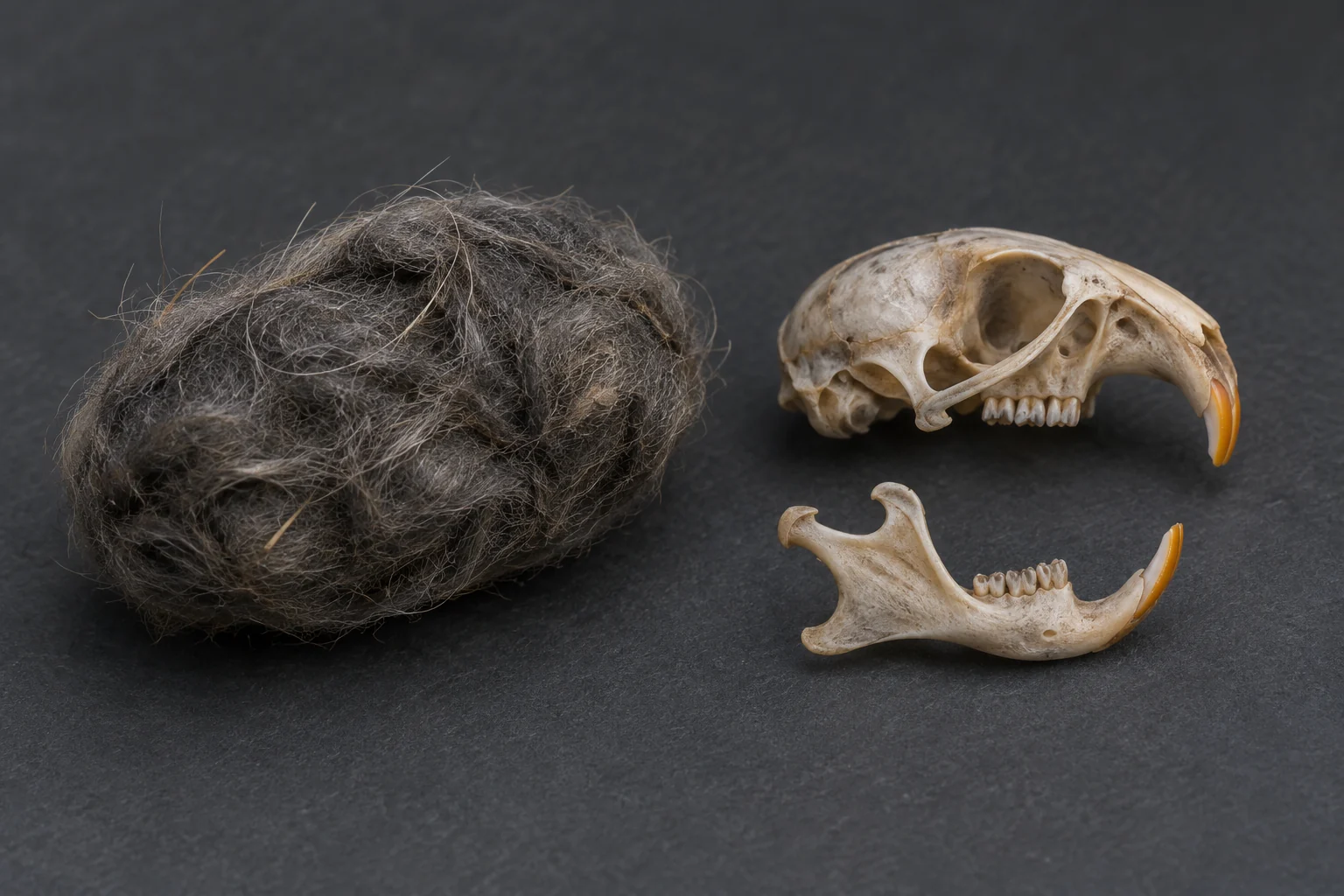
Three tiny left jawbones lie on a tray beside a tangle of grey fur. The right jaws are missing. How many animals did the owl eat? If the bones all belong to the same kind of vole, the answer is at least three. No vole could have supplied two left jaws. Finding three matching right ones would make a neater display, but it wouldn’t double the count. That little piece of bookkeeping explains why a lump beneath a barn owl’s roost can interest someone studying the field outside.[2, 3]
A barn owl pellet is a compact bundle of material the bird swallowed and later brought back up. Fur, teeth and many bones survive after the digestible parts of the meal have passed on. An owl may swallow small prey whole, so a pellet can preserve parts that carry a surprising amount of information. The shape of a tooth can identify a meal long after the coat colour and ears that might once have distinguished the animal are gone.[1, 2]
How a meal becomes a record
A barn owl hunting rough grassland can catch animals that a person walking the same field would rarely see. In Britain, field voles, shrews and wood mice all feature in the diet. An owl carries evidence of its catch away from the hunting ground. Later it casts a pellet, often at a place where it rests. The find spot therefore tells you where the owl spent time. The catch could have come from any of several nearby patches of habitat.[1, 4]
The compact bundle can contain the remains of several individuals. A single prey animal can also leave a frustratingly incomplete assortment of parts. Counting every bone as a capture would turn one well-preserved skeleton into a feast. Treating each pellet as one meal of one mouse would erase much of what was inside it. Researchers keep separate tallies for pellets examined, identifiable remains and the minimum number of prey those remains require. The denominator matters as much as the number written above it.[2, 3, 4]
Start with the teeth
A rib is an excellent indication that an owl swallowed a small vertebrate. It offers fewer clues to identity than a row of cheek teeth. Look at a mouse or vole jaw from the side and there is a large incisor at the front, a gap behind it, then a row of grinding teeth. Look down on that grinding surface and the distinction becomes clearer. Vole teeth can show an angular zigzag pattern. Mouse molars have rounded cusps. A shrew has a quite different series of pointed teeth.[2, 3]
A British identification guide makes the scale of the detective work especially clear. In some mice even the sockets left by a missing back tooth in the upper jaw can help separate species. It matters which tooth has come out, which jaw it came from and whether the tiny openings are intact. A broken piece with no readable feature can stay in the tally as unidentified. Guessing would give a tidy answer in the notebook and a worse account of the owl’s dinner.[2, 3]
Consider those three left jaws again. If one carries the cusps of a mouse and two carry the grinding pattern of voles, the tray contains evidence for at least one mouse and two voles. A loose incisor lying beside them might belong to any of those animals. Keeping it as a separate specimen is sensible. Counting it as another individual would require a reason to rule out all three animals already represented. Much of the work is deciding which pieces can legitimately answer the same question.[2, 3]
What a barn owl samples well
A research team in Mediterranean Europe compared small mammals recorded by three methods. They examined barn owl pellets, studied droppings from a mammalian predator called a genet and used live trapping. Pellets represented grassland rodents and shrews particularly well in their comparisons. Woodland rodents showed up in greater proportions in the other samples. Some tree-dwelling species were better represented in the genet material than in either the traps or the pellets.[5]
That result makes sense if you follow the collector. An owl flying over open ground encounters a different set of animals from a predator moving through trees. A trap on the ground presents yet another opportunity to be counted. A method that picks up a species missed by another one is valuable, even if neither gives a complete picture by itself. A single identifiable jaw can establish that an animal was available to an owl. An empty slot in a list has a much less certain meaning.[4, 5]
Why keep collecting from the same area?
In the English south Midlands, researchers examined more than 61,000 barn owl pellets collected over twenty years. Field voles accounted for an increasing proportion of the prey over the study, while the proportion of wood mice declined. The researchers also found an association between rainfall measures and the vole proportion. A collection spanning that much time let them ask about change in a way that a remarkable single pellet never could.[4]
Read the result carefully. Suppose a sample contained thirty voles and ten mice one year, then thirty voles and thirty mice the next. The vole share would fall from three quarters to one half although the actual vole count in the sample stayed the same. Those are invented numbers, but they show why the study reports proportions and considers more than one explanation for them. A change in diet is a finding. Deciding what it means for the whole mammal population requires additional evidence.[4, 5]
What the owl leaves behind
A record becomes more valuable when the bones stay connected to the place and time they were found. A labelled collection can be compared with a later sample from the same roost or with results from another survey method. A beautifully preserved jaw of unknown origin can still teach someone to recognize a vole. Its value as a point on a distribution map is much smaller.[2, 4, 5]
The lovely thing about an owl pellet is the difference in scale between the object and the question. A tooth only a few millimetres across can establish the presence of an animal nobody saw alive. Thousands of such records can reveal a shift across years. Both depend on the same modest first step. Someone has to look at the little left jaw and count it once.[2, 3, 4]
Related reading
Sources
- Barn Owl Trust — Hunting and feeding
- Barn Owl Trust — Identifying small mammals from pellet remains
- The Mammal Society and The Nature Collection — An introduction to barn owl pellets
- Bird Study — Twenty years of barn owl pellets in the English south Midlands
- Torre and colleagues, Journal of Mammalogy — Comparing three methods of surveying small mammals
Keep exploring.
One remarkable idea at a time—nature, science, history and beyond.
Last updated November 25, 2026.

Barnakle Editorial Team
Barnakle Editorial Team is the collective byline used for Barnakle’s editorial articles. The contributor profile explains the team identity and links to the publication’s editorial policies.
More from the editorial team →