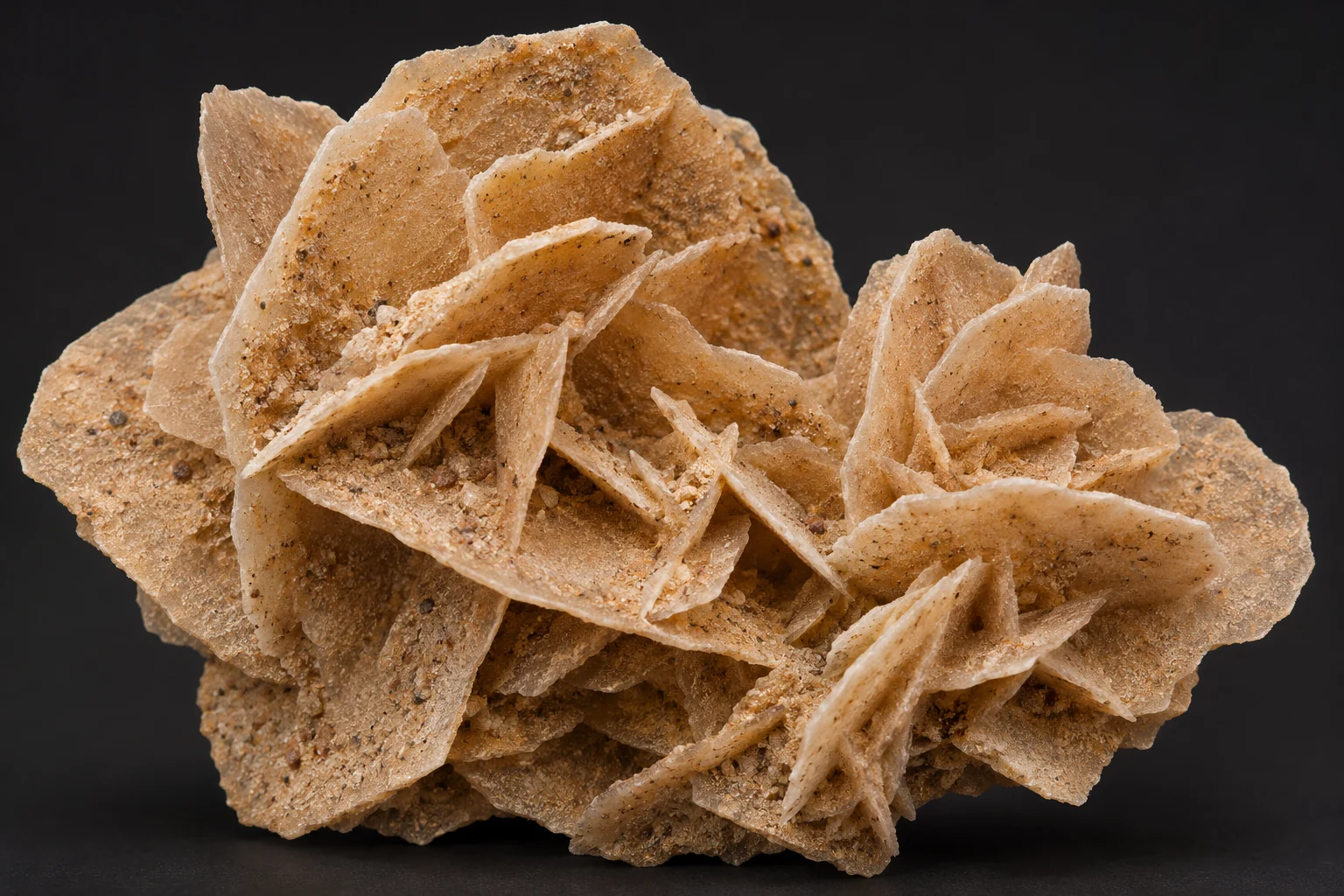
The National Museum of Qatar has a small, light-brown rose from Umm Bab. Its broad, overlapping petals are stiff and sandy, and there was never a stem underneath them. It grew below the surface of a salt flat. What looks like a flower is a cluster of gypsum crystals, and what looks like dust on the petals can run right through them.[1]
A gypsum desert rose forms when mineral-rich water moves through sediment and conditions allow gypsum to crystallize. Growing crystals can enclose grains of the surrounding sand. Flat crystals developing at angles to one another give the whole cluster its familiar rosette shape. Wind can uncover the finished object, but its most important work took place in damp ground. For a mineral associated with some of the driest scenery on Earth, water is an essential part of the story.[1, 2, 3]
Where a desert keeps its water
A salt flat, or sabkha, may have a dry surface and salty groundwater quite close underneath. Between the grains are small, connected spaces. Water can rise a short distance through these pores and evaporate near the surface. The water that leaves as vapour carries away very little of its dissolved mineral load. Water arriving from below can deliver more. Given suitable concentrations of calcium and sulfate, gypsum can precipitate from the solution.[1, 2]
A useful way to picture the setting is to imagine looking at it from the side. At the top is air, below it a dry-looking crust, and deeper down a zone in which the spaces between grains hold water. The water table and the damp sediment just above it can support mineral growth that leaves little sign at the surface. A photograph of dry dunes and bare ground gives a faithful impression of the weather that day and a rather incomplete picture of the geology underneath.[1, 2, 4]
How sand gets inside a petal
Look closely at a sandy rose and separate two sizes of structure. The broad plates that give the specimen its outline are mineral crystals. The specks that roughen those plates are individual grains of sediment. Gypsum grows in spaces among the grains, sometimes enclosing them as growth continues. The sand hadn’t first assembled itself into the outline of a rose. A growing crystal gives a collection of otherwise loose grains a boundary that they can share.[2, 3, 4]
That distinction explains how a specimen can look almost entirely sandy and still have a distinctly crystalline outline. Imagine a clear piece of ice that froze around a handful of gravel. The gravel would give the ice colour and texture. The shape of the ice could still be quite different from the shapes of the individual stones. In a desert rose, several broad or lens-shaped crystals meet. Viewed edge-on, one can look like a narrow ridge. Viewed face-on, its wide surface reads as a petal.[2, 3, 4]
One specimen can look quite different from another
A field study in the United Arab Emirates described gypsum rosettes with conspicuous sand inclusions as well as shinier examples with little visible sand. At one inland site, pinkish specimens incorporated reddish, iron-bearing sand. The differences are easier to understand when you think about the local sediment encountered by a growing crystal. A rosette from one patch of ground needn’t match the shade or surface texture of another example in the same display cabinet.[3]
Work on sand roses in eastern Saudi Arabia took the comparison underground. Researchers studied material from depressions between dunes and looked at the minerals, sand grains and cements. In their study area the amount of gypsum cement generally increased upward from the water table. They also found larger, lighter roses farther from it. Those are observations about particular sites. A pale specimen of unknown origin cannot, on colour alone, tell you how many centimetres above an ancient water table it grew.[2]
Did it grow under a lake or inside the ground?
Both a shrinking pool of salty water and water evaporating through sediment can leave gypsum. Their products may look quite different in a cutting through the ground. Research in southern Tunisia and the central Namib Desert compared bedded gypsum-rich crusts around temporary lakes or lagoons with subsurface crusts containing desert roses. The bedded examples had layers in which the size of the material varied. The rose-bearing examples held sediment grains inside large, lens-shaped crystals.[4]
The distinction matters if you are trying to reconstruct a place long after its water has disappeared. A white mineral in the ground can establish that calcium sulfate accumulated. Bedding, crystal texture and position relative to other deposits help distinguish a pool evaporating in the open from crystals growing in wet pores. The setting of a specimen can answer a question that would remain open if you knew only its name and had a pretty photograph of its surface.[2, 4]
Oklahoma's rose rocks have a different mineral at their heart
Another famous rosette comes from Oklahoma. Its plate-like crystals are barite, a barium sulfate mineral, and enclose quartz sand from the Garber Sandstone. Small amounts of hematite give these rose rocks their reddish colour. On a shelf beside a gypsum rose the resemblance is easy to spot. The shared outline tells you that crystals grew together in a similar-looking arrangement. It gives you much less certainty about their chemical composition.[5]
Even the age needs care. The Oklahoma Geological Survey reports that the barite grew in openings in sandstone that had already hardened. Knowing the age of the host rock sets a limit on the interpretation, but it doesn’t date the later crystals exactly. A label giving only the age of the sandstone could make the rose sound much better dated than it is. This is one reason a museum label often tells you both where an object came from and what is known about how it formed.[5]
Return to the little rose from Umm Bab and its sandy surface has become part of the explanation. Look along one broad plate and you can follow the direction of a crystal. Look at the grit inside it and you can see the ground through which water once moved. It takes both scales of observation to see what the desert preserved inside the shape of a flower.[1, 3]
Related reading
Sources
- National Museum of Qatar — A gypsum desert rose from Umm Bab
- Al-Hussaini and colleagues, Geological Quarterly — Sand roses in eastern Saudi Arabia
- Shahid and Abdelfattah — Gypsum forms in desert soils of the United Arab Emirates
- Watson, Sedimentology — Gypsum crusts in southern Tunisia and the central Namib Desert
- Oklahoma Geological Survey — The barite rose rock
Keep exploring.
One remarkable idea at a time—nature, science, history and beyond.
Last updated November 22, 2026.

Barnakle Editorial Team
Barnakle Editorial Team is the collective byline used for Barnakle’s editorial articles. The contributor profile explains the team identity and links to the publication’s editorial policies.
More from the editorial team →