A right whale can swim forward with its mouth open and eat its way through a patch of tiny crustaceans. The odd part is what doesn’t happen. A few metres into the meal, its mouth hasn’t filled up with seawater and forced it to stop. There is room for more water to enter because water is also finding its way out. A right whale’s meal makes much more sense once you follow both streams.[2, 3]
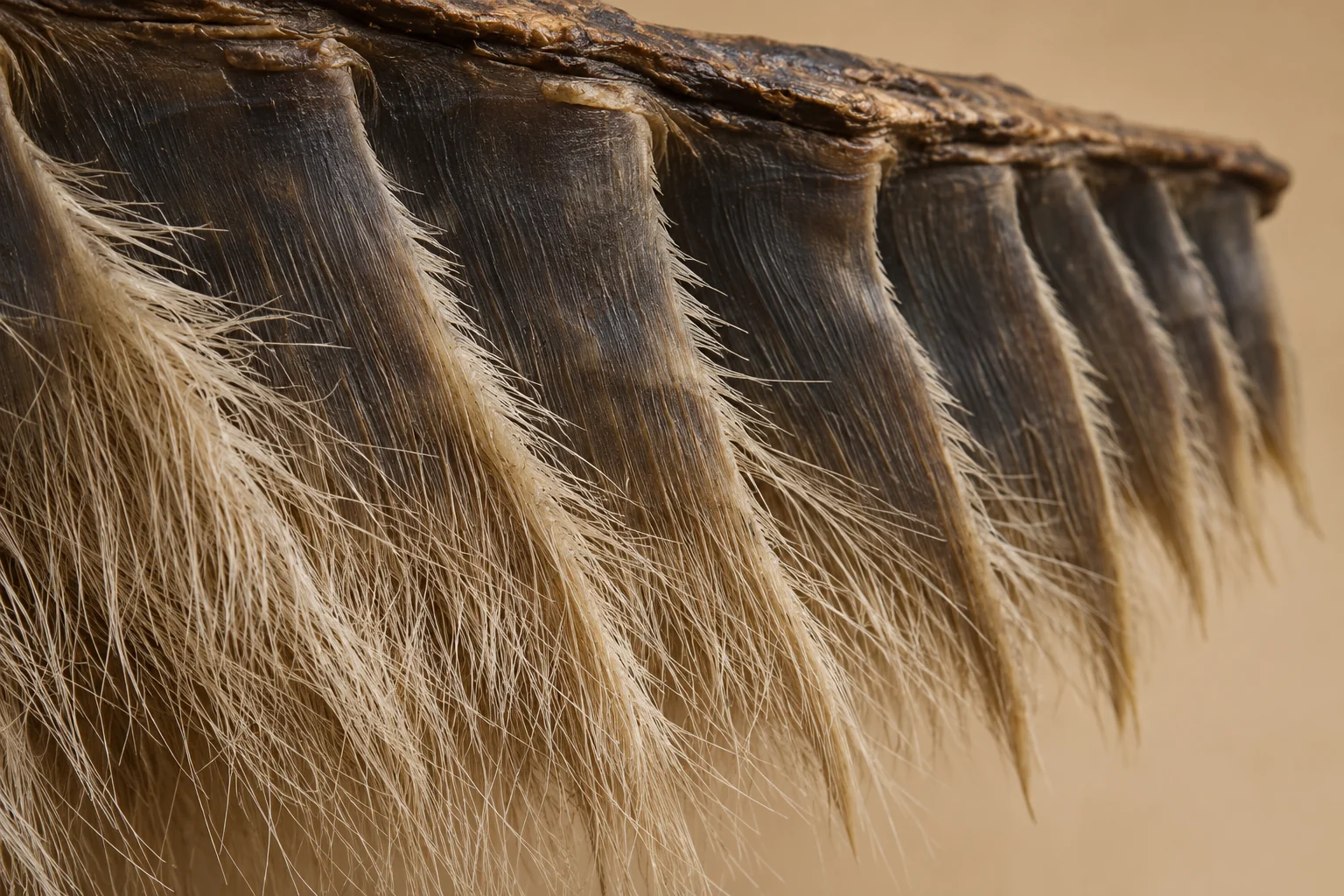
Baleen hangs from the upper jaw in two long rows. Each row contains plates made of keratin, the family of proteins that also gives human fingernails their toughness. On the side facing the tongue, the plates fray into fine fibres. Neighbouring fringes overlap. Together the plates and fibres allow water to escape while the whale retains food. Right whales, humpbacks and gray whales all possess versions of this arrangement, but what comes through the lips and how it gets there can look remarkably different.[1, 2, 4]
Look at the edge of a plate
A single piece of dry baleen in a display case has two strikingly different parts. Much of it resembles a flat piece of horn. Along one edge it looks more like the end of a worn brush. The difference is easy to miss in illustrations that simplify each plate to a triangle. Set many such triangles side by side and there are gaps between them. Add their fringes and those gaps become a filtering surface that extends along much of the mouth.[2, 4, 5]
The dimensions vary with the feeding job. Bowheads and right whales have long plates and fine fringes suited to gathering small drifting prey, including copepods. Rorquals, the group that includes humpbacks and blue whales, generally have shorter plates. They can take krill or, in some species, schooling fish. Gray whales have relatively short, coarse baleen and often feed on small animals associated with the seabed. A single description such as “a whale strains plankton” leaves out much of what those differences mean.[1, 2, 5]
A right whale keeps the water moving
Consider a copepod carried in through the front of a swimming right whale’s open mouth. It needn’t fly straight into a fringe and hang there waiting to be scraped off. Research on balaenid whales describes a substantial flow running along the inner face of the baleen. Some water turns outward through the rack while food particles can continue toward the back of the mouth. Engineers call this crossflow filtration. It makes the path taken by a prey item quite different from the path taken by some of the water beside it.[2, 3]
Think of pouring water and grains across a tilted screen. Some liquid passes through the openings while the remaining stream carries grains along the surface. Changing the angle of the flow changes where the grains collect. A whale’s mouth has a tongue, curved racks and moving tissues, all absent from that kitchen experiment. The comparison helps with one point. A filter can separate particles from water without requiring every captured particle to end up wedged in a pore.[3]
How do researchers study something so difficult to watch? One modelling study combined measurements of mouth geometry with results from flowing water past baleen in a laboratory. The team estimated how water divides between channels and how much resistance the whale encounters. It is possible to test whether a proposed flow is physically plausible without seeing the fate of every copepod in a living whale. The exact distributions still depend on the shape and position of structures inside the open mouth.[3]
A humpback takes the meal in batches
A lunge-feeding whale approaches a patch of prey, opens its jaws and takes in prey-laden water. The pleated tissues beneath its throat unfold, providing room for the engulfed mass. Once the mouth closes, the water is expelled through the baleen and the retained prey can be swallowed. The mouth changes size over the course of a single mouthful. A photograph taken at maximum expansion shows a very different animal outline from one taken a few seconds earlier.[2, 4]
There is a cost to taking such an enormous gulp. Accelerating toward a patch and then moving with a wide-open mouth takes energy. Slowing down and filtering the mouthful also takes time that the whale could have spent swimming toward another patch. A dense school of fish or swarm of krill changes the return on that effort. Imagine taking the same volume of water from two places, one with a hundred times as many prey per litre. The baleen could work equally well in both places while the meals differ enormously.[2, 4]
A gray whale can bring up the bottom
A gray whale often turns on its side near the seabed and draws animals and sediment into its mouth by suction. The meal may include small crustaceans that live in or on the bottom. Expelling water and sediment through coarse baleen leaves edible material behind. Here the animal has to collect prey from the substrate before filtration can accomplish anything. A patch of mud stirred up near a feeding whale can be a clue to the part of the meal hidden below the surface.[1, 2, 5]
Put the three feeding animals side by side in your imagination. The right whale admits a continuing stream. The humpback encloses a discrete mouthful. The gray whale can draw a mixture up from the bottom. Each faces the same practical problem once prey and water are together in the mouth. It would be inefficient to carry all that water into the digestive system for the sake of the animals suspended in it. The way each whale first encounters the meal helps explain the rack it carries.[1, 2, 5]
Next time a feeding whale breaks the surface in a film, look for the part of the sequence the camera caught. An expanding throat tells you about collecting water. Streams leaving the sides of the mouth tell you about getting rid of it. A close view of the ragged edge of a plate adds the missing detail. What looks like wear on a piece of horn is one of the working surfaces that lets a very large mammal make a living from very small animals.[2, 4, 5]
Related reading
Sources
- NOAA Ocean Today — Whale anatomy
- Annual Review of Marine Science — How baleen whales feed
- PLOS ONE — Oral cavity hydrodynamics and drag production in balaenid whale suspension feeding
- Smithsonian Ocean — Whales and dolphins
- Alexander Werth — Models of prey capture and processing in baleen whales
Keep exploring.
One remarkable idea at a time—nature, science, history and beyond.
Last updated November 21, 2026.

Barnakle Editorial Team
Barnakle Editorial Team is the collective byline used for Barnakle’s editorial articles. The contributor profile explains the team identity and links to the publication’s editorial policies.
More from the editorial team →