Most sea sponges pump water using microscopic, whip-like flagella on specialized cells inside their bodies. The moving flagella generate currents through a system of pores, passages and filtering surfaces. Water brings food and oxygen, then leaves through larger openings. A sponge can therefore stay attached to a reef while its internal water is continually renewed. [1, 2, 3]
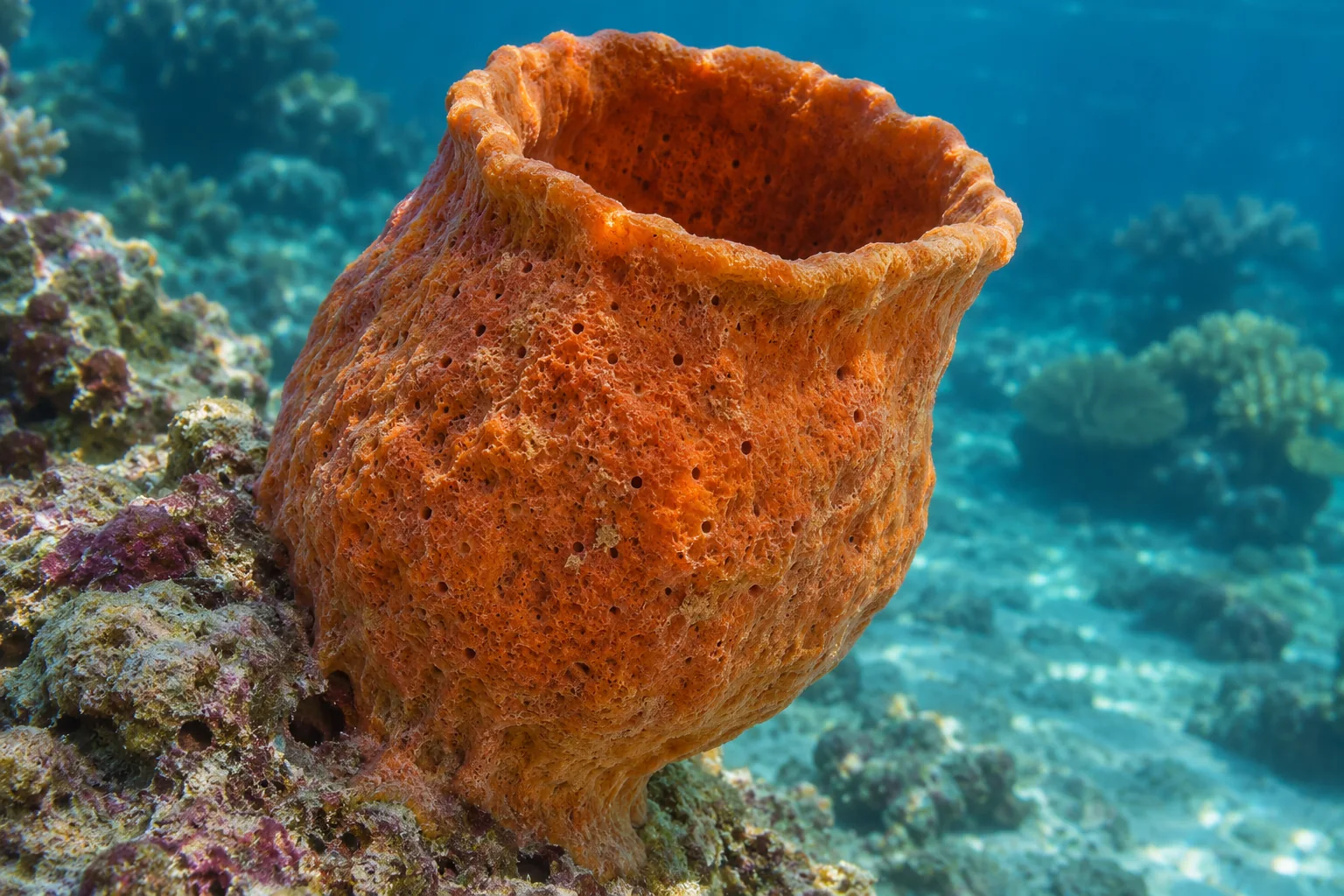
The visible animal looks like a tube, crust, vase or branching mass, depending on the species. The machinery responsible for its flow is much smaller than those outlines suggest. It is a distributed biological system rather than a single organ beating like a heart.
First, a sponge is an animal
A living sea sponge is not a water-soaked plant or a discarded cleaning sponge. Sponges belong to the animal group Porifera and have specialized cells that perform feeding, structural and other functions. Their body organization differs from that of corals, even when both grow attached to the same reef. [1]
Many familiar animals move to find food. A sponge’s feeding system reverses that arrangement: the animal remains in place and moves food-bearing water through itself. Remaining attached does not mean that no active work is taking place.
Most sponges live in the sea, but some species inhabit freshwater. That diversity matters when reading research, because experiments on a freshwater sponge can reveal a pumping principle without serving as measurements of every marine species. [1, 4]
Where does the water enter and leave?
Small inlet pores are called ostia. Water passes through them into the internal system, eventually reaching larger outflow openings called oscula; a single opening is an osculum. Between these entry and exit points, the route depends on how the sponge’s body is organized. [2]
In simpler body plans, the internal cavity is comparatively direct. In more complex sponges, water follows branching canals and many small feeding chambers. Those chambers provide extensive filtering surfaces within a body that may appear fairly compact from outside. [2, 3]
The broad opening at the top of a vase-shaped sponge is therefore not a mouth taking bites. It is commonly an exit for water that has already passed through the internal system. An exterior view alone cannot reveal every passage feeding that opening.
What is a choanocyte?
A choanocyte, often called a collar cell, combines a flagellum with a surrounding collar of tiny projections called microvilli. Movement of the flagellum helps drive water, while the collar participates in capturing small food particles. These are related jobs performed by different parts of the cell. [3, 7]
Food-bearing water passes close to the filtering structures, and suitable particles can be taken into cells. There is no requirement for food to travel into a conventional stomach before digestion begins. This feeding arrangement suits an animal built around water passage and contact with cellular surfaces. [3]
Microscopy reveals that the collar-and-flagellum assembly is a structured apparatus, not simply a tuft of hairs waving randomly. Research comparing sponge choanocytes with related-looking single-celled organisms examines the organization and specialization of these small components. [7]
How can many tiny flagella create a useful current?
Each flagellum moves fluid in its immediate surroundings. When many pumping cells are arranged along suitable chambers and passages, their collective activity creates pressure differences and directed flow through the connected system. The body’s architecture gives those local movements a route to follow. [2, 4]
A 2025 study combined imaging of living sponge chambers with computational models to investigate this connection. It examined how chamber size, flagellar motion and outlet geometry influence pumping. One of its study organisms was the freshwater sponge Ephydatia muelleri, with comparisons extending to other species. [4]
The study also illustrates why judging a chamber from a simple drawing can mislead. Flagella pointing in different directions may still contribute to pressure generation and net transport. It is the interaction between moving structures and chamber geometry that determines the overall flow, not whether every flagellum visually points toward the final exit. [4]
Pumping and filtering are not the same measurement
A sponge could move a large volume of water while capturing only a fraction of a particular substance in that water. Pumping rate describes fluid movement; retention or removal efficiency describes what is taken out. Feeding success also depends on which particles or dissolved materials are available and usable.
A hypothetical example makes the distinction clear. Imagine a filter that processes 10 liters per hour and retains 20 percent of a particular particle type passing through it. The flow rate alone would not justify saying that it removes every particle from 10 liters. This is an illustrative accounting example, not a reported rate or efficiency for a sponge.
Similarly, “body volumes per hour” and “liters per hour” use different reference quantities. Comparing rates requires matching units, species, size and conditions. A single eye-catching number should not be treated as a specification for every sponge on a reef.
Why water movement matters beyond food
Water also brings dissolved oxygen close to living cells and provides a route for exchange with the surrounding environment. A body built around internal flow can maintain contact between its cells and refreshed water without using a fish’s gills or a mammal’s lungs. [1, 2]
That is a useful comparison of functions rather than a claim that the structures are interchangeable. How fish breathe underwater explains a different arrangement for obtaining oxygen from the same medium.
A household sponge, by contrast, can absorb water into spaces without maintaining a living, metabolically powered pumping system. Porosity alone does not account for the current through a living sea sponge.
How do sponges prevent their filters from clogging?
Suspended particles include material that can obstruct rather than nourish a filter. Some sponges use contractions and mucus-related processes to manage accumulated material. Research on the Caribbean tube sponge Aplysina archeri documented a particularly surprising route: particle-laden mucus moved toward the inlet pores, against the usual internal feeding current. [5]
Time-lapse observations showed periodic contractions, described as “sneezing,” that shed this material into the surrounding water. Nearby organisms consumed some of the released detritus. This is a species-specific observation, not a claim that every sponge ejects waste in the same direction. [5]
The important implication is that managing unwanted particles can require more than sending everything straight out of the usual outlet. A living filter must keep its pathways functional as conditions change.
Does more food always mean a bigger sponge?
Growth depends on more than the pumping apparatus. Smithsonian Ocean describes field experiments by Joseph Pawlik’s research team that compared access to food and protection from predators. In the studied Caribbean reef setting, protected sponges grew more, while the expected food-related depth effect did not produce the same growth increase. [6]
The result shows why a pumping explanation is only part of sponge ecology. Predators, available resources and the environment can influence what happens to the tissue produced by feeding. A well-functioning filter does not make an animal independent of the rest of the reef.
For that wider setting, read how coral reefs build islands and protect coastlines. Sponges participate in reef systems while remaining anatomically distinct from the corals around them.
Questions about sponge pumping
Does the large opening suck water in?
In the common flow pattern described here, water enters through small ostia and exits through the larger osculum or oscula. [2, 3]
Do all sponges filter-feed in exactly the same way?
No. Body plans and feeding strategies vary, and some specialized sponges are carnivorous. The pore-and-collar explanation describes the familiar filtering arrangement rather than every exception. [3]
Is a sponge’s current simply caused by ocean waves?
External water motion can affect its surroundings, but active flagellar pumping is an internal source of flow. [2, 4]
What is the main idea?
A sponge combines moving cells with a network of passages. Small biological pumps become an animal-scale feeding system because their arrangement connects the water’s entry, filtering and exit routes.
Sources and further reading
Sources checked November 15, 2026. Abstracts and research syntheses are identified below where used; restricted full texts are not represented as fully reviewed.
- NOAA National Ocean Service — What is a sponge?
- University of Hawaii — Phylum Porifera, Exploring Our Fluid Earth
- OpenStax, Rice University — Biology 2e: Phylum Porifera
- Ogawa and colleagues (2025) — The architecture of sponge choanocyte chambers is well adapted to mechanical pumping functions
- Kornder and colleagues (2022) — Sponges sneeze mucus to shed particulate waste from their seawater inlet pores — research abstract
- Smithsonian Ocean — What Makes Sponges Grow? Research by Joseph Pawlik and colleagues
- The architecture of cell differentiation in choanoflagellates and sponge choanocytes (2019) — research article
Keep exploring.
One remarkable idea at a time—nature, science, history and beyond.
Last updated November 16, 2026.

Barnakle Editorial Team
Barnakle Editorial Team is the collective byline used for Barnakle’s editorial articles. The contributor profile explains the team identity and links to the publication’s editorial policies.
More from the editorial team →