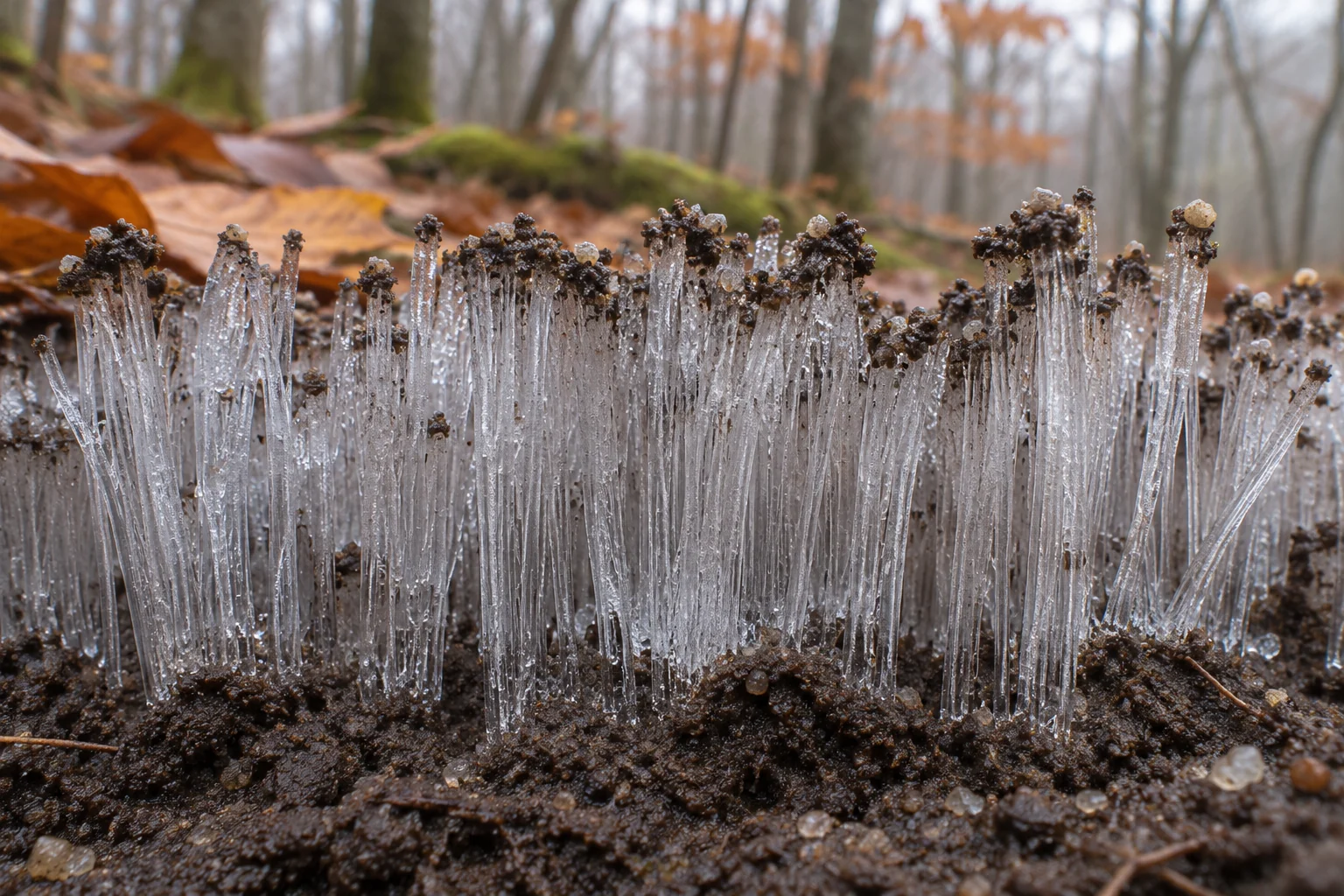
The crust on a muddy path looks higher than it did yesterday. Seen from the side, a patch of grit is balanced on a row of clear ice pillars, with a dark gap beneath its edge. This is needle ice. Water in the soil fed crystals growing at or just below the surface while the air above was cold enough to keep them frozen. New ice formed at the base and raised the ice already there. The grains of dirt riding on top mark where the ground surface was before the night turned cold.[1, 2, 5]
For a few hours the ground has two temperatures
Imagine a damp patch of bare soil at dusk. The exposed surface can lose heat faster than the deeper ground. Under suitable conditions the uppermost layer cools enough for water to freeze while water just below remains liquid and mobile. That brief arrangement supplies the two things a growing needle needs in the same place: a cold end where water can solidify and a connected supply of unfrozen water immediately beneath it. A reading from a thermometer hung well above the path captures only part of the story.[1, 2]
Pore spaces between grains can conduct water toward the freezing zone. As more water arrives and freezes at the ice-soil contact, the solid portion lengthens upward. A loose grain or thin cap of soil caught over the tip can rise with it. This process also explains how a tall tuft can grow out of a surface that looked merely damp. The ice has drawn on water from below. Freezing only the thin film originally present on the exposed ground would supply far less material.[1, 2, 3]
For a sense of the quantities involved, picture a patch one centimetre square carrying a solid centimetre of ice. Its volume would be one cubic centimetre. A real tuft has gaps, so it contains less ice than that solid block. Even so, a film only a tenth of a millimetre thick across the same patch supplies just one hundredth of a cubic centimetre of water. The modest expansion water undergoes on freezing cannot turn that film into a substantial comb of needles. The extra supply and the place where it freezes are both necessary parts of the explanation.[1, 2]
Why the tips can carry brown caps
Look at a side view before stepping on the patch. A clod balanced across several columns can preserve something of its original shape, including tiny roots or bits of grit. The clear stretches underneath show the distance through which that piece of ground was lifted. Taller columns beside short ones can tip a clump sideways. If all you see is the top from standing height, the brown covering can conceal both the ice and the empty space below it.[2, 3, 4]
The number of little shelves in a tuft can be deceptive. Investigators who observed growth outdoors and in the laboratory found that needles with more than one tier could form during a single freezing and thawing cycle. In their laboratory series new needles became less abundant as the surface dried. Those two observations suggest useful cautions for anyone examining a morning find. Two tiers do not give a reliable count of frosty nights. And a cold night following a spectacular display need not produce another one if the supply of water has changed.[2]
Cooling has to continue while the water freezes. Liquid water releases heat as it turns to ice, and this heat has to escape if growth is to proceed. A surface can lose heat to its surroundings under a clear night sky. In a laboratory, evaporation can also play a part in extracting heat. Measurements of soil moisture and heat flow helped researchers distinguish those processes. From a single photograph, you could plausibly identify the needles without being able to say exactly how the surface kept losing heat throughout their growth.[2]
A stone rarely lands exactly where it started
At first, lifting grit seems to accomplish little. Gravity will put it down again when the ice melts. The return trip, however, need not trace the upward one. The columns can lean, bend and collapse. A stone poised near the edge of a raised patch can tumble outward. On a slope there is also more room to move on the downhill side. A shift the width of a small grain is difficult to spot on one walk but can matter if the same patch freezes and thaws many times.[3, 4]
In a laboratory study of this process, researchers began with stones distributed over wet soil. They changed how much of the surface the stones covered and whether the ground sloped. Over repeated freeze-thaw cycles, small groups of stones formed and could merge into larger ones. The experimental arrangement allowed the team to follow movement that would otherwise be hard to reconstruct from a final photograph. A cluster seen on the last day could be compared with the actual starting positions of its members.[3]
Field evidence adds an interesting qualification. At a Scottish site near sea level, a researcher followed the development of small stony borders around patches of finer material over two winters. Differences in how strongly adjacent patches heaved, followed by bending and melting of the ice, helped concentrate stones at the margins. Features on that small scale can form where shallow freezing recurs in suitable soil. They do not require a landscape underlain by permanently frozen ground.[4]
What to look for on a cold morning
Needle ice is easiest to interpret where a path or bank already exposes its side. Look for columns attached to soil, an intact cap in one place and fallen grains nearby. Hair ice can also appear as a mass of fine white threads, but it is associated with decaying wood. Frost deposited from the air can coat a leaf or a fence as readily as a patch of ground. A tuft carrying a piece of the path overhead supplies a further clue. Here the support is ice, the water source is below, and the part that looks like the topsoil has been taken for a short vertical ride.[1, 2, 5]
Related reading
Sources
- National Research Council Canada — Glossary of permafrost and ground-ice terms
- Soons and Greenland — Observations on the growth of needle ice
- Li and colleagues — Ice needles weave patterns of stones in freezing landscapes
- Ballantyne — Formation of miniature sorted patterns by shallow ground freezing
- Frontiers in Ecology and the Environment — The wonders of hair ice and needle ice
Keep exploring.
One remarkable idea at a time—nature, science, history and beyond.
Last updated November 24, 2026.

Barnakle Editorial Team
Barnakle Editorial Team is the collective byline used for Barnakle’s editorial articles. The contributor profile explains the team identity and links to the publication’s editorial policies.
More from the editorial team →