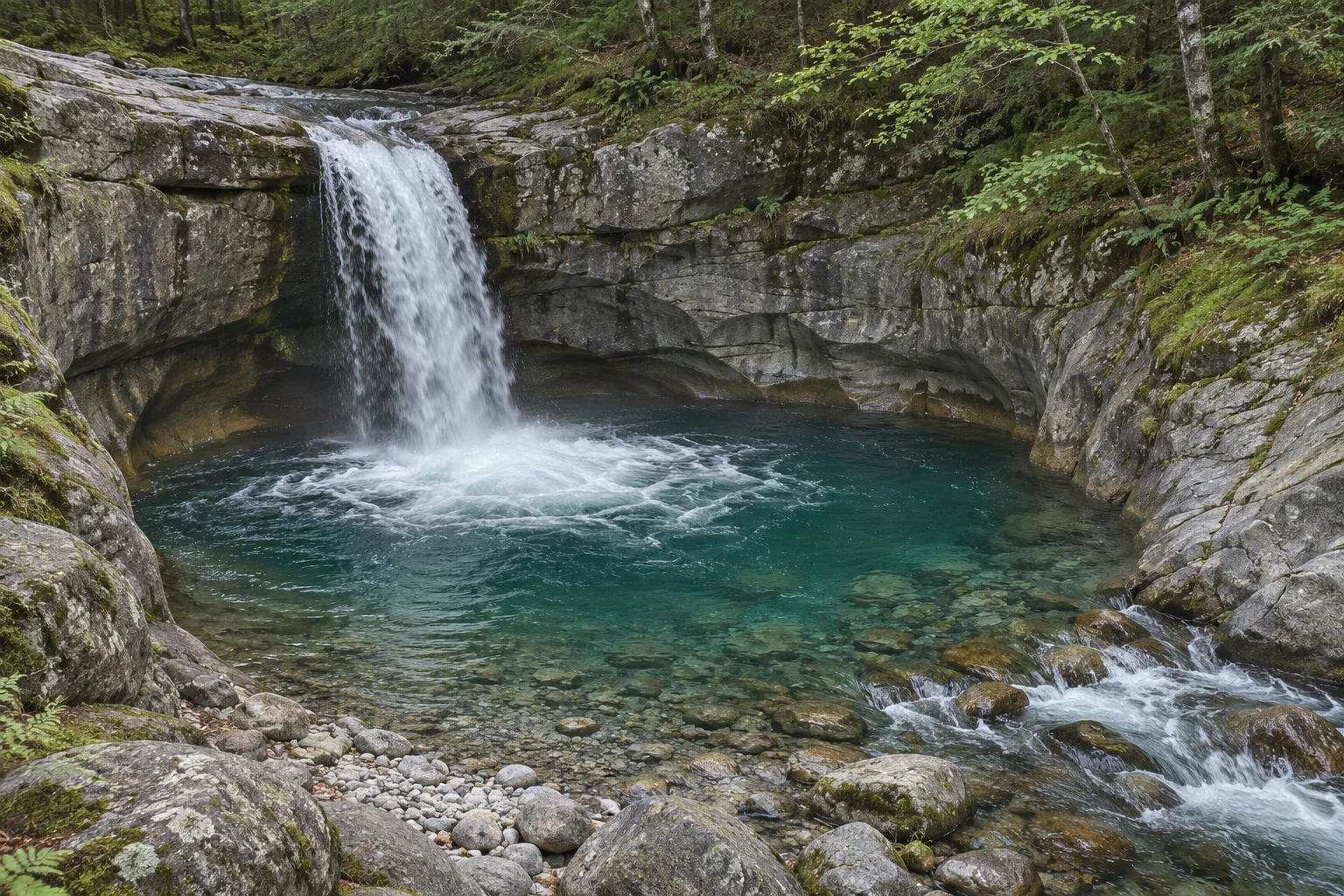
Look down from the bank beside a waterfall and the white patch below the jet seems to mark the place where water drills into rock. Hidden beneath the foam are two very different floors. The upper one can be loose gravel. Farther down lies the bedrock basin carved into the channel. A flood can make the water suddenly deeper by washing out gravel without cutting the basin any deeper at all. To understand how a waterfall excavates a plunge pool, start by asking which floor has moved.[1, 3, 4]
The grains in the falling water
As water drops over a ledge, it delivers energy to a relatively small area. The impact stirs the pool and can drive sand and larger grains against its walls and floor. A grain striking exposed rock can chip or abrade a little material. Repeat the impact many times and a depression can develop. This mechanism is particularly amenable to experiment: researchers can vary the sediment supplied to a jet and then measure exactly where the receiving surface wears away. Natural waterfalls can involve other processes, including the removal of blocks along fractures.[1, 2, 5]
Think about dropping a handful of sand into a clear bowl of moving water. Some grains might be suspended, others might bounce a short distance, and others might settle. Knowing how much sand went in would tell you little about how much of it struck a particular spot. The same distinction matters in a plunge pool. To cut the rock, particles need sufficient energy and access to an exposed surface. Where the current sends them and where they come to rest can matter as much as the amount the river brings over the falls.[2, 3]
In laboratory work on a uniform material, researchers used a synthetic foam block as a stand-in for bedrock. Its usefulness lay in wearing down quickly enough for a pool to evolve during a controlled experiment. At first, downward cutting substantially outpaced sideways erosion. A depression formed even though the starting material lacked a conveniently weak layer where a pool ought to be. The experiment established that abrasion by particles could generate that form. It did not provide a timetable for cutting an equally deep hole into a particular natural rock.[1, 2]
The same gravel can protect the bottom
As a pool grows deeper, sediment has farther to travel to escape over the downstream edge. If incoming grains accumulate faster than the flow can remove them, they build a cover across the rock. New particles may still pound the floor with considerable force, but the receiving surface is now another layer of particles. Under that cover, the bedrock can experience much less wear. This explains the apparent contradiction of a waterfall thundering continuously over a basin whose rocky bottom scarcely changes.[1, 2, 4]
The pool can still change shape around its edges. In the foam experiments erosion continued on parts of the walls after sediment accumulated on the floor. Wear was particularly evident on the downstream side in that arrangement. Lowering the outlet of a natural pool could make it easier for sediment to leave in a later event. That is a proposed route back to exposed rock. A uniform blanket of sediment laid down once and preserved indefinitely is only one possible fate for the material that enters a pool.[1, 2]
Why depth depends on the last flood
Picture the same pool on three visits. During low flow, gravel delivered from upstream has settled behind the outlet. During a flood, the jet becomes more effective at entraining sediment and carrying it out. After the flood, a deeper pocket of water occupies part of the space the gravel filled on the first visit. A sounding line lowered from the same reference elevation would register a change. To count that change as bedrock erosion, you would have to establish where the buried rock surface lay on both dates.[3, 4]
Studies of sediment transport through plunge pools have considered variables a field team can actually measure, including water discharge, drop height, pool radius and depth, and grain size. Those variables help explain why two falls of similar height can have very different floors. One may receive fine material that the flow can readily carry over the rim. Another may be supplied with coarse gravel that accumulates even when the water looks vigorous. The depth of water on a quiet afternoon records something of that recent transport history as well as the underlying geology.[3, 4]
Does the pool make the waterfall move upstream?
A familiar account of waterfall retreat involves water eroding behind the falling curtain until the overhanging ledge collapses. That process can happen, but the connection between cutting a pool and moving a waterfall is more varied. In the uniform-block experiment, researchers saw strong downward cutting without significant undercutting of the upstream wall. A succession of pools deepening on adjacent steps could help a steep reach of stream migrate without every step having to retreat by the collapse of a conspicuous overhang.[1, 2]
Another set of experiments tested the role of waterfall height while holding water discharge, sediment supply and material strength constant. The shorter drops developed small, rapidly eroding steps. The taller examples developed larger plunge pools in which sideways erosion could undermine the headwall. Some shorter experimental falls retreated faster than the taller ones. The extra height available to a falling jet therefore gives an incomplete prediction of how quickly the lip of a waterfall will shift. You also need to know how that energy is applied.[5]
From a bank, a useful first inventory is the shape of the ledge, the position of the outlet and the places where gravel is visible outside the white water. A bar just below the pool is a possible destination for material carried out during high flow. A rock wall beside it records a longer history of impacts and erosion. Together they suggest a more interesting question than how hard the water hits: when the next large flood arrives, will the grains spend it protecting the bottom, escaping over the rim or striking newly exposed rock?[2, 3, 4]
Related reading
- What Can Ripple Marks in Stone Tell Us About Ancient Water?
- How Rivers Create Meanders, Cutoffs and Oxbow Lakes
Sources
- Scheingross and colleagues — Self-formed waterfall plunge pools in homogeneous rock
- Scheingross and Lamb — A mechanistic model of plunge pool erosion
- Scheingross and Lamb — Sediment transport through waterfall plunge pools
- Scheingross and Lamb — Sediment scour and bedrock erosion in waterfall plunge pools
- Waterfall height sets the mechanism and rate of upstream retreat
Keep exploring.
One remarkable idea at a time—nature, science, history and beyond.
Last updated November 23, 2026.

Barnakle Editorial Team
Barnakle Editorial Team is the collective byline used for Barnakle’s editorial articles. The contributor profile explains the team identity and links to the publication’s editorial policies.
More from the editorial team →