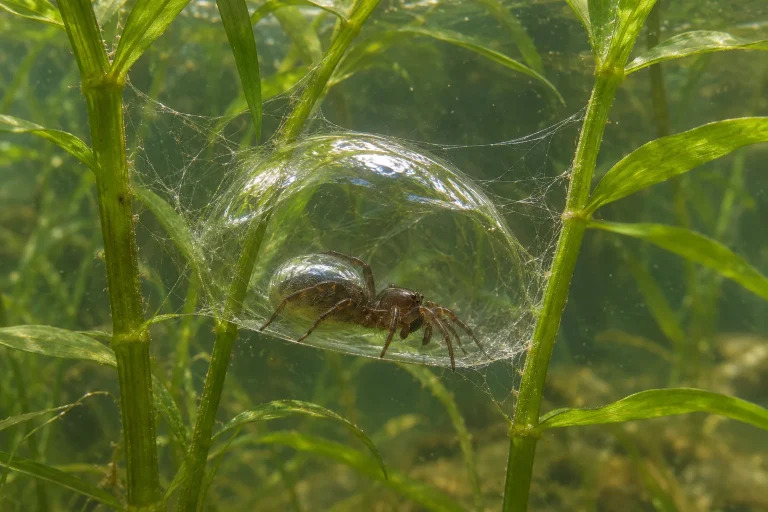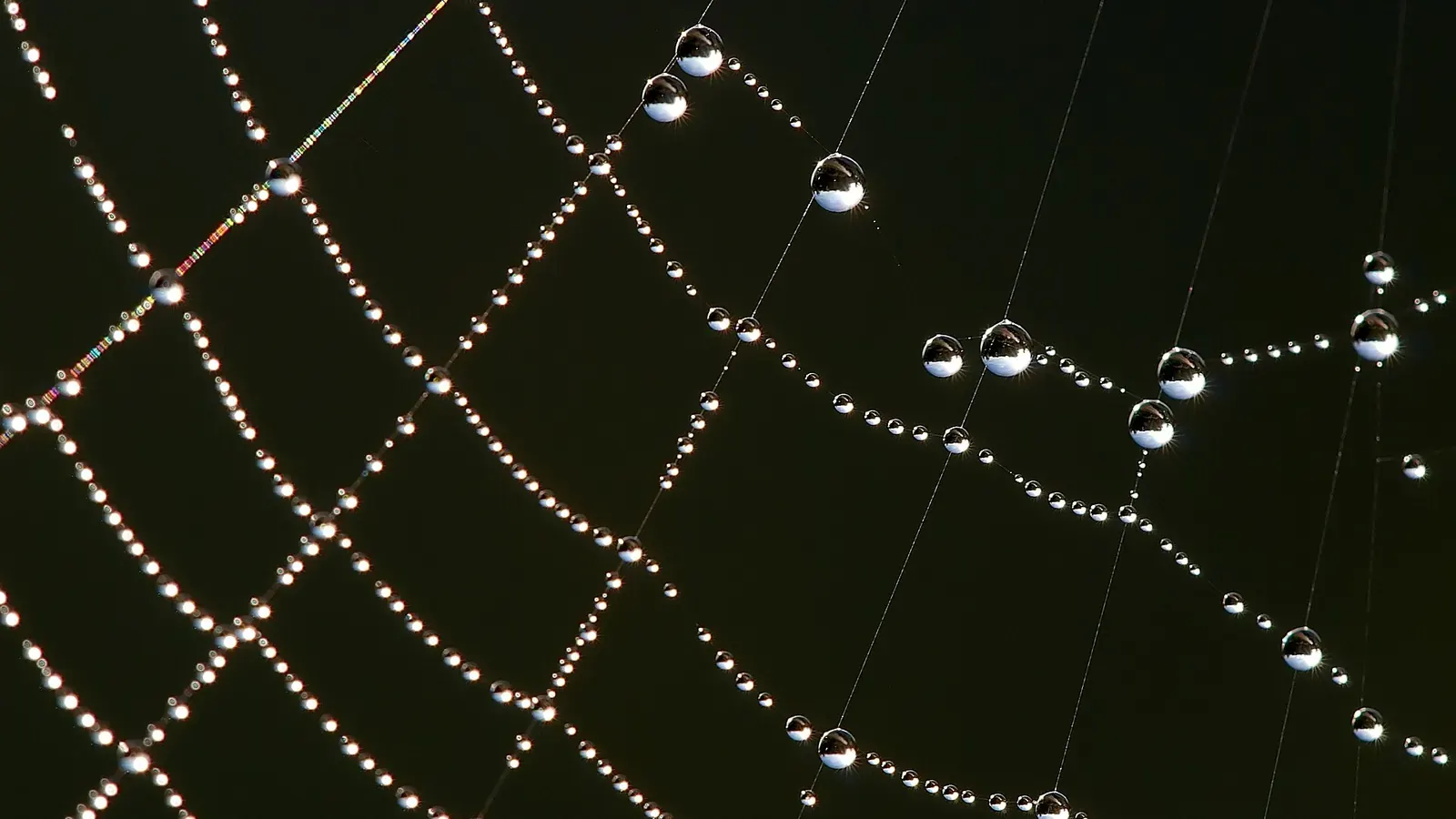
When an insect strikes an orb web, it disturbs more than sticky threads. The disturbance travels through silk and reaches a spider in contact with the structure. The web therefore participates in sensing: its design affects the information available to the animal.
This is a mechanical process. It does not require silk to think, and the vibration travelling along a thread is not necessarily sound travelling through air.
A disturbance becomes a pattern
An impact can launch several forms of vibration through a web. Different threads and junctions transmit, reflect and attenuate that motion. The signal reaching the spider depends on the source and on the route through the structure.
An orb web has supporting radial threads and a capture spiral with different roles. It is therefore not equivalent to a uniform sheet. Its arrangement helps determine how a disturbance at one position becomes movement at another.
The spider senses through contact
Mechanosensory structures on the legs respond to deformation and vibration. By maintaining contact at several points, a spider can receive information from different parts of the web. Body position is consequently part of the sensing arrangement, rather than a passive detail in a photograph.
The same structure also carries wind-driven disturbances, movements made by the spider and signals associated with other animals. A useful sensory system must operate amid this background instead of assuming every vibration means captured prey.
Silk changes the message
Research on the sonic properties of webs examines how material properties, web geometry and tension influence vibration transmission. A thread that is stretched differently can respond differently even when its chemical material is similar.
This is why the description “the web is an instrument” can be helpful. Changing its construction changes the response. The analogy has limits, however: a web is not a musical instrument designed to deliver one fixed tone, and experiments on one species do not establish identical behaviour in every spider.
How researchers measure something so small
Laser vibrometry allows scientists to measure tiny movements without placing a heavy sensor on a thread. Controlled excitation can then be compared with the resulting vibrations at other positions. Models help test which structural features account for the measurements.
A measurement method may capture one direction of motion more readily than another, so interpreting the data requires knowing what the instrument actually recorded. A simplified web model also needs comparison with real silk and real geometry.
A trap with a sensory role
The physical requirements of capturing prey and transmitting information interact. A web must deform enough to handle impacts while carrying useful signals to its occupant. Understanding that combination reveals why the surrounding structure is part of the spider's sensory world, rather than merely a platform on which sensing occurs.
Explore a related question
How Elephants Communicate Through Ground Vibrations
Sources and further reading
Keep exploring.
One remarkable idea at a time—nature, science, history and beyond.
Last updated October 27, 2026.

Barnakle Editorial Team
Barnakle Editorial Team is the collective byline used for Barnakle’s editorial articles. The contributor profile explains the team identity and links to the publication’s editorial policies.
More from the editorial team →