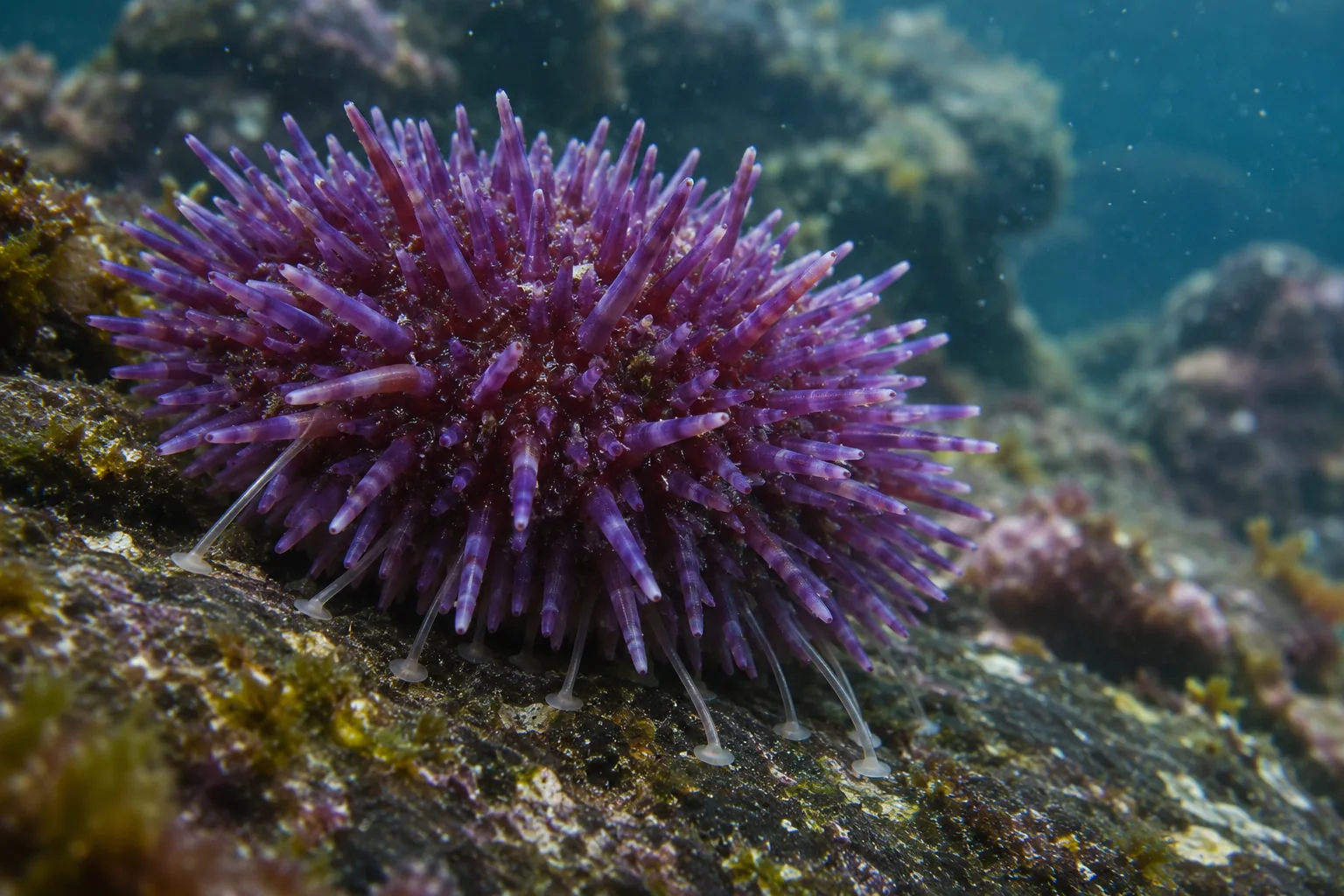
Sea urchins crawl using many flexible tube feet, assisted by movable spines. The feet extend between the spines, attach to nearby surfaces and help pull the body along. Their motion depends on a water-filled hydraulic system and muscles, so the animal can travel without jointed legs. [1, 2]
The hard, spiny shape can make an urchin look immobile. Watch one long enough, however, and the softer equipment becomes apparent. Slender feet reach beyond the armor, while spines change position. What looks like a single rigid ball is a living collection of moving parts. [1, 3]
Where are the feet hidden?
The rigid shell of an urchin is called its test. It consists of skeletal plates, and the tube feet pass through small openings in particular regions. The University of Washington's anatomy guide shows how the pores in the test correspond to the soft structures reaching outside. [3]
The arrangement reflects an underlying five-part body plan. Sea urchins belong to the echinoderms, alongside sea stars and other marine animals. Their adult radial organization is less obvious than the five arms of a familiar sea star, but it is built into their anatomy. [7]
Descriptions of a particular species require more detail. The University of Florida's account of the long-spined Diadema antillarum distinguishes the ambulacral regions associated with tube feet from other regions of the test. A round outline therefore conceals a patterned skeleton rather than a uniform shell punctured at random. [8]
How does water pressure extend a foot?
Each tube foot connects with a muscular bulb inside the body called an ampulla. When that bulb contracts, fluid moves into the external tube and the foot extends. Muscles then help shorten the foot and return fluid toward the ampulla. [2]
The animal is using its own tissues to control a fluid-filled structure. The fluid provides a way to transmit force and change shape; it does not mean the urchin simply pumps a fresh jet of seawater out of each foot every time it takes a step. [2]
The feet connect to the water vascular system, which includes canals arranged around and through the body. Smithsonian describes this hydraulic system as a defining feature of echinoderms. The system supports movement despite the very different outward shapes of an urchin, sea star or sea cucumber. [7]
How can a soft foot pull a hard body?
A foot needs both reach and attachment. Extending it toward a rock does not by itself move the animal. Once the tip contacts a suitable surface and holds, contraction can help draw the body closer. Many small contacts allow the animal to keep making progress while individual feet change position. [1, 3]
The University of Washington notes that each foot may appear weak on its own, but the large number of feet compensates. This is a useful distinction between the force at one contact and the behavior of the whole animal. An urchin does not depend on one giant appendage carrying its entire body. [3]
Are the tips really suction cups?
That familiar description can be misleading. A 2012 experimental study investigated whether tube-foot attachment in sea stars and sea urchins relied on suction. The researchers examined attached feet and measured their grip under conditions that could distinguish pressure-based attachment from an adhesive mechanism. [4]
One revealing comparison used perforated surfaces. A suction mechanism depends on maintaining a pressure difference across a sealed contact, which holes would undermine. The tested sea-urchin feet nevertheless attached strongly. Together with the other measurements, the results supported adhesive secretions rather than suction as the explanation for attachment. [4]
Hydraulics and adhesion solve different problems. Internal fluid pressure helps position the foot. Secreted material at the contact helps it hold the surface. Combining these jobs under the word suction hides the distinction between moving an appendage and attaching its tip. [2, 4]
What have researchers found in the adhesive?
In a 2018 study, researchers examined temporary adhesive left by the sea urchin Paracentrotus lividus. They allowed tube feet to attach and voluntarily detach, leaving small footprints of material on prepared surfaces. Atomic force microscopy then revealed features far smaller than the foot itself. [5]
The footprints contained a network of aggregated nanostructures rather than a simple featureless coating. Measurements in seawater also produced behavior consistent with particular protein structures. These findings concern the studied species and material under the experimental conditions; they are not a complete recipe for every urchin's adhesive. [5]
The important functional point is temporary attachment. The animal must hold while moving, then release the contact so a foot can reach elsewhere. This differs from a permanently fixed attachment that would prevent locomotion. The microscopic footprint helps researchers investigate what remains after that temporary contact ends. [5]
Do the spines help with walking?
Yes. Spines are not merely passive spikes. Arizona State University's movement account notes that strong muscles control them and that urchins can also use them in moving. Their contribution works alongside the flexible feet rather than replacing the water vascular system. [1]
The relative appearance of the equipment differs among species. A long-spined urchin presents a very different surface from an animal with short, stout spines. Anatomical accounts of Diadema describe a specific organization of plates, tube feet and internal ampullae, reminding us that a generic drawing cannot capture every species. [8]
Are tube feet only for locomotion?
They perform other jobs too. Monterey Bay Aquarium describes purple urchins using tube feet to pass food toward the mouth, including material landing on the upper body. The mouth is on the underside, so moving food can require a journey across the animal's surface. [6]
The aquarium also describes gas exchange through the feet. Their thin, exposed tissues are therefore part of more than a walking apparatus. Movement, surface contact and exchange with the surrounding water are linked within structures that can look like little more than translucent threads. [6]
An urchin's crawl brings together that soft anatomy with a hard skeleton. Fluid pressure changes a foot's shape, muscles contribute movement, temporary adhesive helps establish contact, and spines can assist. Looking between the spikes reveals the machinery that makes a seemingly stationary animal mobile. [1, 4]
Keep exploring
Compare another marine animal’s use of moving water, then see how engineers use fluid pressure in hydraulic brakes.
Sources and further reading
Urchin locomotion checked November 17, 2026. Anatomy resources explain the hydraulic system; attachment claims follow the cited experimental studies rather than older suction-cup shorthand. Species-specific findings are identified below.
- Arizona State University, Ask A Biologist — Sea Urchin Movement
- Arizona State University, Ask A Biologist — Sea Urchin Anatomy
- University of Washington — Sea Urchin Embryology: Anatomy and Physiology
- Hennebert, Santos and Flammang — Echinoderms don’t suck: evidence against suction in tube-foot attachment (2012 abstract)
- Viana and Santos — Nanoscale characterization of the temporary adhesive of Paracentrotus lividus (2018)
- Monterey Bay Aquarium — Purple Sea Urchin
- Smithsonian Ocean — Sea Stars, Urchins, and Relatives
- University of Florida IFAS — Anatomy of the long-spined sea urchin Diadema antillarum
Keep exploring.
One remarkable idea at a time—nature, science, history and beyond.
Last updated November 20, 2026.

Barnakle Editorial Team
Barnakle Editorial Team is the collective byline used for Barnakle’s editorial articles. The contributor profile explains the team identity and links to the publication’s editorial policies.
More from the editorial team →