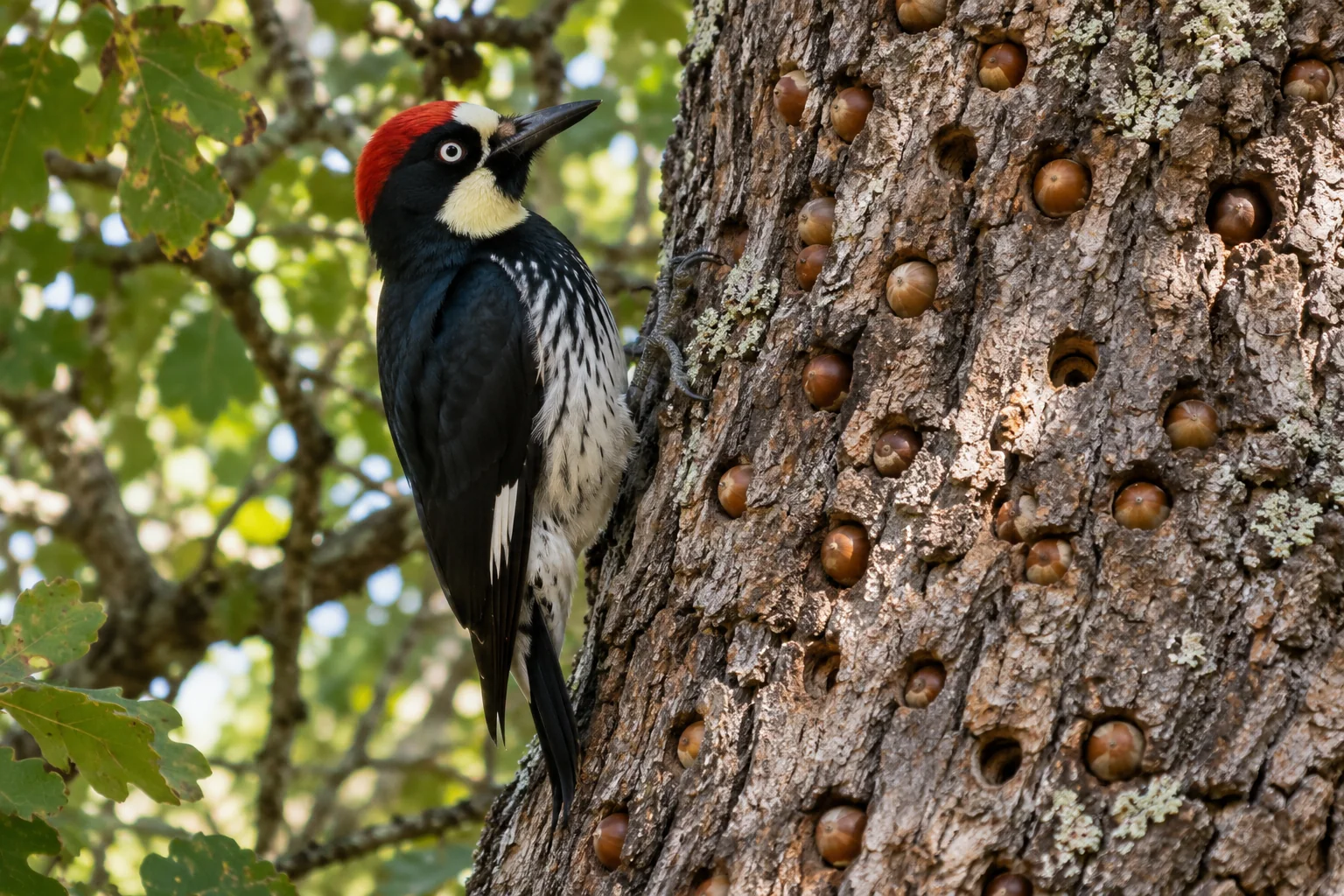
An acorn stuck in the side of an oak tree looks like the answer to a small mystery. An acorn woodpecker put it there for later. Spend a winter watching the same tree, though, and you might see a bird take the acorn out, carry it a short distance and hammer it into another hole. Dinner has moved a few centimetres without getting any closer to being eaten.[1]
The acorn has shrunk. As stored nuts dry, a hole that gripped one firmly in autumn can become a poor fit. Moving the acorn into a smaller opening helps keep it secure. A trunk studded with hundreds or thousands of acorns is called a granary. Think of it as a family food store whose shelves come in different sizes, and whose contents keep changing size after the harvest.[1, 2]
One hole, one acorn
An acorn woodpecker makes a shallow storage socket with its bill. The bird can carry an acorn to the granary, try it against an opening and drive it in until it holds. A snug fit matters on a vertical trunk. The acorn must remain there through wind and weather, and a thief looking for an easy meal has an easier time with a loose one. Each socket is a small investment of labour. Once made, it can serve again in another season.[1, 2]
Step back from the tree and its scale becomes easier to appreciate. Imagine a trunk with two thousand sockets. A family that used each opening twice over two seasons could make four thousand deposits without drilling another two thousand holes. An old, well-stocked tree therefore represents two resources at once: this year’s food and a piece of usable infrastructure accumulated over years. An empty hole can still have value to a bird returning with a bill full of acorn.[2]
The little sockets also help distinguish a granary from a nest. A nest cavity is a chamber large enough to hold the birds and their young. On the face of a granary the openings are small, many, and often visibly occupied by the blunt ends of nuts. If you see such a tree, look for several different hole sizes. An acorn that has become too loose for one socket may be just right for the hole that held a smaller nut last year.[1, 3]
Why put the harvest in one conspicuous place?
A concentrated food supply is easy for its owners to find and possible for them to defend. A group can keep watch over one granary in its territory. Concentration also means that the costs of losing access to that tree can be considerable. The social life of the birds matters here. Acorn woodpeckers can live in extended families whose members share territory defence, tend young and contribute to food storage. The bird hammering a nut into the bark today need not be the one that eventually eats it.[3, 4]
At California’s Hastings Natural History Reservation, researchers have followed these birds over many generations. A long-running project can distinguish a change of occupants from a change in the granary itself. A casual observer might recognise the tree each autumn and reasonably assume the same family kept coming back. Following known individuals lets researchers ask the much finer question of which birds stayed, which departed and which took up the work at a familiar tree.[4]
Acorns supply stored food between harvests, but an acorn woodpecker also catches insects. A photograph of a well-filled granary encourages the idea that one could calculate the birds’ entire diet by counting holes. Even a perfect count would leave out everything caught in flight, eaten directly from a tree, lost to theft or added between visits. The visible stockpile is a reserve that helps the family through lean periods and can support it into the following breeding season.[2, 4]
Would the largest acorns make the best store?
For a test of that idea, Walter Koenig and Lauryn Benedict examined twelve granaries at Hastings. They compared the stored acorns with those available in the surrounding territories. It was a particularly revealing year for the question because all three oak species in the study area produced abundant crops. The birds had a choice. A count of nuts in the tree alone would never tell whether a common variety was genuinely preferred or simply the only one easy to obtain.[5]
Every granary contained some acorns from all three species. For two of the species, stored nuts were lighter on average than available ones. The researchers also found no consistent difference in insect infestation between acorns in storage and those available to the birds. The sample offered little support for a simple rule such as always choosing the biggest acorns or filling a store with nuts selected for their insect contents.[5]
A shopper buying by weight might regard a small nut as a poor bargain. A bird carrying one item at a time faces a different calculation. Where is the oak in relation to the granary? Which acorn can be harvested and carried readily? Is there an empty socket that fits? The California comparison cannot assign a motive to a particular bird. It does show why the chemical energy in one nut, measured apart from the work of gathering and storing it, cannot explain the contents of a whole tree.[2, 5]
A good autumn can change the following spring
Oak crops vary from year to year. Different oak species on a territory can help if a poor crop in one coincides with a better crop in another. In a widespread shortage, however, even a family with an impressive array of empty sockets may struggle. Observations in California link good acorn years to strong breeding in the following spring. Exceptionally favourable conditions have also allowed birds to raise young in the autumn itself.[2, 4]
That leaves a useful distinction for anyone looking up at a granary from a trail. Count the holes and you see something of the tree’s working history. Count the nuts and you have a rough inventory for that day. Watch one woodpecker remove a nut and patiently fit it elsewhere, and you see the job that connects the two. Storing a harvest is only the beginning of keeping it.
Keep exploring
Explore how a woodpecker handles repeated impacts, then compare the way a seed bank keeps a harvest for the future.
Sources and further reading
- Audubon and BirdNote — Winter maintenance of a family granary
- University of California Agriculture and Natural Resources — Oaks, acorns and acorn woodpeckers
- Cornell Lab of Ornithology — Acorn woodpecker life history
- Hastings Natural History Reservation — Long-term acorn woodpecker research
- Koenig and Benedict — Which acorns do woodpeckers store?
Keep exploring.
One remarkable idea at a time—nature, science, history and beyond.
Last updated November 20, 2026.

Barnakle Editorial Team
Barnakle Editorial Team is the collective byline used for Barnakle’s editorial articles. The contributor profile explains the team identity and links to the publication’s editorial policies.
More from the editorial team →